







Question: Based off the scenario provided below create an ERD. The Scenario Treasure Hunters, an augmented reality online game. In order to play the game, each
Based off the scenario provided below create an ERD.
The Scenario Treasure Hunters, an augmented reality online game. In order to play the game, each player creates their account. They must choose a unique username, provide their name (first and last names), gender (female, male, other or prefer not to disclose), date of birth, email and postal address (street number, street name, suburb, city and postcode) and up to three phone numbers. The date and time of account creation and the players total points will also be associated with their account. The game revolves around players embarking on quests and hunting for treasure. Multiple players can go on the same quest and find the same treasure. There are hundreds of quests, new quests are added every week and some of the more advanced quests can contain up to five mini quests. Each quest needs to be identifiable using a unique id, and they also have a name. Players initiate quests by finding objects in the real world, which act as beacons, and each quest is assigned a beacon. Once the player finds a beacon they will be presented with a story, which provides some background on the quest, and a list of the treasure they must hunt down in order to finish the quest. The database needs to keep track of each players progress (active, complete, inactive) on each quest. There are different types of treasure (common, uncommon, rare, ultra-rare and elite). The players are directed to a webpage where they can obtain various clues to find the treasure (we only wish to store the web address in our database however, not the clues themselves). Each treasure has one webpage. When a player finds the treasure, they are awarded points. Each piece of treasure rewards a different amount of points. When a player unlocks the list of treasures for a quest, they can see a description for each piece. Players can use their points to purchase badges from virtual stores. All stores have a name, and they are only open at certain times of the day, so their opening and closing times need to be recorded. In order to purchase badges from the stores, players can use their points. There are a lot of different badges that players can purchase. To help players decide what to purchase they will be able to read the badge names and descriptions. The price of the badges varies depending on demand, and is re-calculated when a player reaches a store. This means that the price itself is not stored in the database. However, when a player purchases a badge from a store, the store name, date and time of purchase and the cost of the purchase need to be recorded, so that they can see a detailed list of their purchases at any time.
The ERD must be in the format shown below.
The diagram needs to show:
the entity types the binary relationship types the complex relationship type the multiplicity of relationship types the attributes (and if applicable their domains) of entity types the attributes (and if applicable their domains) of relationship types, and the primary key of each entity type
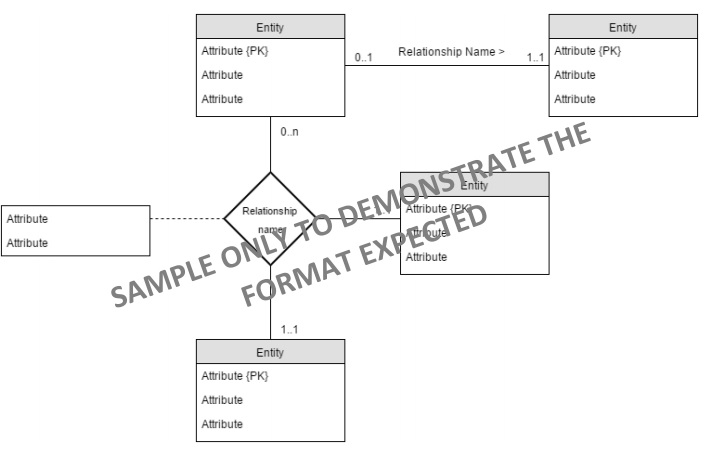
Entity Entity Attribute (PKy Attribute Attribute Attribute (PK) Attribute Attribute 0.1 Relationship Name>11 O.n Relationship tribute Attribute Attribute Attribute SAMPLE ONL FORMAT EXPETED Entity Attribute (PK) Attribute Attribute
Step by Step Solution
There are 3 Steps involved in it

Get step-by-step solutions from verified subject matter experts
 Study Help