







Question: Based on Case, do you believe that Johnson Controls' policy regarding fertile women working in environments with the potential for lead exposure was an ethical
- Based on Case, do you believe that Johnson Controls' policy regarding fertile women working in environments with the potential for lead exposure was an ethical policy? Could they have made it better or should they have not had it at all?
- In one or more news media sources, find and provide details about one or two recent (within the last three years) lawsuits filed in response to workplace accidents.
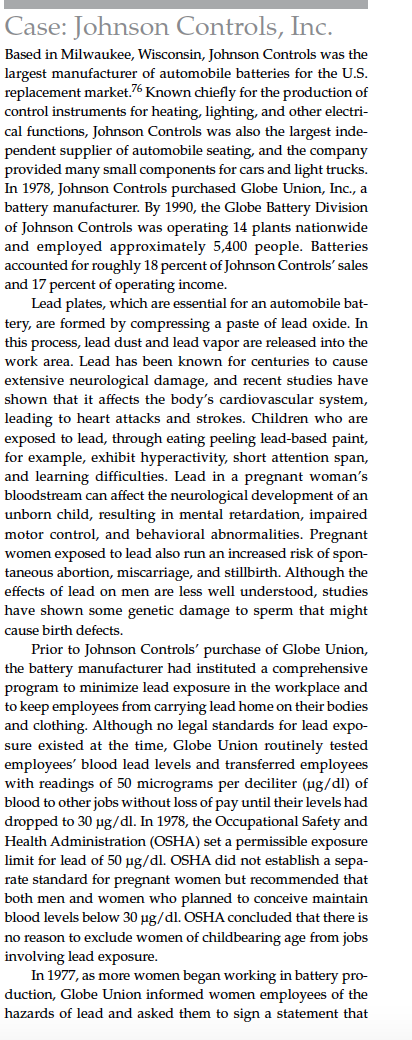
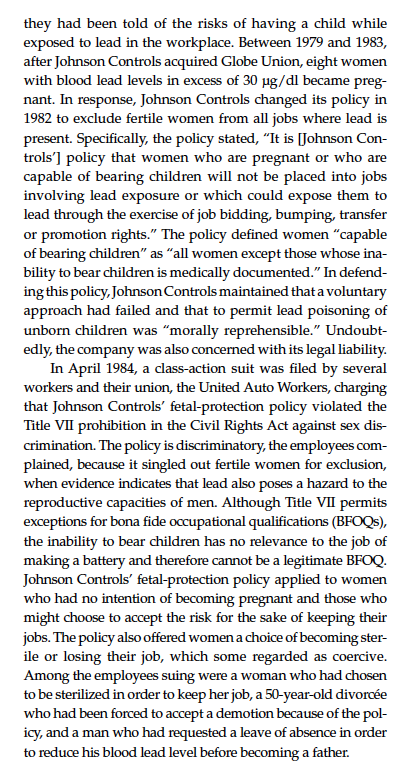
Case: Johnson Controls, Inc. Based in Milwaukee, Wisconsin, Johnson Controls was the largest manufacturer of automobile batteries for the U.S. replacement market.76 Known chiefly for the production of control instruments for heating, lighting, and other electri- cal functions, Johnson Controls was also the largest inde- pendent supplier of automobile seating, and the company provided many small components for cars and light trucks. In 1978, Johnson Controls purchased Globe Union, Inc., a battery manufacturer. By 1990, the Globe Battery Division of Johnson Controls was operating 14 plants nationwide and employed approximately 5,400 people. Batteries accounted for roughly 18 percent of Johnson Controls' sales and 17 percent of operating income. Lead plates, which are essential for an automobile bat- tery, are formed by compressing a paste of lead oxide. In this process, lead dust and lead vapor are released into the work area. Lead has been known for centuries to cause extensive neurological damage, and recent studies have shown that it affects the body's cardiovascular system, leading to heart attacks and strokes. Children who are exposed to lead, through eating peeling lead-based paint, for example, exhibit hyperactivity, short attention span, and learning difficulties. Lead in a pregnant woman's bloodstream can affect the neurological development of an unborn child, resulting in mental retardation, impaired motor control, and behavioral abnormalities. Pregnant women exposed to lead also run an increased risk of spon- taneous abortion, miscarriage, and stillbirth. Although the effects of lead on men are less well understood, studies have shown some genetic damage to sperm that might cause birth defects. Prior to Johnson Controls' purchase of Globe Union, the battery manufacturer had instituted a comprehensive program to minimize lead exposure in the workplace and to keep employees from carrying lead home on their bodies and clothing. Although no legal standards for lead expo- sure existed at the time, Globe Union routinely tested employees' blood lead levels and transferred employees with readings of 50 micrograms per deciliter (ug/dl) of blood to other jobs without loss of pay until their levels had dropped to 30 g/dl. In 1978, the Occupational Safety and Health Administration (OSHA) set a permissible exposure limit for lead of 50 g/dl. OSHA did not establish a sepa- rate standard for pregnant women but recommended that both men and women who planned to conceive maintain blood levels below 30 g/dl. OSHA concluded that there is no reason to exclude women of childbearing age from jobs involving lead exposure. In 1977, as more women began working in battery pro- duction, Globe Union informed women employees of the hazards of lead and asked them to sign a statement that they had been told of the risks of having a child while exposed to lead in the workplace. Between 1979 and 1983, after Johnson Controls acquired Globe Union, eight women with blood lead levels in excess of 30 g/dl became preg- nant. In response, Johnson Controls changed its policy in 1982 to exclude fertile women from all jobs where lead is present. Specifically, the policy stated, "It is [Johnson Con- trols'] policy that women who are pregnant or who are capable of bearing children will not be placed into jobs involving lead exposure or which could expose them to lead through the exercise of job bidding, bumping, transfer or promotion rights." The policy defined women "capable of bearing children" as "all women except those whose ina- bility to bear children is medically documented." In defend- ing this policy, Johnson Controls maintained that a voluntary approach had failed and that to permit lead poisoning of unborn children was "morally reprehensible." Undoubt- edly, the company was also concerned with its legal liability. In April 1984, a class-action suit was filed by several workers and their union, the United Auto Workers, charging that Johnson Controls' fetal-protection policy violated the Title VII prohibition in the Civil Rights Act against sex dis- crimination. The policy is discriminatory, the employees com- plained, because it singled out fertile women for exclusion, when evidence indicates that lead also poses a hazard to the reproductive capacities of men. Although Title VII permits exceptions for bona fide occupational qualifications (BFOQs), the inability to bear children has no relevance to the job of making a battery and therefore cannot be a legitimate BFOQ. Johnson Controls' fetal-protection policy applied to women who had no intention of becoming pregnant and those who might choose to accept the risk for the sake of keeping their jobs. The policy also offered women a choice of becoming ster- ile or losing their job, which some regarded as coercive. Among the employees suing were a woman who had chosen to be sterilized in order to keep her job, a 50-year-old divorce who had been forced to accept a demotion because of the pol- and a man who had requested a leave of absence in order to reduce his blood lead level before becoming a father. icy
Step by Step Solution
There are 3 Steps involved in it
1 Expert Approved Answer
Step: 1 Unlock

Question Has Been Solved by an Expert!
Get step-by-step solutions from verified subject matter experts
Step: 2 Unlock
Step: 3 Unlock
 Study Help