







Question: Based on Chapter 1 1 , Distinguish between a cost center, a profit center, and an investment center. Cost, Profit, and Investment Centers Cost Center
Based on Chapter Distinguish between a cost center, a profit center, and an investment center.
Cost, Profit, and Investment Centers
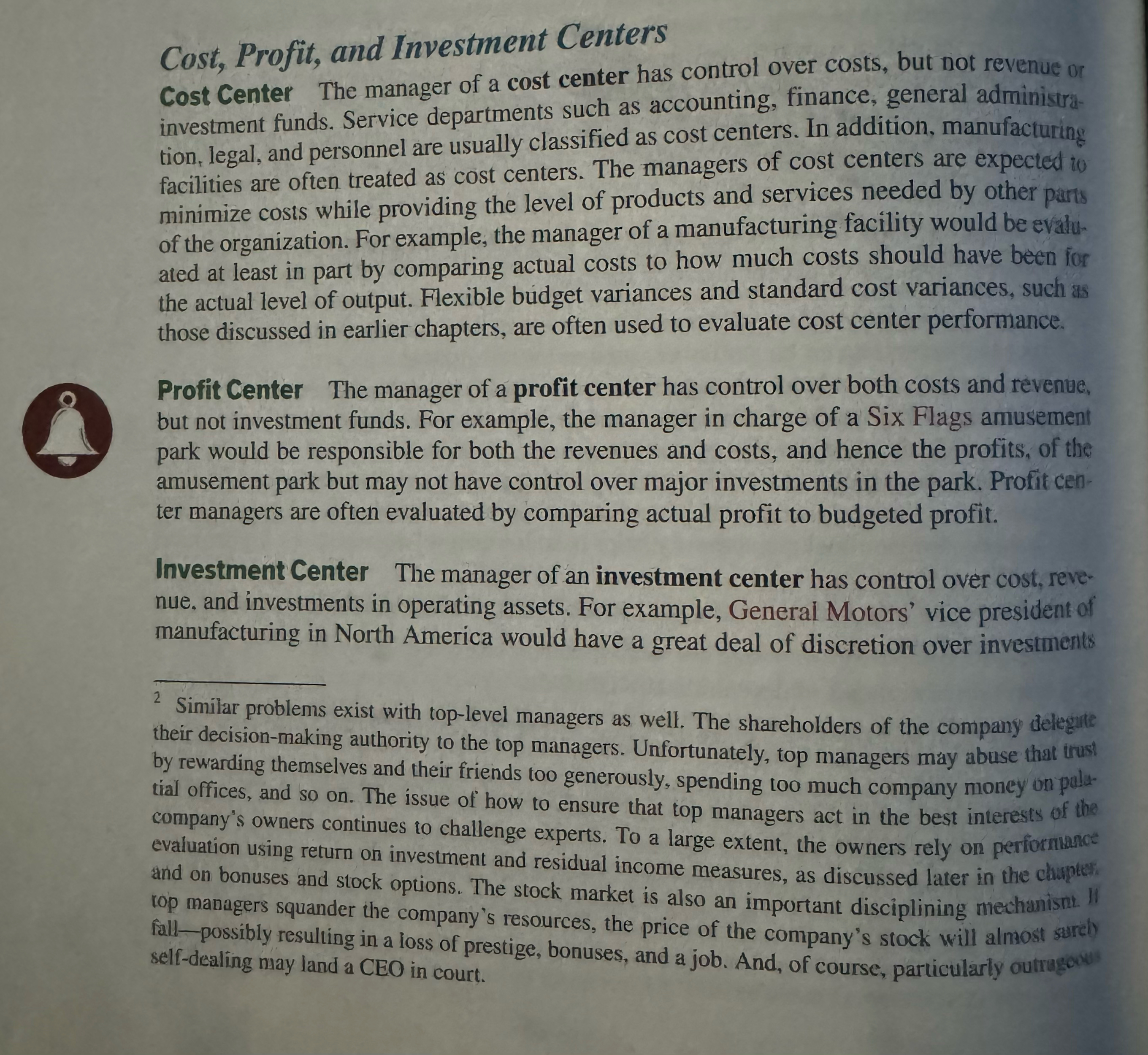
Cost Center The manager of a cost center has control over costs, but not revenue or investment funds. Service departments such as accounting, finance, general administration, legal, and personnel are usually classified as cost centers. In addition, manufacturing facilities are often treated as cost centers. The managers of cost centers are expected to minimize costs while providing the level of products and services needed by other parts of the organization. For example, the manager of a manufacturing facility would be evatu. ated at least in part by comparing actual costs to how much costs should have been for the actual level of output. Flexible budget variances and standard cost variances, such as those discussed in earlier chapters, are often used to evaluate cost center performance.
Profit Center The manager of a profit center has control over both costs and revenue, but not investment funds. For example, the manager in charge of a Six Flags amusement park would be responsible for both the revenues and costs, and hence the profits, of the amusement park but may not have control over major investments in the park. Profit center managers are often evaluated by comparing actual profit to budgeted profit.
Investment Center The manager of an investment center has control over cost, revenue, and investments in operating assets. For example, General Motors' vice president of manufacturing in North America would have a great deal of discretion over investments
Similar problems exist with toplevel managers as well. The shareholders of the company delegite their decisionmaking authority to the top managers. Unfortunately, top managers may abuse that trust by rewarding themselves and their friends too generously, spending too much company money on palatial offices, and so on The issue of how to ensure that top managers act in the best interests of the company's owners continues to challenge experts. To a large extent, the owners rely on perfornance evaluation using return on investment and residual income measures, as discussed later in the clupptes. and on bonuses and stock options. The stock market is also an important disciplining mechanisn. If top managers squander the company's resources, the price of the company's stock will alnost surct fallpossibly resulting in a loss of prestige, bonuses, and a job. And, of course, particularly outrugous selfdealing may land a CEO in court.
Step by Step Solution
There are 3 Steps involved in it
1 Expert Approved Answer
Step: 1 Unlock

Question Has Been Solved by an Expert!
Get step-by-step solutions from verified subject matter experts
Step: 2 Unlock
Step: 3 Unlock
 Study Help