



Question: Based on Chapter 3: Tort Law - Negligence: Failure to Administer Proper Nourishment - Caruso v. Pine Manor Nursing Center, Page 54 only, answer the
Based on Chapter 3: Tort Law - Negligence: Failure to Administer Proper Nourishment - Caruso v. Pine Manor Nursing Center, Page 54 only, answer the following:
- Discuss the element sof "foreseeability" as applied in this case. (You must include the definition of the term.)
- Based on "Foreseeability of Risk in New York Law," how would you apply in New York definition to the Caruso v. Pine Manor Nursing Center case? (You must show an understanding of the definition of foreseeability in New York and the definition of foreseeability in the Caruso case ) Would the court decision be any different; why; explain?
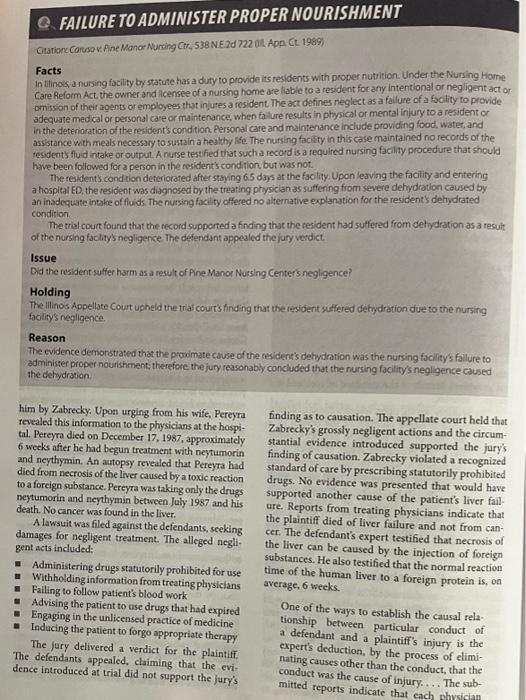
Chationc Corwo v. Pine Manor Nuning Ctt, 538 NE.zd 722 ofl App. Ct. 1989) Facts In tilinois, a nursing focility by statute has a duty to provide its residents with proper nutrition. Under the Nursing Home Care Reform Act the owner and licensee of a nursing home are liable to a resident foc any intentional or negligent act or omission of their apents or employees that injutes a resident The act defines neglect as a failure of a faclity to provide adequate med cal or personal care or maintenance, when falure results in ptysical or mental injury to a resident or in the deterioration of the resident's condition. Personal care and maintenance include providing food, water, and assistance with meals necessary to sustain a healhy se. The nutsing facity in this case maintained no records of the residents fuid intake or output. A nurse test fied that such a record is a required nursing facility procedure that should hwe been followed for a person in the resident's condition, but was not. The residents condtion deteriorated after staying 6.5 days at the faclity. Upon leaving the facility and entering a hospital ED, the resident was diagnosed by the treating physician as suffering from severe dehydration caused by an inadequate intake of fuids. The nursing facti ty offered no alternative explanation for the resident's dehydrated condition. The trial court found that the record supported a finding that the resident had sulfered from dehydration as a result of the nursing faclity's negligence. The defendant appealed the jury vetict. Issue Did the resident suffer harm as a result of Pine Manor Nursing Center's negligence? Holding The Illinos Appellate Court upheid the triat court's finding that the resident suffered dehydration due to the nursing facility's negligence. Reason The evidence demonstrated that the provimate cause of the cesidene's dehydration was the nursing focility's fallure to administer proper nourishment; therefore, the jury reasonably concluded that the nursing facility's negligence caused the clehydration. him by Zabrecky, Upon urging from his wife, Pereyra revealed this information to the physicians at the hospital. Pereyra died on December 17, 1987, approximately 6 weeks affer he had begun treatment with neytumorin and neythymin. An autopsy revealed that Pereyra had died from necrosis of the liver caused by a toxic reaction to a forcign substance. Percyra was taking only the drugs neytumorin and neythymin between July 1987 and his death. No cancer was found in the liver. A lawsuit was filed against the defendants, sceking damages for negligent treatment. The alleged negligent acts included: - Administering drugs statutorily prohibited for use - Withholding information from treating physicians a Falling to follow patient's blood work - Advising the patient to use drugs that had expired - Engaging in the unlicensed practice of medicine - Inducing the patient to forgo appropriate therapy The jury delivered a verdict for the plaintiff. The defendants appealed, claiming that the evidence introduced at trial did not support the jury's finding as to causation. The appellate court held that Zabrecky's grossly negligent actions and the circumstantial evidence introduced supported the jury's finding of causation. Zabrecky violated a recognized standard of care by prescribing statutorily prohibited drugs. No evidence was presented that would have supported another cause of the patient's liver failure. Reports from treating physicians indicate that the plaintiff died of liver failure and not from cancer. The defendant's expert testified that necrosis of the liver can be caused by the injection of foreign substances. He also testified that the normal reaction time of the human liver to a foreign protein is, on average, 6 weeks. One of the ways to establish the causal rela. tionship between particular conduct of a defendant and a plaintiff's injury is the expert's deduction, by the process of eliminating causes other than the conduct, that the conduct was the cause of injury.... The submitted reports indicate that en... The sub
Step by Step Solution
There are 3 Steps involved in it

Get step-by-step solutions from verified subject matter experts