Question: Based on Enclosure A and Enclosure B, we would like to know the optimal production quantity for each product (SC-A, SC-B, SC-C, SC-D, S-10, S-20,
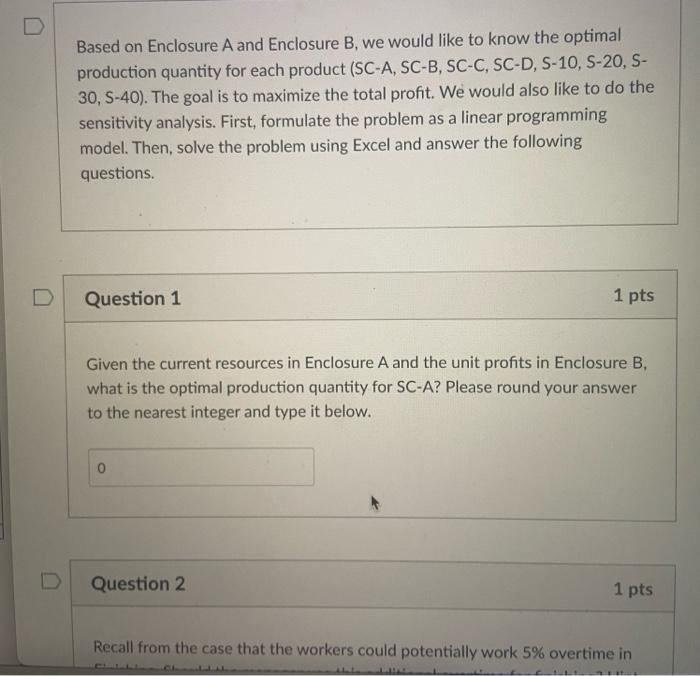
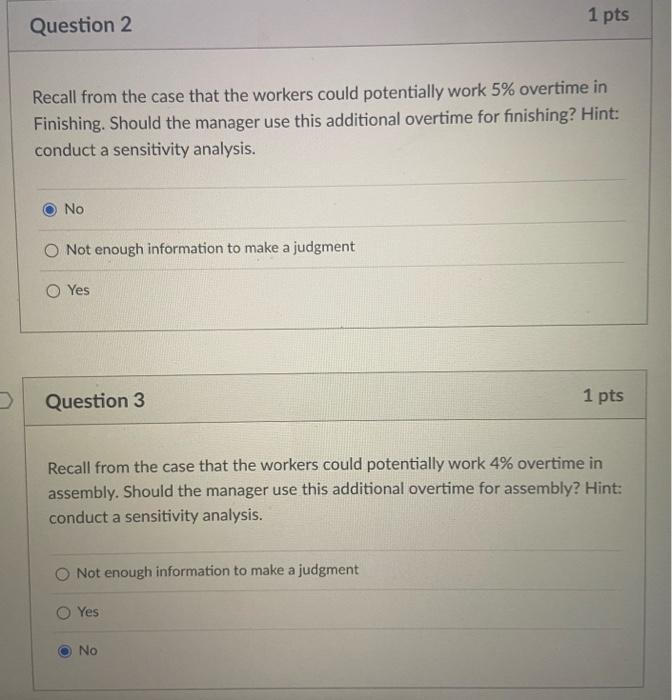
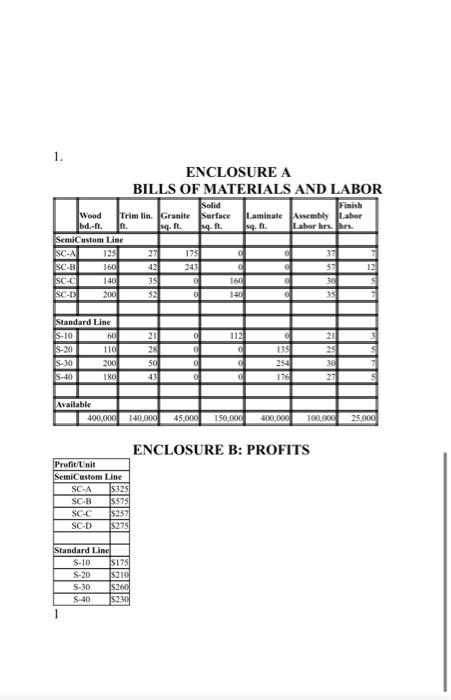
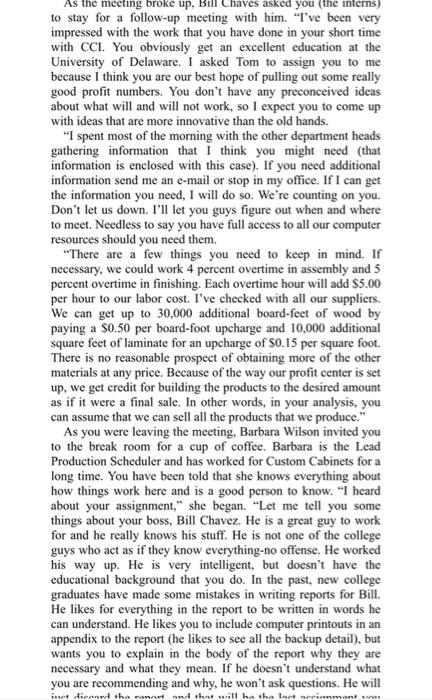
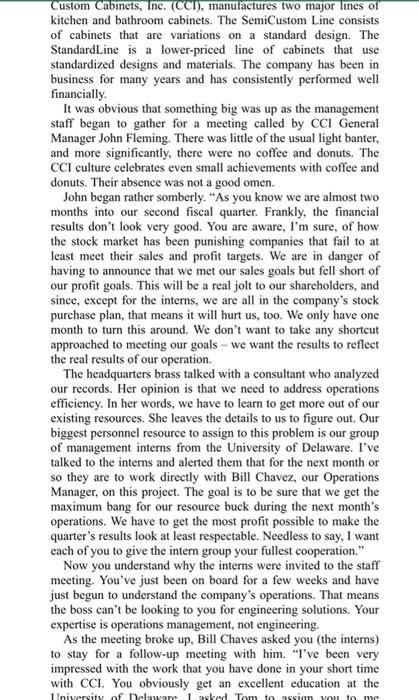
Based on Enclosure A and Enclosure B, we would like to know the optimal production quantity for each product (SC-A, SC-B, SC-C, SC-D, S-10, S-20, S- 30, S-40). The goal is to maximize the total profit. We would also like to do the sensitivity analysis. First, formulate the problem as a linear programming model. Then, solve the problem using Excel and answer the following questions. D 1 pts Question 1 Given the current resources in Enclosure A and the unit profits in Enclosure B, what is the optimal production quantity for SC-A? Please round your answer to the nearest integer and type it below. 0 Question 2 1 pts Recall from the case that the workers could potentially work 5% overtime in D Question 2 1 pts Recall from the case that the workers could potentially work 5% overtime in Finishing. Should the manager use this additional overtime for finishing? Hint: conduct a sensitivity analysis. No O Not enough information to make a judgment OYes Question 3 1 pts Recall from the case that the workers could potentially work 4% overtime in assembly. Should the manager use this additional overtime for assembly? Hint: conduct a sensitivity analysis. Not enough information to make a judgment Yes No Wood Trim lin. Granite bd.-ft. ft. sq. ft. 27 42 35 52 SemiCustom Line SC-A 125 SC-B 160 0 SC-C 140 0 SC-D 200 Standard Line S-10 60 21 S-20 110 28 135 S-30 200 50 OF 254 S-40 180 43 0 0 176 Available 400,000 140,000 45.000 150,000 400,000 Profit/Unit SemiCustom Line 1 ENCLOSURE A BILLS OF MATERIALS AND LABOR Solid Surface sq. ft. Laminate sq. ft. Finish Assembly Labor Labor hrs. hrs. 37 57 30 35 21 30 27 100,000 SC-A $325 SC-B $575 SC-C $257 SC-D $275 S-10 $175 S-20 $210 S-30 $260 S-40 $230 Standard Line 175 243 0 0 0 160 140 112 ENCLOSURE B: PROFITS 12 25,000 As the meeting broke up, Bill Chaves asked you (the interns) to stay for a follow-up meeting with him. "I've been very impressed with the work that you have done in your short time with CCI. You obviously get an excellent education at the University of Delaware. I asked Tom to assign you to me because I think you are our best hope of pulling out some really good profit numbers. You don't have any preconceived ideas about what will and will not work, so I expect you to come up with ideas that are more innovative than the old hands. "I spent most of the morning with the other department heads gathering information that I think you might need (that information is enclosed with this case). If you need additional information send me an e-mail or stop in my office. If I can get the information you need, I will do so. We're counting on you. Don't let us down. I'll let you guys figure out when and where to meet. Needless to say you have full access to all our computer resources should you need them. "There are a few things you need to keep in mind. If necessary, we could work 4 percent overtime in assembly and 5 percent overtime in finishing. Each overtime hour will add $5.00 per hour to our labor cost. I've checked with all our suppliers. We can get up to 30,000 additional board-feet of wood by paying a $0.50 per board-foot upcharge and 10,000 additional square feet of laminate for an upcharge of $0.15 per square foot. There is no reasonable prospect of obtaining more of the other materials at any price. Because of the way our profit center is set up, we get credit for building the products to the desired amount as if it were a final sale. In other words, in your analysis, you can assume that we can sell all the products that we produce." As you were leaving the meeting, Barbara Wilson invited you to the break room for a cup of coffee. Barbara is the Lead Production Scheduler and has worked for Custom Cabinets for a long time. You have been told that she knows everything about how things work here and is a good person to know. "I heard about your assignment," she began. "Let me tell you some things about your boss, Bill Chavez. He is a great guy to work for and he really knows his stuff. He is not one of the college guys who act as if they know everything-no offense. He worked his way up. He is very intelligent, but doesn't have the educational background that you do. In the past, new college graduates have made some mistakes in writing reports for Bill. He likes for everything in the report to be written in words he can understand. He likes you to include computer printouts in an appendix to the report (he likes to see all the backup detail), but wants you to explain in the body of the report why they are necessary and what they mean. If he doesn't understand what you are recommending and why, he won't ask questions. He will inet dienord the ranart and that will ha tha Inet neeianmont von Custom Cabinets, Inc. (CCI), manufactures two major lines of kitchen and bathroom cabinets. The SemiCustom Line consists of cabinets that are variations on a standard design. The Standard Line is a lower-priced line of cabinets that use standardized designs and materials. The company has been in business for many years and has consistently performed well financially. It was obvious that something big was up as the management staff began to gather for a meeting called by CCI General Manager John Fleming. There was little of the usual light banter, and more significantly, there were no coffee and donuts. The CCI culture celebrates even small achievements with coffee and donuts. Their absence was not a good omen. John began rather somberly. "As you know we are almost two months into our second fiscal quarter. Frankly, the financial results don't look very good. You are aware, I'm sure, of how the stock market has been punishing companies that fail to at least meet their sales and profit targets. We are in danger of having to announce that we met our sales goals but fell short of our profit goals. This will be a real jolt to our shareholders, and since, except for the interns, we are all in the company's stock purchase plan, that means it will hurt us, too. We only have one month to turn this around. We don't want to take any shortcut approached to meeting our goals - we want the results to reflect the real results of our operation. The headquarters brass talked with a consultant who analyzed our records. Her opinion is that we need to address operations efficiency. In her words, we have to learn to get more out of our existing resources. She leaves the details to us to figure out. Our biggest personnel resource to assign to this problem is our group of management interns from the University of Delaware. I've talked to the interns and alerted them that for the next month or so they are to work directly with Bill Chavez, our Operations Manager, on this project. The goal is to be sure that we get the maximum bang for our resource buck during the next month's operations. We have to get the most profit possible to make the quarter's results look at least respectable. Needless to say, I want each of you to give the intern group your fullest cooperation." Now you understand why the interns were invited to the staff meeting. You've just been on board for a few weeks and have just begun to understand the company's operations. That means the boss can't be looking to you for engineering solutions. Your expertise is operations management, not engineering. As the meeting broke up, Bill Chaves asked you (the interns) to stay for a follow-up meeting with him. "I've been very impressed with the work that you have done in your short time with CCI. You obviously get an excellent education at the University of Delaware I asked Tom to assign you to me









 Study Help