







Question: Based on figure in slide 19, the user program performs a series of WRITE calls interleaved with processing. Code segments 1, 2, and 3 refer
Based on figure in slide 19, the user program performs a series of WRITE calls interleaved with processing. Code segments 1, 2, and 3 refer to sequences of instructions that do not involve I/O. The WRITE calls are to an I/O program that is a system utility and that will perform the actual I/O operation. I/O operation labelled 4 prepares the actual I/O operation. I/O operation labelled 5 is to complete the I/O operation.
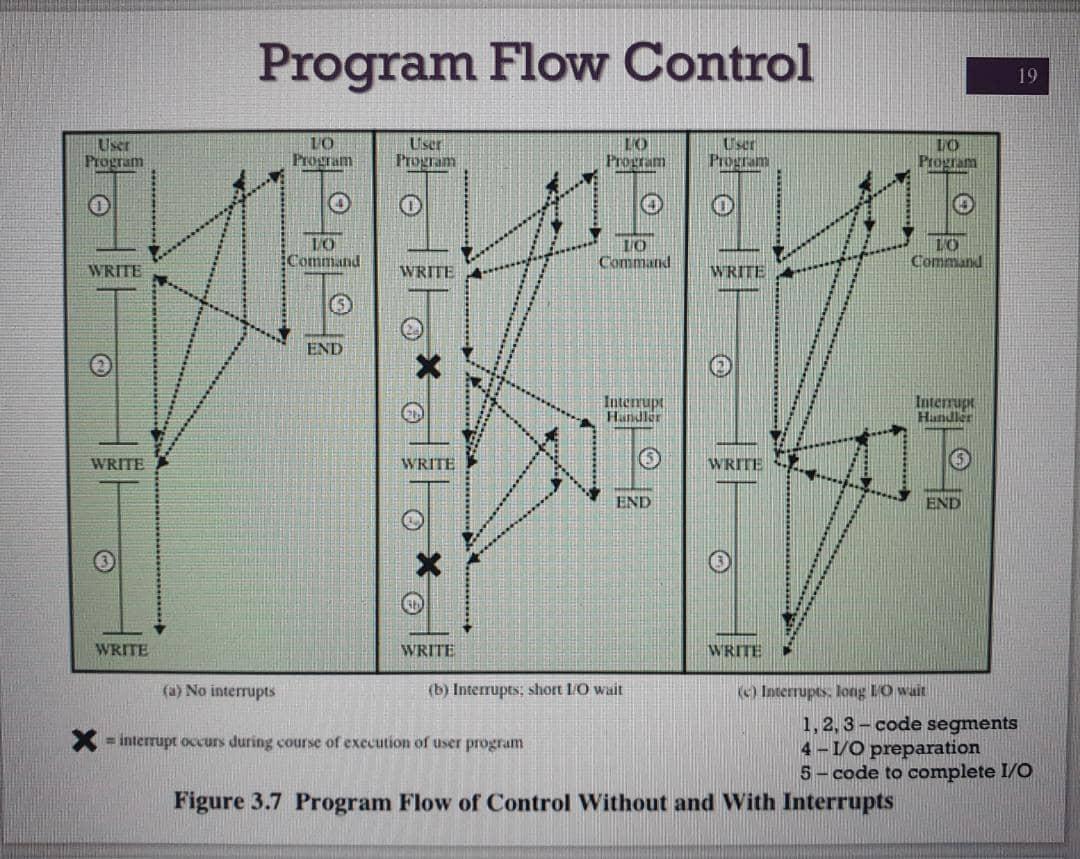
Discuss the program timing for the following executions:
i. Without interrupts [1 mark]
ii. Short I/O wait [1 mark]
iii. Long I/O wait [1 mark]
iv. State one advantage OR one disadvantage for each execution.
Program Flow Control 19 User Program 10 Program User Program LO Programi User Program 110 Program e TO Command 10 Command LO Command WRITE WRITE WRITE END Interrupt Handler Interrupt Handler WRITE WRITE WRITE END END ... WRITE WRITE WRITE (a) No interrupts (b) Interrupts, short I/O wait (c) Interrupts, long 10 wait 1, 2, 3-code segments X = interrupt occurs during course of execution of user program 4-I/O preparation 5- code to complete I/O Figure 3.7 Program Flow of Control Without and With Interrupts
Step by Step Solution
There are 3 Steps involved in it

Get step-by-step solutions from verified subject matter experts
 Study Help