







Question: Based on Heathrow's experience, use your fishbone diagram to identify the major factors affecting airport capacity. Discuss the relationships between these factors. Operations Management Challenges
- Based on Heathrow's experience, use your fishbone diagram to identify the major factors affecting airport capacity.
- Discuss the relationships between these factors.
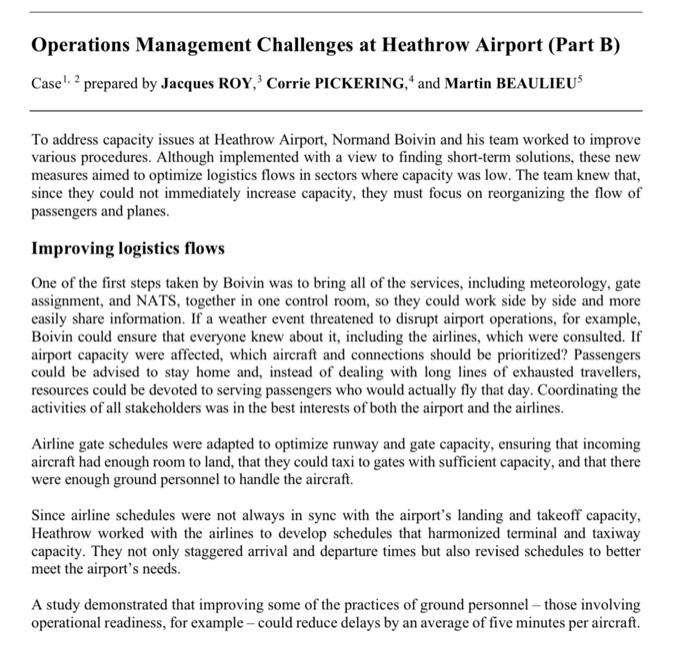
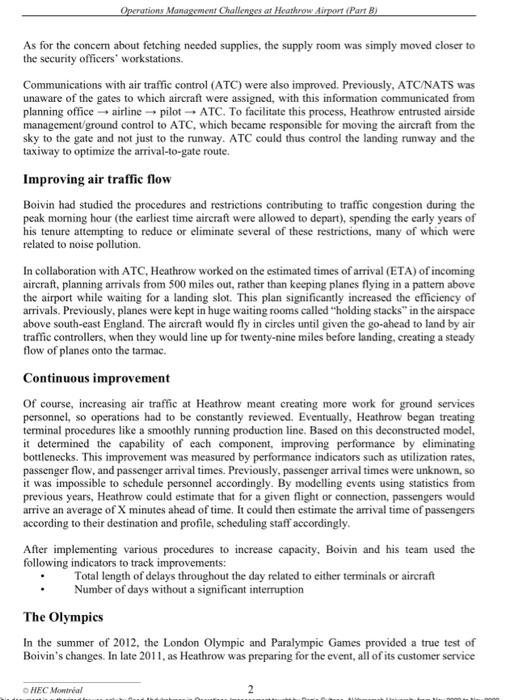
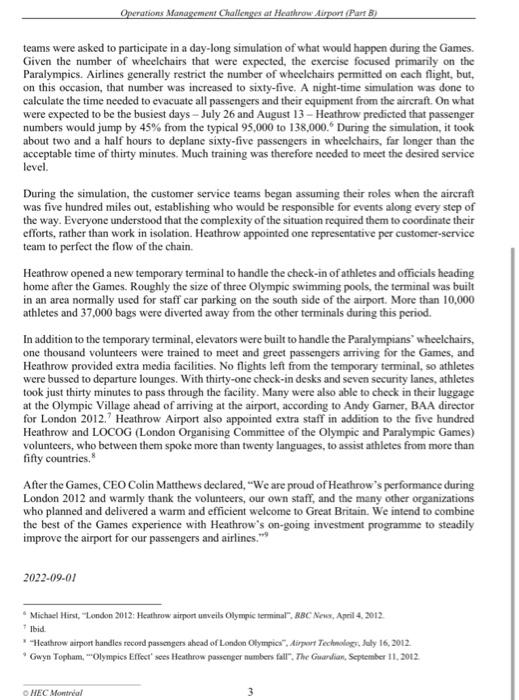
Operations Management Challenges at Heathrow Airport (Part B) Case 1,2 prepared by Jacques ROY, 3 Corrie PICKERING,4 and Martin BEAULIEU 5 To address capacity issues at Heathrow Airport, Normand Boivin and his team worked to improve various procedures. Although implemented with a view to finding short-term solutions, these new measures aimed to optimize logistics flows in sectors where capacity was low. The team knew that, since they could not immediately increase capacity, they must focus on reorganizing the flow of passengers and planes. Improving logistics flows One of the first steps taken by Boivin was to bring all of the services, including meteorology, gate assignment, and NATS, together in one control room, so they could work side by side and more easily share information. If a weather event threatened to disrupt airport operations, for example, Boivin could ensure that everyone knew about it, including the airlines, which were consulted. If airport capacity were affected, which aircraft and connections should be prioritized? Passengers could be advised to stay home and, instead of dealing with long lines of exhausted travellers, resources could be devoted to serving passengers who would actually fly that day. Coordinating the activities of all stakeholders was in the best interests of both the airport and the airlines. Airline gate schedules were adapted to optimize runway and gate capacity, ensuring that incoming aircraft had enough room to land, that they could taxi to gates with sufficient capacity, and that there were enough ground personnel to handle the aircraft. Since airline schedules were not always in sync with the airport's landing and takeoff capacity, Heathrow worked with the airlines to develop schedules that harmonized terminal and taxiway capacity. They not only staggered arrival and departure times but also revised schedules to better meet the airport's needs. A study demonstrated that improving some of the practices of ground personnel - those involving operational readiness, for example - could reduce delays by an average of five minutes per aircraft. As for the concem about fetching needed supplies, the supply room was simply moved closer to the security officers' workstations. Communications with air traffic control (ATC) were also improved. Previously, ATC/NATS was unaware of the gates to which aircraft were assigned, with this information communicated from planning office airline pilot ATC. To facilitate this process, Heathrow entrusted airside management/ground control to ATC, which became responsible for moving the aircraft from the sky to the gate and not just to the runway. ATC could thus control the landing runway and the taxiway to optimize the arrival-to-gate route. Improving air traffic flow Boivin had studied the procedures and restrictions contributing to traffic congestion during the peak moming hour (the earliest time aireraft were allowed to depart), spending the early years of his tenure attempting to reduce or eliminate several of these restrictions, many of which were related to noise pollution. In collaboration with ATC, Heathrow worked on the estimated times of arrival (ETA) of incoming aireraft, planning arrivals from 500 miles out, rather than keeping planes flying in a pattem above the airport while waiting for a landing slot. This plan significantly increased the efficiency of arrivals. Previously, planes were kept in huge waiting rooms called "holding stacks" in the airspace above south-east England. The aircraft would fly in cireles until given the go-ahead to land by air traffic controllers, when they would line up for twenty-nine miles before landing, creating a steady flow of planes onto the tarmac. Continuous improvement Of course, increasing air traffic at Heathrow meant creating more work for ground services personnel, so operations had to be constantly reviewed. Eventually, Heathrow began treating terminal procedures like a smoothly running production line. Based on this deconstructed model, it determined the capability of each component, improving performance by eliminating bottlenecks. This improvement was measured by performance indicators such as utilization rates, passenger flow, and passenger arrival times. Previously, passenger arrival times were unknown, so it was impossible to schedule personnel accordingly. By modelling events using statisties from previous years, Heathrow could estimate that for a given flight or connection, passengers would arrive an average of X minutes ahead of time. It could then estimate the arrival time of passengers according to their destination and profile, scheduling staff accordingly. After implementing various procedures to increase capacity, Boivin and his team used the following indicators to track improvements: - Total length of delays throughout the day related to either terminals or aircraft - Number of days without a significant interruption The Olympics In the summer of 2012, the London Olympic and Paralympic Games provided a true test of Boivin's changes. In late 2011, as Heathrow was preparing for the event, all of its customer service O HEC Momtrial 2 Operations Management Challenges af Heathnow Airport (Part B) teams were asked to participate in a day-long simulation of what would happen during the Games. Given the number of wheclchairs that were expected, the exereise focused primarily on the Paralympics. Airlines generally restrict the number of wheelchairs permitted on each flight, but, on this occasion, that number was increased to sixty-five. A night-time simulation was done to calculate the time needed to evacuate all passengers and their equipment from the aircraft. On what were expected to be the busiest days - July 26 and August 13 - Heathrow predicted that passenger numbers would jump by 45% from the typical 95,000 to 138,000.6 During the simulation, it took about two and a half hours to deplane sixty-five passengers in wheelchairs, far longer than the acceptable time of thirty minutes. Much training was therefore needed to meet the desired service level. During the simulation, the customer service teams began assuming their roles when the aireraft was five hundred miles out, establishing who would be responsible for events along every step of the way. Everyone understood that the complexity of the situation required them to coordinate their efforts, rather than work in isolation. Heathrow appointed one representative per customer-service team to perfect the flow of the chain. Heathrow opened a new temporary terminal to handle the check-in of athletes and officials heading home after the Games. Roughly the size of three Olympic swimming pools, the terminal was built in an area normally used for staff car parking on the south side of the airport. More than 10,000 athletes and 37,000 bags were diverted away from the other terminals during this period. In addition to the temporary terminal, elevators were built to handle the Paralympians' wheelchairs, one thousand volunteers were trained to meet and greet passengers arriving for the Games, and Heathrow provided extra media facilities. No flights left from the temporary terminal, so athletes were bussed to departure lounges. With thirty-one check-in desks and seven security lanes, athletes took just thirty minutes to pass through the facility. Many were also able to check in their luggage at the Olympic Village ahead of arriving at the airport, according to Andy Garner, BAA director for London 2012. 7 Heathrow Airport also appointed extra staff in addition to the five hundred Heathrow and LOCOG (London Organising Committee of the Olympic and Paralympic Games) volunteers, who between them spoke more than twenty languages, to assist athletes from more than fifty countries. 8 After the Games, CEO Colin Matthews declared, "We are proud of Heathrow's performance during London 2012 and warmly thank the volunteers, our own staff, and the many other organizations who planned and delivered a warm and efficient welcome to Great Britain. We intend to combine the best of the Games experience with Heathrow's on-going investment programme to steadily improve the airport for our passengers and airlines., +9 2022-09-01 * Michael Hirst, London 2012: Heathrow airpont usveils Olyngic terminal". RBC Nins, April 4, 2012. Thid. " Gryn Topham, "'Olympies Effect' sees Heathrow passenger numben fall", The Gazhilan, September 11, 2012
Step by Step Solution
There are 3 Steps involved in it

Get step-by-step solutions from verified subject matter experts
 Study Help