





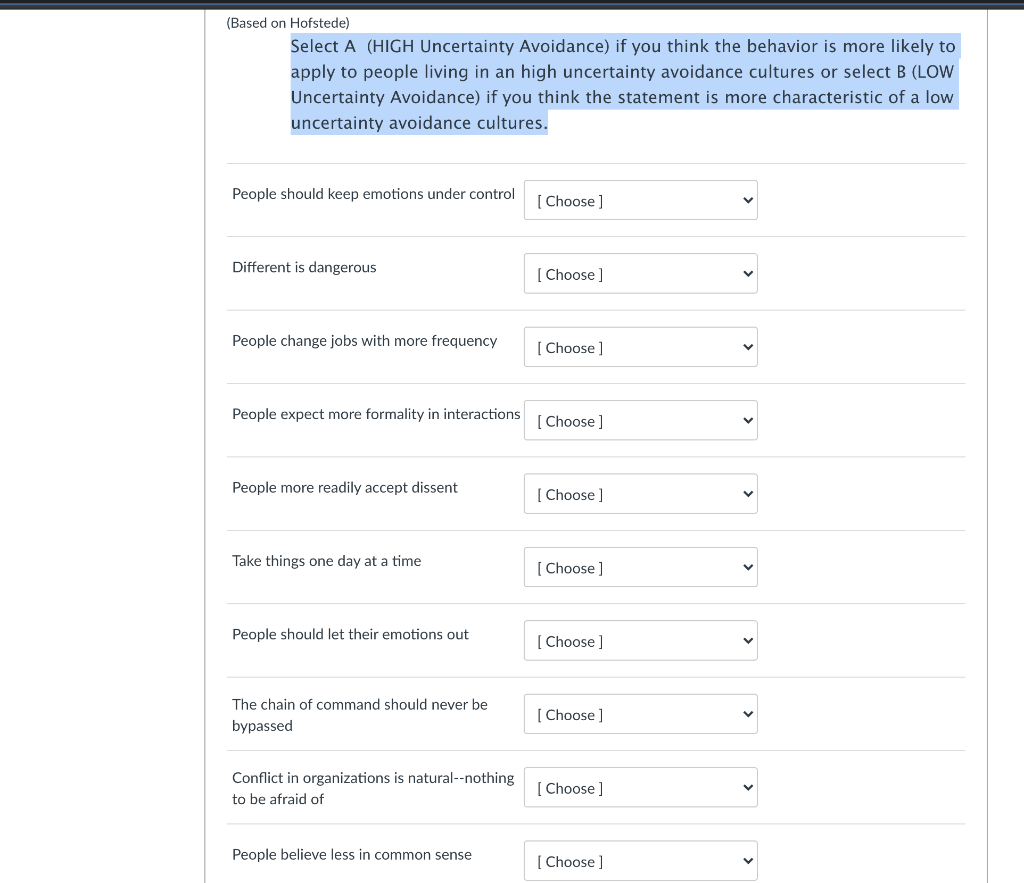
Question: (Based on Hofstede) Select A (HIGH Uncertainty Avoidance) if you think the behavior is more likely to apply to people living in an high uncertainty
(Based on Hofstede) Select A (HIGH Uncertainty(Based on Hofstede) Select A (HIGH Uncertainty

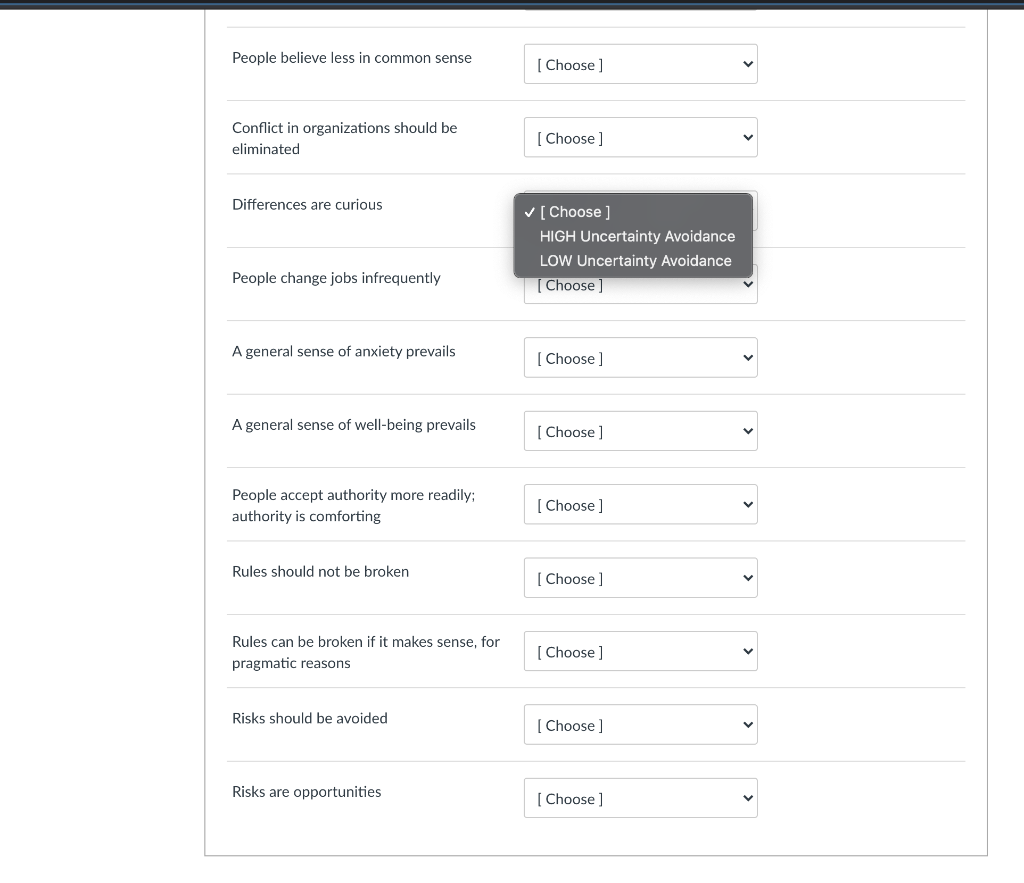
(Based on Hofstede) Select A (HIGH Uncertainty Avoidance) if you think the behavior is more likely to apply to people living in an high uncertainty avoidance cultures or select B (LOW Uncertainty Avoidance) if you think the statement is more characteristic of a low uncertainty avoidance cultures. People should keep emotions under control [Choose ] Different is dangerous [Choose ] People change jobs with more frequency [ Choose ] People expect more formality in interactions [Choose ] People more readily accept dissent [Choose ] Take things one day at a time [Choose ] People should let their emotions out [Choose ] The chain of command should never be [ Choose ] bypassed Conflict in organizations is natural--nothing to be afraid of [Choose ] People believe less in common sense [ Choose] People believe less in common sense [Choose ] Conflict in organizations should be eliminated [Choose] Differences are curious [Choose ] HIGH Uncertainty Avoidance LOW Uncertainty Avoidance [Choose ] People change jobs infrequently A general sense of anxiety prevails [Choose ] A general sense of well-being prevails [ Choose ] People accept authority more readily; authority is comforting [Choose ] Rules should not be broken Choose] Rules can be broken if it makes sense, for pragmatic reasons Choose] Risks should be avoided [Choose] Risks are opportunities [Choose ]

Step by Step Solution

There are 3 Steps involved in it

1 Expert Approved Answer
Step: 1 Unlock blur-text-image

Question Has Been Solved by an Expert!

Get step-by-step solutions from verified subject matter experts

Step: 2 Unlock
Step: 3 Unlock

Students Have Also Explored These Related General Management Questions!