







Question: Based on operations illustrated in Section 2, write a program to evaluate the arithmetic expression X = (AXB-C) = (D+E) Make effective use of the
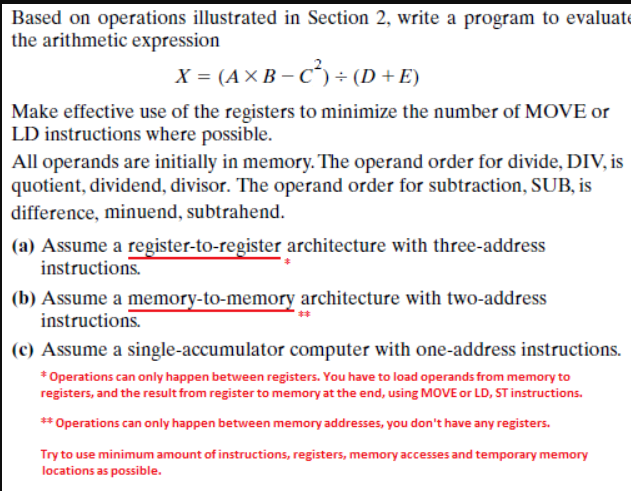
Based on operations illustrated in Section 2, write a program to evaluate the arithmetic expression X = (AXB-C) = (D+E) Make effective use of the registers to minimize the number of MOVE or LD instructions where possible. All operands are initially in memory. The operand order for divide, DIV, is quotient, dividend, divisor. The operand order for subtraction, SUB, is difference, minuend, subtrahend. (a) Assume a register-to-register architecture with three-address instructions (b) Assume a memory-to-memory architecture with two-address instructions (c) Assume a single-accumulator computer with one-address instructions. * Operations can only happen between registers. You have to load operands from memory to registers, and the result from register to memory at the end, using MOVE or LD, ST instructions. *Operations can only happen between memory addresses, you don't have any registers. Try to use minimum amount of instructions, registers, memory accesses and temporary memory locations as possible
Step by Step Solution
There are 3 Steps involved in it

Get step-by-step solutions from verified subject matter experts
 Study Help