







Question: Based on python, use genetic algorithm (GA) to process a unimodal function (f2) and a multimodal function(f11) at the same time. Briefly discuss the result,
Based on python, use genetic algorithm (GA) to process a unimodal function (f2) and a multimodal function(f11) at the same time.
Briefly discuss the result, including the use of parameters, accuracy, the use of function evaluations(FE), consistency of execution results (can we get good results every time?), dimension that can achieve satisfactory results, etc.
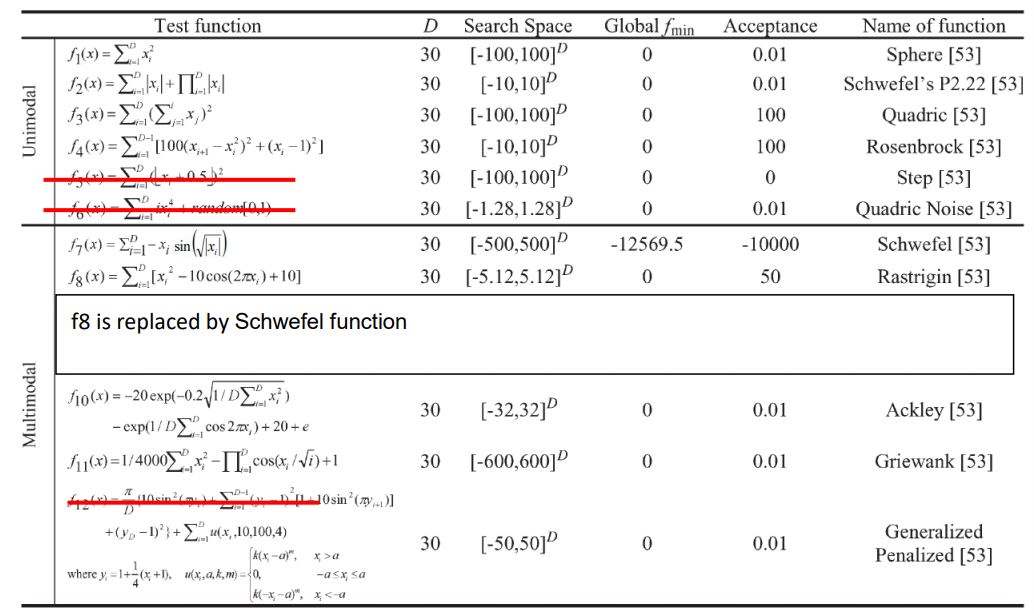
D Global fmin 0 Acceptance 0.01 0 0.01 Unimodal 0 100 Search Space 30 [-100,100] 30 [-10,10] 30 [-100,100] 30 [-10,10] 30 [-100,100] 30 [-1.28,1.28] 30 [-500,500] 30 [-5.12,5.12] 0 Test function fj(x) = x? 12(x) = {"://+II\ f3(x)= 2,2=x;) 14(x) = { '[100(X, 11 x?)? + (x - 1)?] 05.12 2 ade1) 17(x) = -1- *; sin(/tx;) fg(x) = {"[** - 10cos(2.06.) +10] 100 Name of function Sphere [53] Schwefel's P2.22 [53] Quadric [53] Rosenbrock [53] Step [53] Quadric Noise [53] Schwefel [53] Rastrigin [53] 0 0 0 0.01 -12569.5 -10000 0 50 f8 is replaced by Schwefel function Multimodal 30 [-32,32] 0 0.01 Ackley [53] 310(x) = -20 exp(-0.2/1/DCx}) - exp(1/ Dcos 27x) + 20+e $11(x)=1/40002., * -II.cos(x)/Vi)+1 30 [-600,600] 0 0.01 Griewank [53] (37) 0sin .] 30 [-50,50] 0 +(y)-1)}+2,4(x,10,100,4) k(x-a)", where y = 1+34 +), ux,a,k,m) = -a
Step by Step Solution
There are 3 Steps involved in it

Get step-by-step solutions from verified subject matter experts
 Study Help