







Question: Based on Taguchi Quality loss function, what should the tolerance be before an adjustment is made at the factory? What are the upper and lower
Based on Taguchi Quality loss function, what should the tolerance be before an adjustment is made at the factory?
What are the upper and lower for the production of the product?
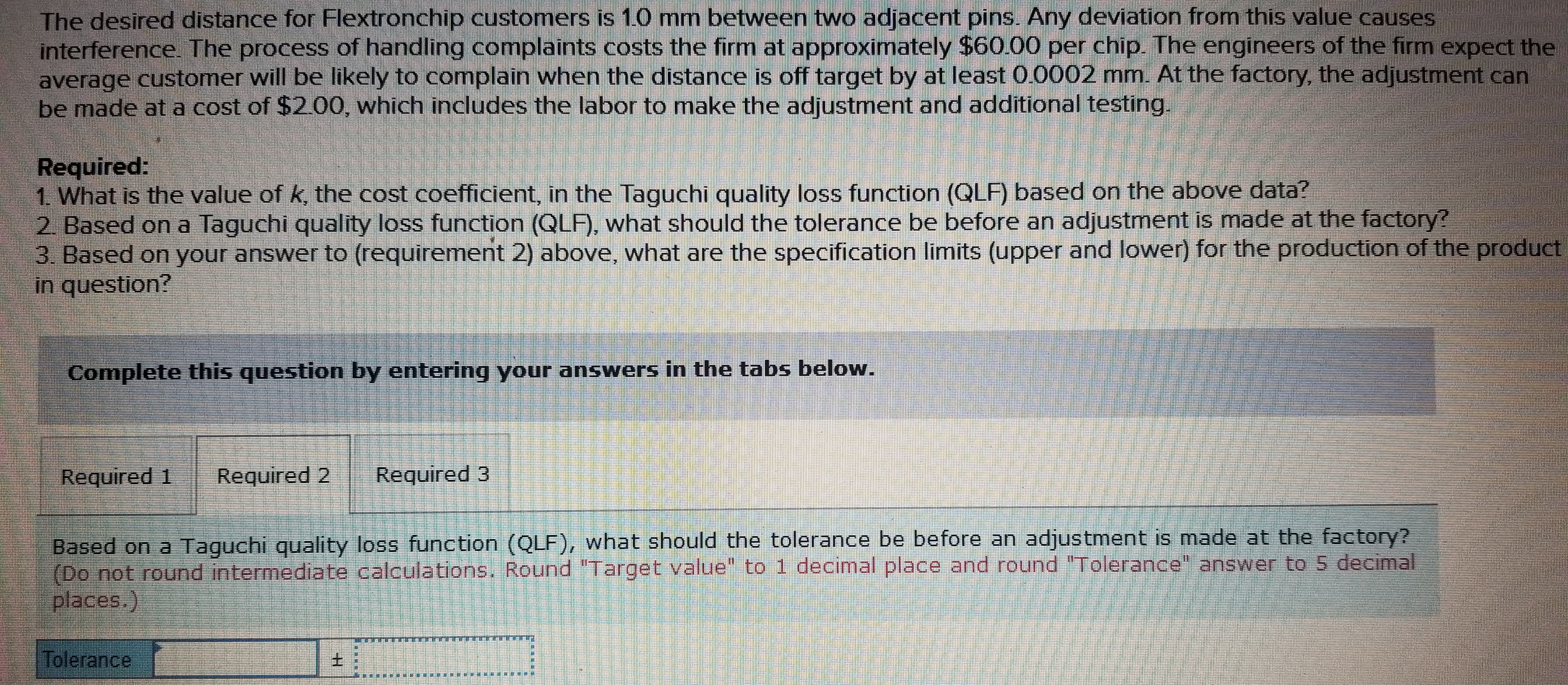
The desired distance for Flextronchip customers is 10 mm between two adjacent pins. Any deviation from this value causes interference. The process of handling complaints costs the firm at approximately $60.00 per chip. The engineers of the firm expect the average customer will be likely to complain when the distance is off target by at least 0.0002 mm. At the factory, the adjustment can be made at a cost of $2.00, which includes the labor to make the adjustment and additional testing Required: 1. What is the value of k, the cost coefficient, in the Taguchi quality loss function (QLF) based on the above data? 2. Based on a Taguchi quality loss function (QLF), what should the tolerance be before an adjustment is made at the factory? 3. Based on your answer to (requirement 2) above, what are the specification limits (upper and lower) for the production of the product in question? Complete this question by entering your answers in the tabs below. Required 1 Required 2 Required 3 Based on a Taguchi quality loss function (QLF), what should the tolerance be before an adjustment is made at the factory? (Do not round intermediate calculations. Round "Target value" to 1 decimal place and round "Tolerance" answer to 5 decimal places.) Tolerance
Step by Step Solution
There are 3 Steps involved in it

Get step-by-step solutions from verified subject matter experts
 Study Help