







Question: Based on the Article above, answer the below question : Question : 1) How did Tony Fernandes transform and build Airasia into the organisation it
Based on the Article above, answer the below question :
Question :
1) How did Tony Fernandes transform and build Airasia into the organisation it is today ?
2) Why does he believe that people development is important ?
3) How does entrepreneurial culture in Air Asia influence innovation and employee behaviour towards customer ?
1) How did Tony Fernandes transfro
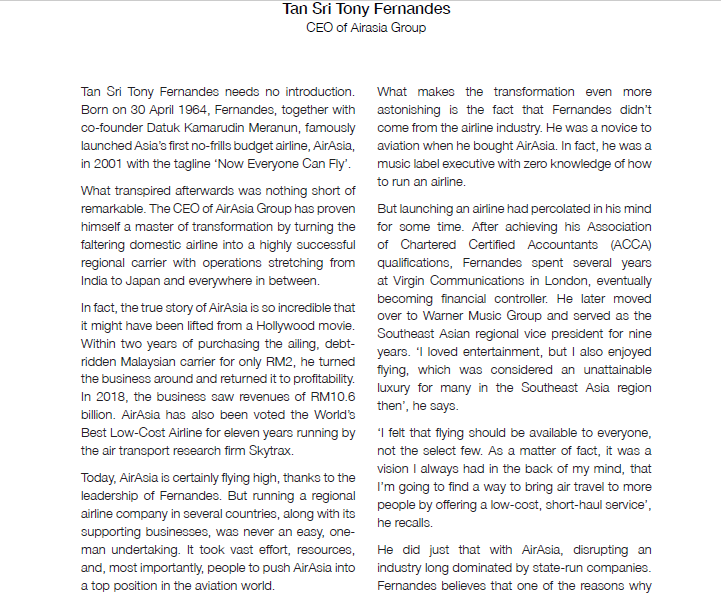
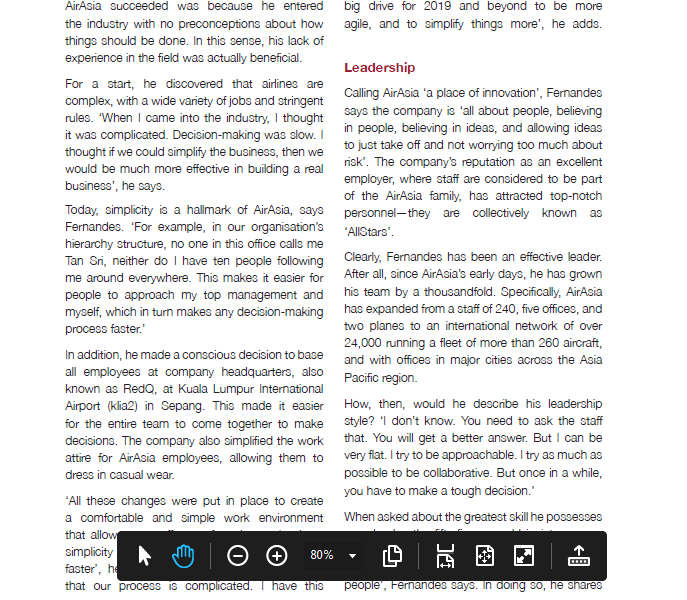
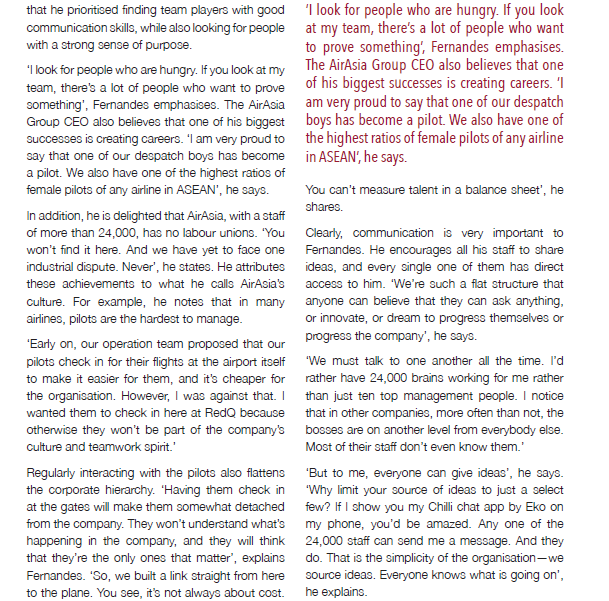
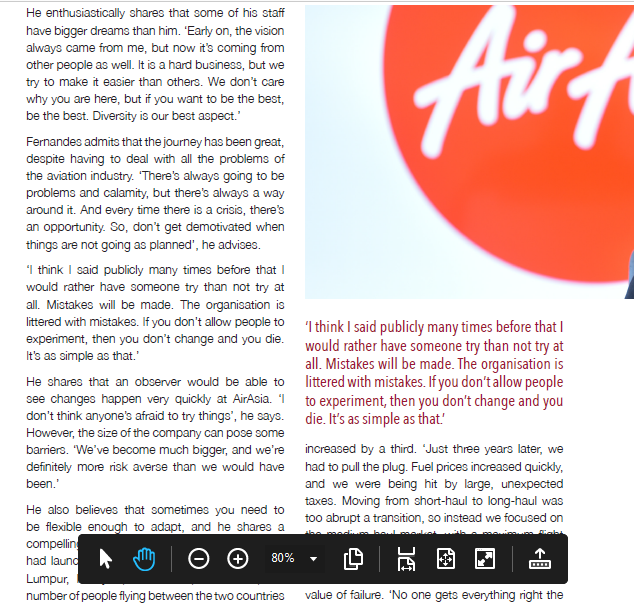
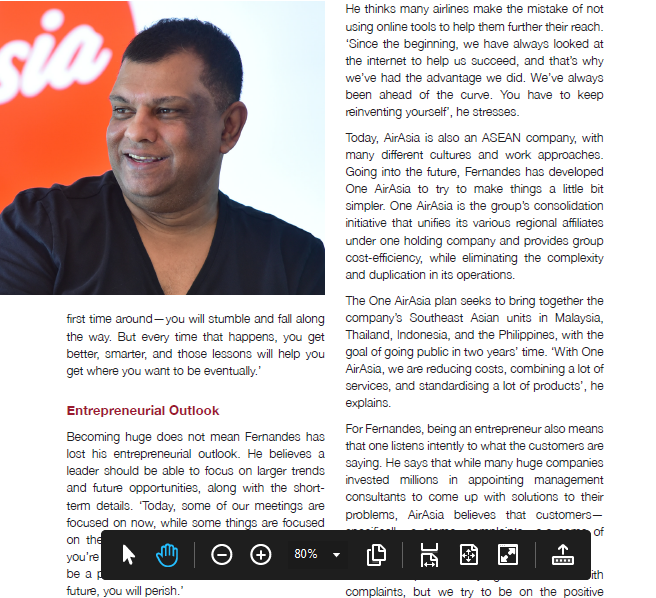
Tan Sri Tony Fernandes CEO of Airasia Group Tan Sri Tony Fernandes needs no introduction. Born on 30 April 1964, Fernandes, together with co-founder Datuk Kamarudin Meranun, famously launched Asia's first no-frills budget airline, AirAsia, in 2001 with the tagline 'Now Everyone Can Fly'. What transpired afterwards was nothing short of remarkable. The CEO of AirAsia Group has proven himself a master of transformation by turning the faltering domestic airline into a highly successful regional carrier with operations stretching from India to Japan and everywhere in between. What makes the transformation even more astonishing is the fact that Fernandes didn't come from the airline industry. He was a novice to aviation when he bought AirAsia. In fact, he was a music label executive with zero knowledge of how to run an airline. In fact, the true story of AirAsia is so incredible that it might have been lifted from a Hollywood movie. Within two years of purchasing the ailing, debt- ridden Malaysian carrier for only RM2, he turned the business around and returned it to profitability In 2018, the business saw revenues of RM10.6 billion. AirAsia has also been voted the World's Best Low-Cost Airline for eleven years running by the air transport research firm Skytrax. But launching an airline had percolated in his mind for some time. After achieving his Association of Chartered Certified Accountants (ACCA) qualifications, Fernandes spent several years at Virgin Communications in London, eventually becoming financial controller. He later moved over to Warner Music Group and served as the Southeast Asian regional vice president for nine years. 'I loved entertainment, but I also enjoyed flying, which was considered an unattainable luxury for many in the Southeast Asia region then', he says. 'I felt that flying should be available to everyone, not the select few. As a matter of fact, it was a vision I always had in the back of my mind, that I'm going to find a way to bring air travel to more people by offering a low-cost, short-haul service', he recalls. Today, AirAsia is certainly flying high, thanks to the leadership of Fernandes. But running a regional airline company in several countries, along with its supporting businesses, was never an easy, one- man undertaking. It took vast effort, resources, and, most importantly, people to push AirAsia into a top position in the aviation world. He did just that with AirAsia, disrupting an industry long dominated by state-run companies. Fernandes believes that one of the reasons why AirAsia Succeeded was because he entered the industry with no preconceptions about how things should be done. In this sense, his lack of experience in the field was actually beneficial. big drive for 2019 and beyond to be more agile, and to simplify things more', he adds. Leadership For a start, he discovered that airlines are complex, with a wide variety of jobs and stringent rules. 'When I came into the industry, I thought it was complicated. Decision-making was slow. thought if we could simplify the business, then we would be much more effective in building a real business', he says. Today, simplicity is a hallmark of AirAsia, says Fernandes. 'For example, in Our Organisation's hierarchy Structure, no one in this office calls me Tan Sri, neither do I have ten people following me around everywhere. This makes it easier for people to approach my top management and myself, which in turn makes any decision-making process faster.' Calling AirAsia 'a place of innovation', Fernandes says the company is all about people, believing in people, believing in ideas, and allowing ideas to just take off and not worrying too much about risk'. The company's reputation as an excellent employer, where staff are considered to be part of the AirAsia family, has attracted top-notch personnel, they are collectively known as "AllStars'. Clearly, Fernandes has been an effective leader. After all, since AirAsia's early days, he has grown his team by a thousandfold. Specifically, AirAsia has expanded from a staff of 240, five offices, and two planes to an international network of over 24,000 running a fleet of more than 260 aircraft, and with offices in major cities across the Asia Pacific region In addition, he made a conscious decision to base all employees at company headquarters, also known as Redo, at Kuala Lumpur International Airport (klia2) in Sepang. This made it easier for the entire team to come together to make decisions. The company also simplified the work attire for AirAsia employees, allowing them to dress in casual wear. "All these changes were put in place to Create a comfortable and simple work environment that allow How, then, would he describe his leadership Style? 'I don't know. You need to ask the staff that. You will get a better answer. But I can be very flat. I try to be approachable. I try as much as possible to be collaborative. But once in a while, you have to make a tough decision.' when asked about the greatest skill he possesses simplicity A 0 80% . that our process is complicated. I have this people, Fernandes says. In doing so, he shares that he prioritised finding team players with good communication skills, while also looking for people with a strong sense of purpose. 'I look for people who are hungry. If you look at my team, there's a lot of people who want to prove something'. Fernandes emphasises. The AirAsia Group CEO also believes that one of his biggest Successes is creating careers. 'I am very proud to say that one of our despatch boys has become a pilot. We also have one of the highest ratios of female pilots of any airline in ASEAN', he says. 'I look for people who are hungry. If you look at my team, there's a lot of people who want to prove something', Fernandes emphasises. The AirAsia Group CEO also believes that one of his biggest successes is creating careers. 'I am very proud to say that one of our despatch boys has become a pilot. We also have one of the highest ratios of female pilots of any airline in ASEAN', he says. You can't measure talent in a balance sheet', he shares. In addition, he is delighted that AirAsia, with a staff of more than 24,000, has no labour unions. 'You won't find it here. And we have yet to face one industrial dispute. Never', he states. He attributes he calls AirAsia's Culture. For example, he notes that in many airlines, pilots are the hardest to manage. 'Early on, our operation team proposed that our pilots check in for their flights at the airport itself to make it easier for them, and it's cheaper for the Organisation. However, I was against that. I wanted them to check in here at Redo because otherwise they won't be part of the company's culture and teamwork spirit.' Clearly, communication is very important to Fernandes. He encourages all his staff to share ideas, and every single one of them has direct access to him. 'We're such a flat Structure that anyone can believe that they can ask anything, Or innovate, or dream to progress themselves or progress the company, he says. 'We must talk to one another all the time. I'd rather have 24,000 brains working for me rather than just ten top management people. I notice that in other companies, more often than not, the bosses are on another level from everybody else. Most of their staff don't even know them.' Regularly interacting with the pilots also flattens the corporate hierarchy. 'Having them check in at the gates will make them somewhat detached from the company. They won't understand what's happening in the company, and they will think that they're the only ones that matter', explains Fernandes. 'So, we built a link straight from here to the plane. You see, it's not always about cost. 'But to me, everyone can give ideas', he says. 'Why limit your source of ideas to just a select few? If I show you my Chilli chat app by Eko on my phone, you'd be amazed. Any one of the 24,000 staff can send me a message. And they do. That is the simplicity of the organisation-we source ideas. Everyone knows what is going on', he explains. He enthusiastically shares that some of his staff have bigger dreams than him. 'Early on, the vision always came from me, but now it's coming from other people as well. It is a hard business, but we try to make it easier than others. We don't care why you are here, but if you want to be the best, be the best. Diversity is our best aspect." Fernandes admits that the journey has been great, despite having to deal with all the problems of the aviation industry. There's always going to be problems and calamity, but there's always a way around it. And every time there is a crisis, there's an opportunity. So, don't get demotivated when things are not going as planned', he advises. 'I think I said publicly many times before that I would rather have someone try than not try at all. Mistakes will be made. The organisation is littered with mistakes. If you don't allow people to experiment, then you don't change and you die. It's as simple as that.' He shares that an observer would be able to see changes happen very quickly at AirAsia. '1 don't think anyone's afraid to try things', he says. However, the size of the company can pose some barriers. 'We've become much bigger, and we're definitely more risk averse than we would have been.' 'I think I said publicly many times before that I would rather have someone try than not try at all. Mistakes will be made. The organisation is littered with mistakes. If you don't allow people to experiment, then you don't change and you die. It's as simple as that! increased by a third. 'Just three years later, we had to pull the plug. Fuel prices increased quickly, and we were being hit by large, unexpected taxes. Moving from short-haul to long-haul was too abrupt a transition, so instead we focused on ka d .. . . . . .. He also believes that sometimes you need to be flexible enough to adapt, and he shares a compelling had laund AC 0 80% D E S .. Lumpur, number of people flying between the two countries value of failure. 'No one gets everything right the He thinks many airlines make the mistake of not using online tools to help them further their reach. 'Since the beginning, we have always looked at the internet to help us Succeed, and that's why we've had the advantage we did. We've always been ahead of the curve. You have to keep reinventing yourself, he stresses. Today, AirAsia is also an ASEAN company, with many different cultures and work approaches. Going into the future, Fernandes has developed One AirAsia to try to make things a little bit simpler. One AirAsia is the group's consolidation initiative that unifies its various regional affiliates under one holding company and provides group cost-efficiency, while eliminating the complexity and duplication in its operations. The One AirAsia plan seeks to bring together the company's Southeast Asian units in Malaysia, Thailand, Indonesia, and the Philippines, with the goal of going public in two years' time. With One AirAsia, we are reducing costs, combining a lot of Services, and standardising a lot of products', he explains. first time around you will stumble and fall along the way. But every time that happens, you get better, smarter, and those lessons will help you get where you want to be eventually.' Entrepreneurial Outlook Becoming huge does not mean Fernandes has lost his entrepreneurial Outlook. He believes a leader should be able to focus on larger trends and future opportunities, along with the short- term details. Today, some of our meetings are focused on now, while some things are focused on the For Fernandes, being an entrepreneur also means that one listens intently to what the customers are saying. He says that while many huge companies invested millions in appointing management consultants to come up with solutions to their problems, AirAsia believes that customers- you're 80% D E S 1 be a future, you will perish.' complaints, but we try to be on the positiveStep by Step Solution
There are 3 Steps involved in it
1 Expert Approved Answer
Step: 1 Unlock

Question Has Been Solved by an Expert!
Get step-by-step solutions from verified subject matter experts
Step: 2 Unlock
Step: 3 Unlock
 Study Help