Question: Based on the case above, identify the customer segments, value propositions, revenue streams and distribution channels of the Bauing Construction Group Shenzhen Bauing Construction Group
 Based on the case above, identify the customer segments, value propositions, revenue streams and distribution channels of the Bauing Construction Group
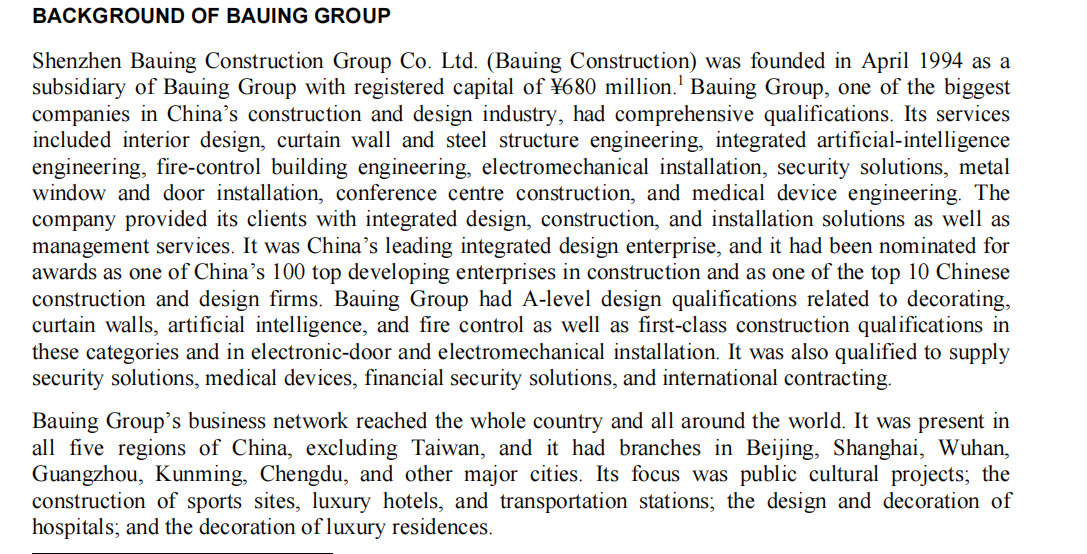
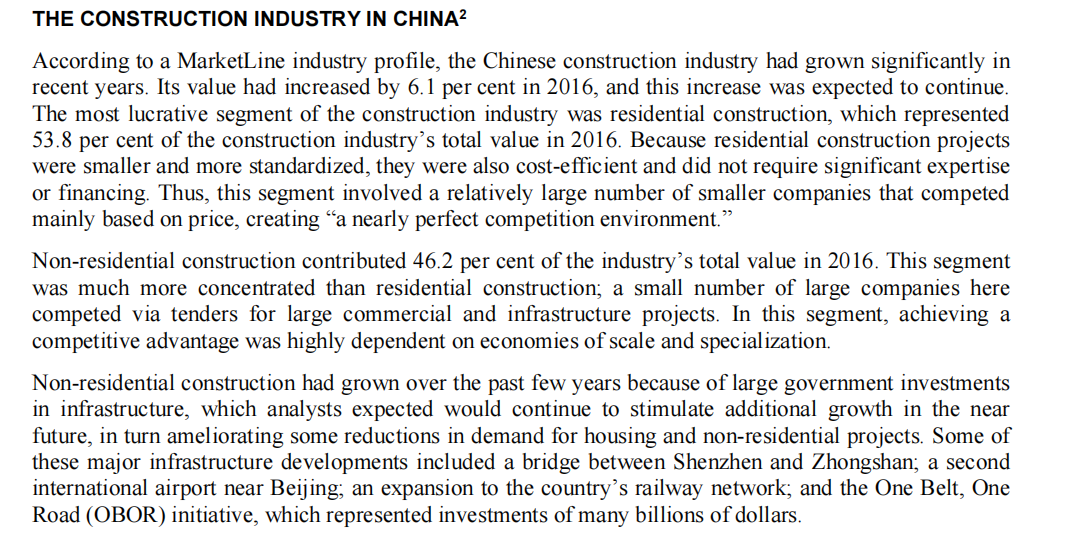
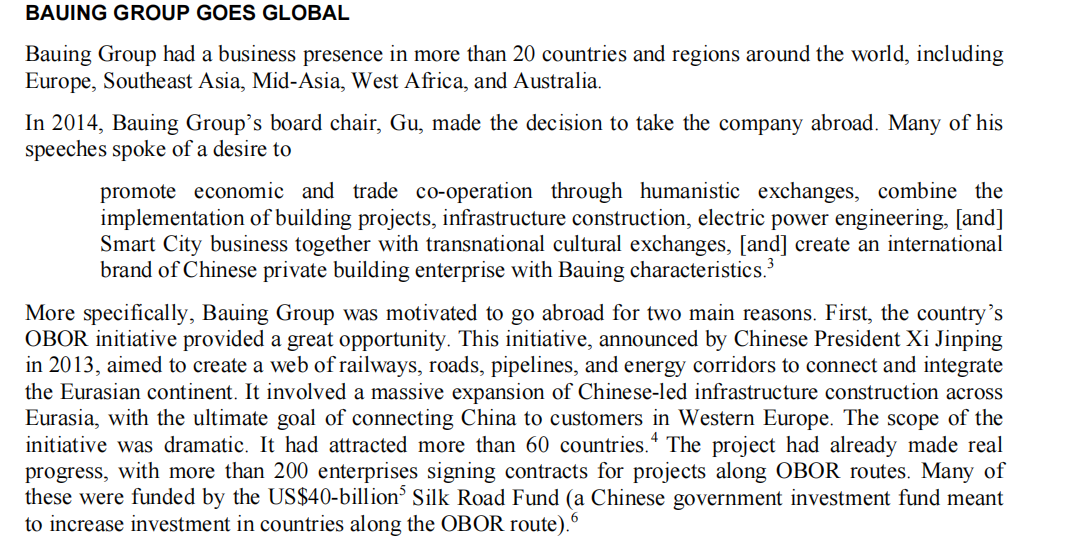
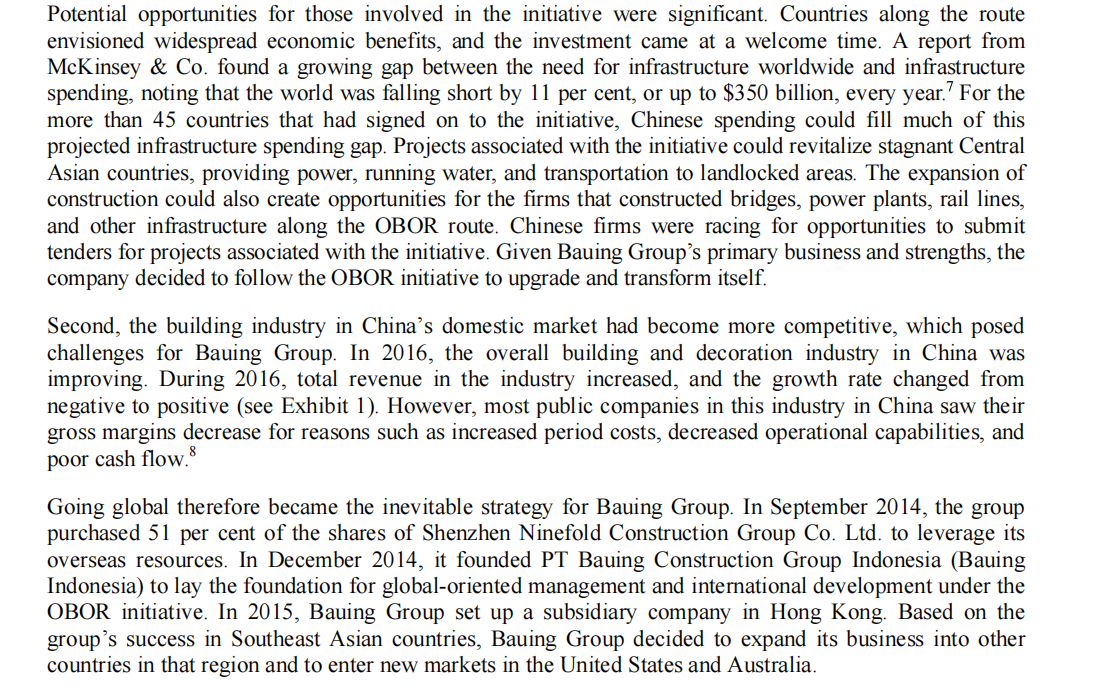
Shenzhen Bauing Construction Group Co. Ltd. (Bauing Construction) was founded in April 1994 as a subsidiary of Bauing Group with registered capital of 680 million. 1 Bauing Group, one of the biggest companies in China's construction and design industry, had comprehensive qualifications. Its services included interior design, curtain wall and steel structure engineering, integrated artificial-intelligence engineering, fire-control building engineering, electromechanical installation, security solutions, metal window and door installation, conference centre construction, and medical device engineering. The company provided its clients with integrated design, construction, and installation solutions as well as management services. It was China's leading integrated design enterprise, and it had been nominated for awards as one of China's 100 top developing enterprises in construction and as one of the top 10 Chinese construction and design firms. Bauing Group had A-level design qualifications related to decorating, curtain walls, artificial intelligence, and fire control as well as first-class construction qualifications in these categories and in electronic-door and electromechanical installation. It was also qualified to supply security solutions, medical devices, financial security solutions, and international contracting. Bauing Group's business network reached the whole country and all around the world. It was present in all five regions of China, excluding Taiwan, and it had branches in Beijing, Shanghai, Wuhan, Guangzhou, Kunming, Chengdu, and other major cities. Its focus was public cultural projects; the construction of sports sites, luxury hotels, and transportation stations; the design and decoration of hospitals; and the decoration of luxury residences. THE CONSTRUCTION INDUSTRY IN CHINA 2 According to a MarketLine industry profile, the Chinese construction industry had grown significantly in recent years. Its value had increased by 6.1 per cent in 2016, and this increase was expected to continue. The most lucrative segment of the construction industry was residential construction, which represented 53.8 per cent of the construction industry's total value in 2016. Because residential construction projects were smaller and more standardized, they were also cost-efficient and did not require significant expertise or financing. Thus, this segment involved a relatively large number of smaller companies that competed mainly based on price, creating "a nearly perfect competition environment." Non-residential construction contributed 46.2 per cent of the industry's total value in 2016 . This segment was much more concentrated than residential construction; a small number of large companies here competed via tenders for large commercial and infrastructure projects. In this segment, achieving a competitive advantage was highly dependent on economies of scale and specialization. Non-residential construction had grown over the past few years because of large government investments in infrastructure, which analysts expected would continue to stimulate additional growth in the near future, in turn ameliorating some reductions in demand for housing and non-residential projects. Some of these major infrastructure developments included a bridge between Shenzhen and Zhongshan; a second international airport near Beijing; an expansion to the country's railway network; and the One Belt, One Road (OBOR) initiative, which represented investments of many billions of dollars. Bauing Group had a business presence in more than 20 countries and regions around the world, including Europe, Southeast Asia, Mid-Asia, West Africa, and Australia. In 2014, Bauing Group's board chair, Gu, made the decision to take the company abroad. Many of his speeches spoke of a desire to promote economic and trade co-operation through humanistic exchanges, combine the implementation of building projects, infrastructure construction, electric power engineering, [and] Smart City business together with transnational cultural exchanges, [and] create an international brand of Chinese private building enterprise with Bauing characteristics. 3 More specifically, Bauing Group was motivated to go abroad for two main reasons. First, the country's OBOR initiative provided a great opportunity. This initiative, announced by Chinese President Xi Jinping in 2013, aimed to create a web of railways, roads, pipelines, and energy corridors to connect and integrate the Eurasian continent. It involved a massive expansion of Chinese-led infrastructure construction across Eurasia, with the ultimate goal of connecting China to customers in Western Europe. The scope of the initiative was dramatic. It had attracted more than 60 countries. 4 The project had already made real progress, with more than 200 enterprises signing contracts for projects along OBOR routes. Many of these were funded by the US\$40-billion 5 Silk Road Fund (a Chinese government investment fund meant to increase investment in countries along the OBOR route). 6 Potential opportunities for those involved in the initiative were signiticant. Countries along the route envisioned widespread economic benefits, and the investment came at a welcome time. A report from McKinsey \& Co. found a growing gap between the need for infrastructure worldwide and infrastructure spending, noting that the world was falling short by 11 per cent, or up to $350 billion, every year. 7 For the more than 45 countries that had signed on to the initiative, Chinese spending could fill much of this projected infrastructure spending gap. Projects associated with the initiative could revitalize stagnant Central Asian countries, providing power, running water, and transportation to landlocked areas. The expansion of construction could also create opportunities for the firms that constructed bridges, power plants, rail lines, and other infrastructure along the OBOR route. Chinese firms were racing for opportunities to submit tenders for projects associated with the initiative. Given Bauing Group's primary business and strengths, the company decided to follow the OBOR initiative to upgrade and transform itself. Second, the building industry in China's domestic market had become more competitive, which posed challenges for Bauing Group. In 2016, the overall building and decoration industry in China was improving. During 2016, total revenue in the industry increased, and the growth rate changed from negative to positive (see Exhibit 1). However, most public companies in this industry in China saw their gross margins decrease for reasons such as increased period costs, decreased operational capabilities, and poor cash flow. Going global therefore became the inevitable strategy for Bauing Group. In September 2014, the group purchased 51 per cent of the shares of Shenzhen Ninefold Construction Group Co. Ltd. to leverage its overseas resources. In December 2014, it founded PT Bauing Construction Group Indonesia (Bauing Indonesia) to lay the foundation for global-oriented management and international development under the OBOR initiative. In 2015, Bauing Group set up a subsidiary company in Hong Kong. Based on the group's success in Southeast Asian countries, Bauing Group decided to expand its business into other countries in that region and to enter new markets in the United States and Australia









 Study Help