Question: Based on the case study ABOUT FACEBOOK . Construct strength and weaknesses (with explanation and NO PLAGIARISM) Facebook, Inc., 2015 www.facebook.com, FB Headquartered in Menlo
Based on the case study ABOUT FACEBOOK . Construct strength and weaknesses (with explanation and NO PLAGIARISM)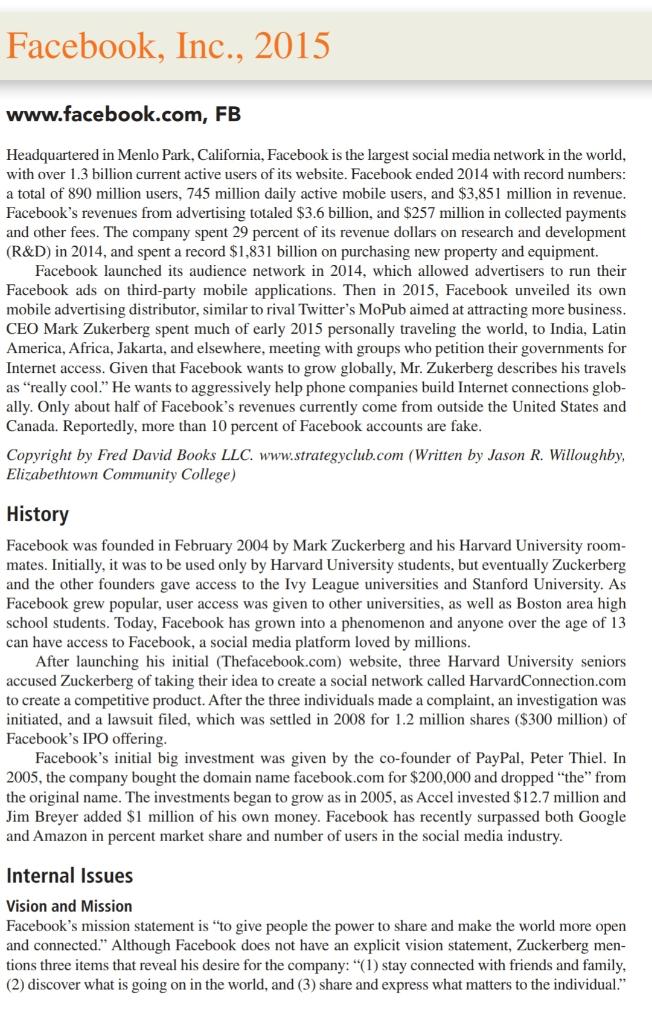
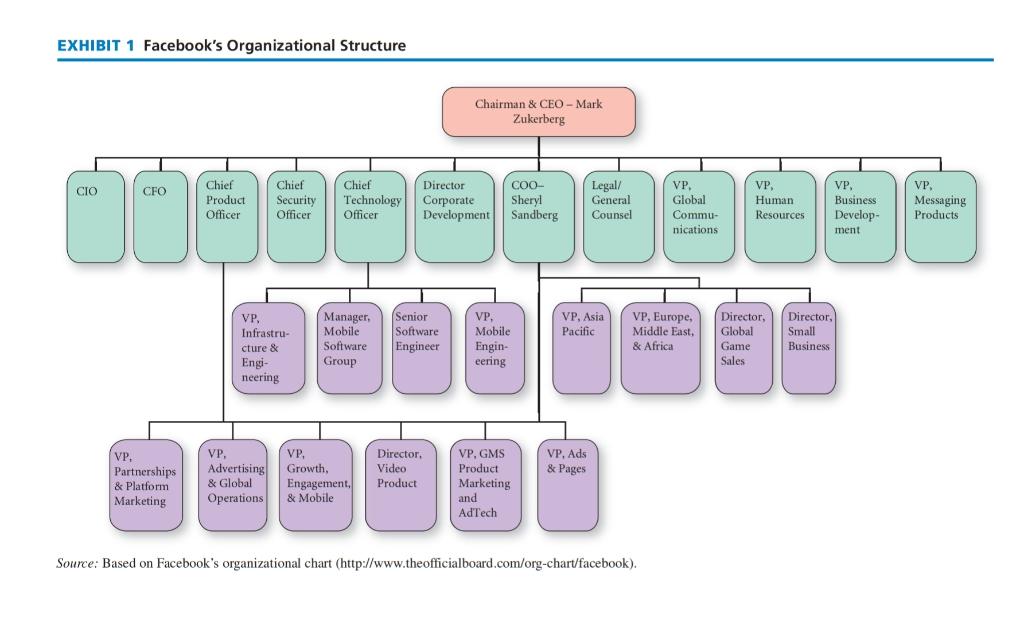
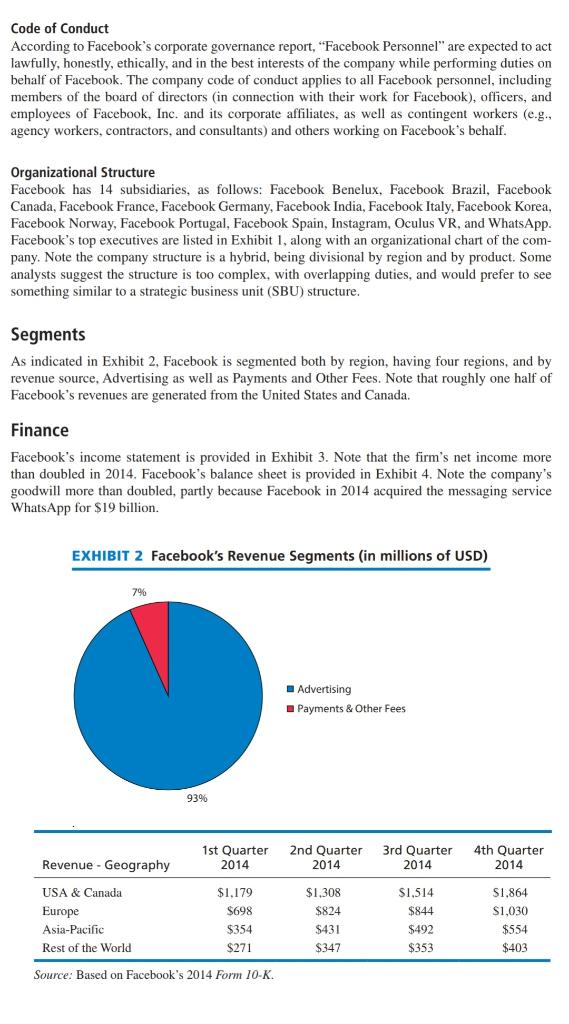
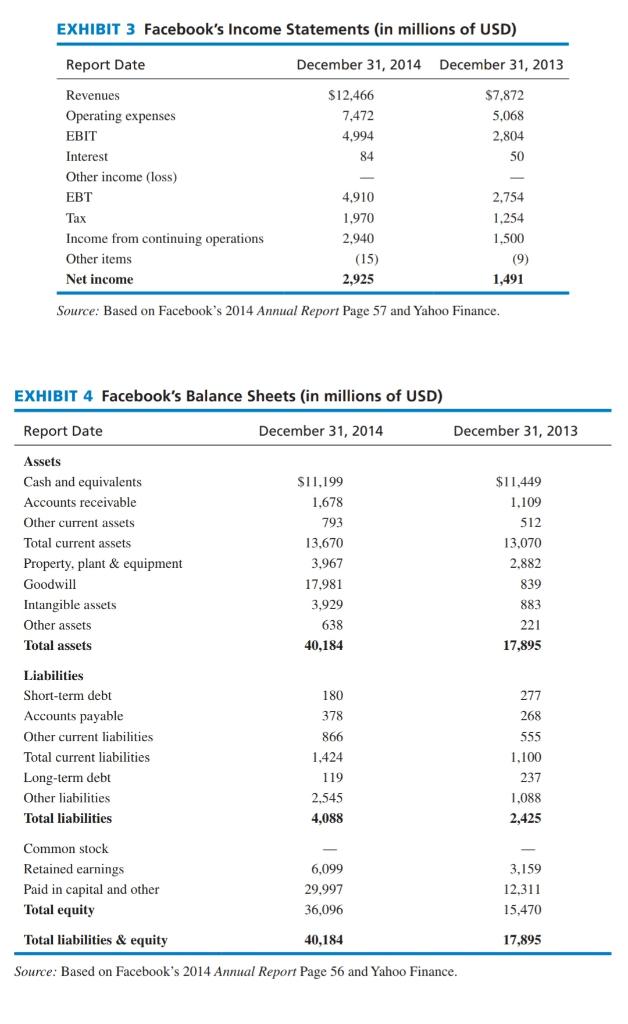
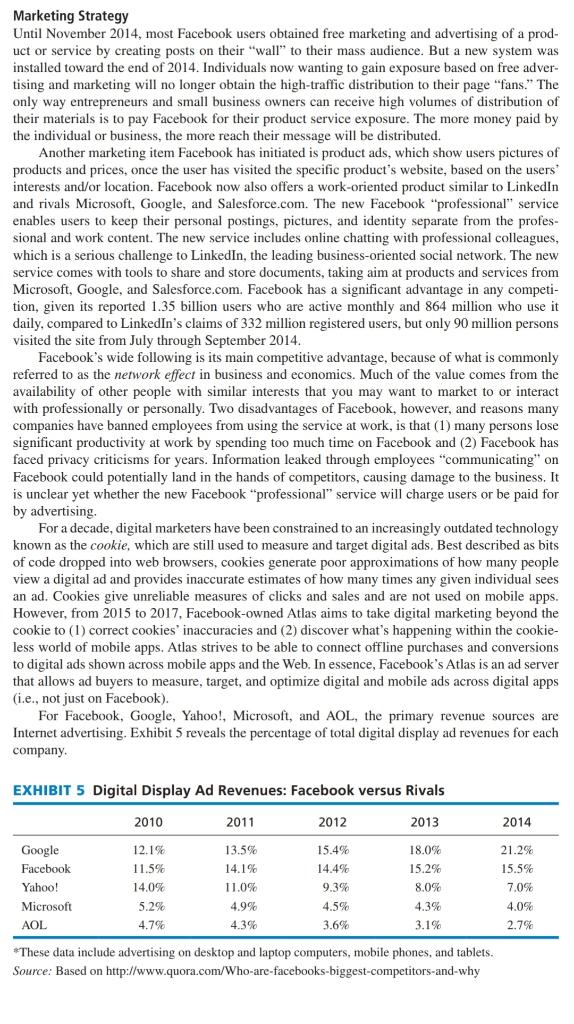
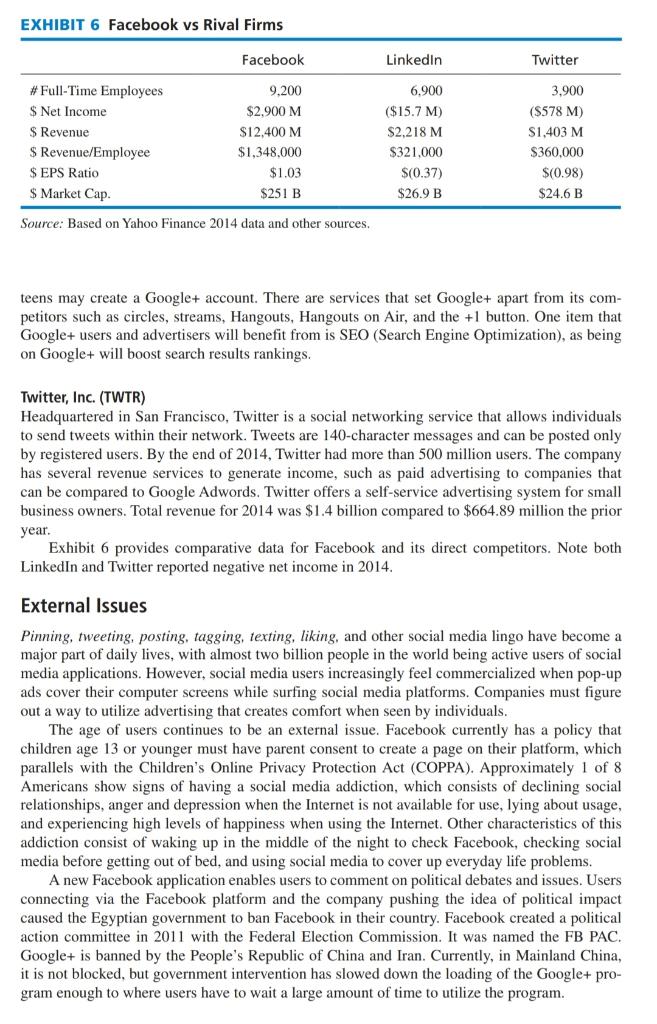
Facebook, Inc., 2015 www.facebook.com, FB Headquartered in Menlo Park, California, Facebook is the largest social media network in the world, with over 1.3 billion current active users of its website. Facebook ended 2014 with record numbers: a total of 890 million users, 745 million daily active mobile users, and $3,851 million in revenue. Facebook's revenues from advertising totaled $3.6 billion, and $257 million in collected payments and other fees. The company spent 29 percent of its revenue dollars on research and development (R&D) in 2014, and spent a record $1,831 billion on purchasing new property and equipment. Facebook launched its audience network in 2014, which allowed advertisers to run their Facebook ads on third-party mobile applications. Then in 2015, Facebook unveiled its own mobile advertising distributor, similar to rival Twitter's MoPub aimed at attracting more business. CEO Mark Zukerberg spent much of early 2015 personally traveling the world, to India, Latin America, Africa, Jakarta, and elsewhere, meeting with groups who petition their governments for Internet access. Given that Facebook wants to grow globally, Mr. Zukerberg describes his travels as "really cool." He wants to aggressively help phone companies build Internet connections glob- ally. Only about half of Facebook's revenues currently come from outside the United States and Canada. Reportedly, more than 10 percent of Facebook accounts are fake. Copyright by Fred David Books LLC. www.strategyclub.com (Written by Jason R. Willoughby, Elizabethtown Community College) History Facebook was founded in February 2004 by Mark Zuckerberg and his Harvard University room- mates. Initially, it was to be used only by Harvard University students, but eventually Zuckerberg and the other founders gave access to the Ivy League universities and Stanford University. As Facebook grew popular, user access was given to other universities, as well as Boston area high school students. Today, Facebook has grown into a phenomenon and anyone over the age of 13 can have access to Facebook, a social media platform loved by millions. After launching his initial (Thefacebook.com) website, three Harvard University seniors accused Zuckerberg of taking their idea to create a social network called HarvardConnection.com to create a competitive product. After the three individuals made a complaint, an investigation was initiated, and a lawsuit filed, which was settled in 2008 for 1.2 million shares ($300 million) of Facebook's IPO offering. Facebook's initial big investment was given by the co-founder of PayPal, Peter Thiel. In 2005, the company bought the domain name facebook.com for $200,000 and dropped "the" from the original name. The investments began to grow as in 2005, as Accel invested $12.7 million and Jim Breyer added $1 million of his own money. Facebook has recently surpassed both Google and Amazon in percent market share and number of users in the social media industry. Internal Issues Vision and Mission Facebook's mission statement is to give people the power to share and make the world more open and connected. Although Facebook does not have an explicit vision statement, Zuckerberg men- tions three items that reveal his desire for the company: "(1) stay connected with friends and family, (2) discover what is going on in the world, and (3) share and express what matters to the individual." EXHIBIT 1 Facebook's Organizational Structure Chairman & CEO - Mark Zukerberg CIO CFO Chief Chief Chief Product Officer Security Officer Technology Officer Director Corporate Development COO- Sheryl Sandberg Legal/ General Counsel VP, Global Commu- nications VP, Human Resources VP, Business Develop- ment VP. Messaging Products VP Infrastru cture & Engi- VP, Asia Pacific Manager, Mobile Software Group Senior Software Engineer VP. Mobile Engin- eering VP, Europe, Middle East, & Africa Director, Global Game Sales Director, Small Business neering VP. Partnerships & Platform Marketing VP, Ads & Pages VP, Advertising & Global Operations VP, Growth, Engagement, & Mobile Director, Video Product VP, GMS Product Marketing and AdTech Source: Based on Facebook's organizational chart (http://www.theofficialboard.com/org-chart/facebook) Code of Conduct According to Facebook's corporate governance report, "Facebook Personnel" are expected to act lawfully, honestly, ethically, and in the best interests of the company while performing duties on behalf of Facebook. The company code of conduct applies to all Facebook personnel, including members of the board of directors (in connection with their work for Facebook), officers, and employees of Facebook, Inc. and its corporate affiliates, as well as contingent workers (e.g., agency workers, contractors, and consultants) and others working on Facebook's behalf. Organizational Structure Facebook has 14 subsidiaries, as follows: Facebook Benelux, Facebook Brazil, Facebook Canada, Facebook France, Facebook Germany, Facebook India, Facebook Italy, Facebook Korea, Facebook Norway, Facebook Portugal, Facebook Spain, Instagram, Oculus VR, and WhatsApp. Facebook's top executives are listed in Exhibit 1, along with an organizational chart of the com- pany. Note the company structure is a hybrid, being divisional by region and by product. Some analysts suggest the structure is too complex, with overlapping duties, and would prefer to see something similar to a strategic business unit (SBU) structure. Segments As indicated in Exhibit 2, Facebook is segmented both by region, having four regions, and by revenue source, Advertising as well as Payments and Other Fees. Note that roughly one half of Facebook's revenues are generated from the United States and Canada. Finance Facebook's income statement is provided in Exhibit 3. Note that the firm's net income more than doubled in 2014. Facebook's balance sheet is provided in Exhibit 4. Note the company's goodwill more than doubled, partly because Facebook in 2014 acquired the messaging service WhatsApp for $19 billion. EXHIBIT 2 Facebook's Revenue Segments (in millions of USD) 7% Advertising Payments & Other Fees 93% Revenue - Geography 1st Quarter 2014 2nd Quarter 2014 3rd Quarter 2014 4th Quarter 2014 $1,864 USA & Canada Europe Asia-Pacific Rest of the World $1,179 $698 $354 $271 $1,308 $824 $431 $347 S1.514 $844 $492 $353 $1,030 $554 $403 Source: Based on Facebook's 2014 Form 10-K. EXHIBIT 3 Facebook's Income Statements (in millions of USD) Report Date December 31, 2014 December 31, 2013 $12,466 7.472 4,994 84 $7.872 5.068 2.804 50 Revenues Operating expenses EBIT Interest Other income (loss) EBT Tax Income from continuing operations Other items Net income 2.754 1.254 4,910 1,970 2.940 (15) 2,925 1.500 (9) 1,491 Source: Based on Facebook's 2014 Annual Report Page 57 and Yahoo Finance. EXHIBIT 4 Facebook's Balance Sheets (in millions of USD) Report Date December 31, 2014 December 31, 2013 $11,199 1,678 793 Assets Cash and equivalents Accounts receivable Other current assets Total current assets Property, plant & equipment Goodwill Intangible assets Other assets Total assets $11,449 1,109 512 13,070 2.882 839 13,670 3,967 17.981 3,929 638 40.184 883 221 17,895 180 378 277 268 555 Liabilities Short-term debt Accounts payable Other current liabilities Total current liabilities Long-term debt Other liabilities Total liabilities 1,100 866 1,424 119 2.545 4,088 237 1,088 2,425 6,099 Common stock Retained earnings Paid in capital and other Total equity 29.997 36,096 3,159 12.311 15,470 Total liabilities & equity 40,184 17,895 Source: Based on Facebook's 2014 Annual Report Page 56 and Yahoo Finance. Marketing Strategy Until November 2014, most Facebook users obtained free marketing and advertising of a prod- uct or service by creating posts on their "wall" to their mass audience. But a new system was installed toward the end of 2014. Individuals now wanting to gain exposure based on free adver- tising and marketing will no longer obtain the high-traffic distribution to their page "fans." The only way entrepreneurs and small business owners can receive high volumes of distribution of their materials is to pay Facebook for their product service exposure. The more money paid by the individual or business, the more reach their message will be distributed. Another marketing item Facebook has initiated is product ads, which show users pictures of products and prices, once the user has visited the specific product's website, based on the users interests and/or location. Facebook now also offers a work-oriented product similar to LinkedIn and rivals Microsoft, Google, and Salesforce.com. The new Facebook professional" service enables users to keep their personal postings, pictures, and identity separate from the profes- sional and work content. The new service includes online chatting with professional colleagues, which is a serious challenge to LinkedIn, the leading business-oriented social network. The new service comes with tools to share and store documents, taking aim at products and services from Microsoft, Google, and Salesforce.com. Facebook has a significant advantage in any competi- tion, given its reported 1.35 billion users who are active monthly and 864 million who use it daily, compared to LinkedIn's claims of 332 million registered users, but only 90 million persons visited the site from July through September 2014. Facebook's wide following is its main competitive advantage, because of what is commonly referred to as the network effect in business and economics. Much of the value comes from the availability of other people with similar interests that you may want to market to or interact with professionally or personally. Two disadvantages of Facebook, however, and reasons many companies have banned employees from using the service at work, is that (1) many persons lose significant productivity at work by spending too much time on Facebook and (2) Facebook has faced privacy criticisms for years. Information leaked through employees "communicating on Facebook could potentially land in the hands of competitors, causing damage to the business. It is unclear yet whether the new Facebook professional service will charge users or be paid for by advertising. For a decade, digital marketers have been constrained to an increasingly outdated technology known as the cookie, which are still used to measure and target digital ads. Best described as bits of code dropped into web browsers, cookies generate poor approximations of how many people view a digital ad and provides inaccurate estimates of how many times any given individual sees an ad. Cookies give unreliable measures of clicks and sales and are not used on mobile apps. However, from 2015 to 2017, Facebook-owned Atlas aims to take digital marketing beyond the cookie to (1) correct cookies' inaccuracies and (2) discover what's happening within the cookie- less world of mobile apps. Atlas strives to be able to connect offline purchases and conversions to digital ads shown across mobile apps and the Web. In essence, Facebook's Atlas is an ad server that allows ad buyers to measure, target, and optimize digital and mobile ads across digital apps (i.e., not just on Facebook). For Facebook, Google, Yahoo!, Microsoft, and AOL, the primary revenue sources are Internet advertising. Exhibit 5 reveals the percentage of total digital display ad revenues for each company EXHIBIT 5 Digital Display Ad Revenues: Facebook versus Rivals 2010 2011 2012 2013 2014 18.0% 15.2% Google Facebook Yahoo! Microsoft AOL 12.1% 11.5% 14.0% 5.2% 4.7% 13.5% 14.1% 11.0% 4.9% 15.4% 14.4% 9.3% 4.5% 3.6% 8.0% 21.2% 15.5% 7.0% 4.0% 2.7% 4.3% 3.1% 4.3% *These data include advertising on desktop and laptop computers, mobile phones, and tablets. Source: Based on http://www.quora.com/Who-are-facebooks-biggest competitors-and-why EXHIBIT 6 Facebook vs Rival Firms Facebook LinkedIn Twitter 6.900 # Full-Time Employees $ Net Income $ Revenue $ Revenue/Employee $ EPS Ratio $ Market Cap. 9.200 $2.900 M $12.400 M $1,348,000 $1.03 ($15.7 M) $2,218 M $321.000 $(0.37) $26.9 B 3,900 (S578 M) $1,403 M $360,000 $(0.98) $24.6 B $251 B Source: Based on Yahoo Finance 2014 data and other sources. teens may create a Google+ account. There are services that set Google+ apart from its com- petitors such as circles, streams, Hangouts, Hangouts on Air, and the +1 button. One item that Google+ users and advertisers will benefit from is SEO (Search Engine Optimization), as being on Google+ will boost search results rankings. Twitter, Inc. (TWTR) Headquartered in San Francisco, Twitter is a social networking service that allows individuals to send tweets within their network. Tweets are 140-character messages and can be posted only by registered users. By the end of 2014, Twitter had more than 500 million users. The company has several revenue services to generate income, such as paid advertising to companies that can be compared to Google Adwords. Twitter offers a self-service advertising system for small business owners. Total revenue for 2014 was $1.4 billion compared to $664.89 million the prior year. Exhibit 6 provides comparative data for Facebook and its direct competitors. Note both LinkedIn and Twitter reported negative net income in 2014. External Issues Pinning, tweeting, posting, tagging, texting, liking, and other social media lingo have become a major part of daily lives, with almost two billion people in the world being active users of social media applications. However, social media users increasingly feel commercialized when pop-up ads cover their computer screens while surfing social media platforms. Companies must figure out a way to utilize advertising that creates comfort when seen by individuals. The age of users continues to be an external issue. Facebook currently has a policy that children age 13 or younger must have parent consent to create a page on their platform, which parallels with the Children's Online Privacy Protection Act (COPPA). Approximately 1 of 8 Americans show signs of having a social media addiction, which consists of declining social relationships, anger and depression when the Internet is not available for use, lying about usage, and experiencing high levels of happiness when using the Internet. Other characteristics of this addiction consist of waking up in the middle of the night to check Facebook, checking social media before getting out of bed, and using social media to cover up everyday life problems. A new Facebook application enables users to comment on political debates and issues. Users connecting via the Facebook platform and the company pushing the idea of political impact caused the Egyptian government to ban Facebook in their country. Facebook created a political action committee in 2011 with the Federal Election Commission. It was named the FB PAC. Google+ is banned by the People's Republic of China and Iran. Currently, in Mainland China, it is not blocked, but government intervention has slowed down the loading of the Google+ pro- gram enough to where users have to wait a large amount of time to utilize the program. Social Media and Personal Branding A new trend is the idea of using social media platforms to create a person brand whereby indi- viduals are combining their social media applications to create a personal brand or image that directly relates to future employment. A common practice for human resource managers is to perform a search on potential employees. One company, Klout, has grasped the idea that society has become aware of individual brands, and has made it easier for human resource managers to review a potential employee's social media influence. Headquartered in San Francisco, Klout is a private company that measures social media analytics to rank an individual's social influence. One's Klout score can be between 1 and 100. As President Obama's score is 99, the likes of Justin Bieber and actress Zooey Deschanel have scores of 92 and 86, respectively. To put a Klout score into perspective, my (the case author) clout score is currently 53. The higher the score, the better it is for individuals looking to be hired at large corporations in the United States. Klout uses Bing, Facebook, Foursquare, Google+, Instagram, LinkedIn, Twitter, and Wikipedia data to create Klout user profiles that are assigned a unique Klout Score." The Future Social media use is growing exponentially. A key question moving forward is: Where will the large amounts of data be stored? Who will control the stored data? Will government interven- tion play a part of using the stored data? Does Facebook have a right to store and even sell this information? Google and Facebook are becoming closer friends. Both companies want more people on- line, searching around and clicking on ads. Both firms are finding new ways to make it happen- from selling smartphone data plans, to using solar-powered drone aircraft as floating cell towers, to partnering with telecom providers in the developing world to get people hooked on apps. Both companies recently gave updates on their efforts at the Mobile World Congress wireless show in Barcelona, Spain, in March 2015. At the meeting, Facebook CEO Mark Zuckerberg and Google Vice President Sundar Pichai told attendees they plan to collaborate more, but are taking very different approaches to getting the world connected. Internet.org is Facebook's fledgling effort to create new users in countries with little or low Internet use. Zuckerberg revealed at the meeting that his company has launched apps with basic free services in six countries: Zambia, Ghana, Kenya, Tanzania, Colombia, and most recently, India. The app is customized for each coun- try and telecom operator, in order to attract new users while not hurting the telecoms' already existing base of customers. Facebook offers free versions of services users already pay for a primary reason why Internet.org does not include the WhatsApp messaging service. Develop a three-year strategic plan for Facebook's CEO, Mr. Mark Zukerberg









 Study Help