







Question: Based on the case study above, answer the below question Discuss why Sony's senior management are ignoring the underlying rationale behind Boston Consulting Group Matrix,
Based on the case study above, answer the below question
- Discuss why Sony's senior management are ignoring the underlying rationale behind Boston Consulting Group Matrix, i.e., its purpose is to review the effectiveness of individual lines of business? (50 marks)
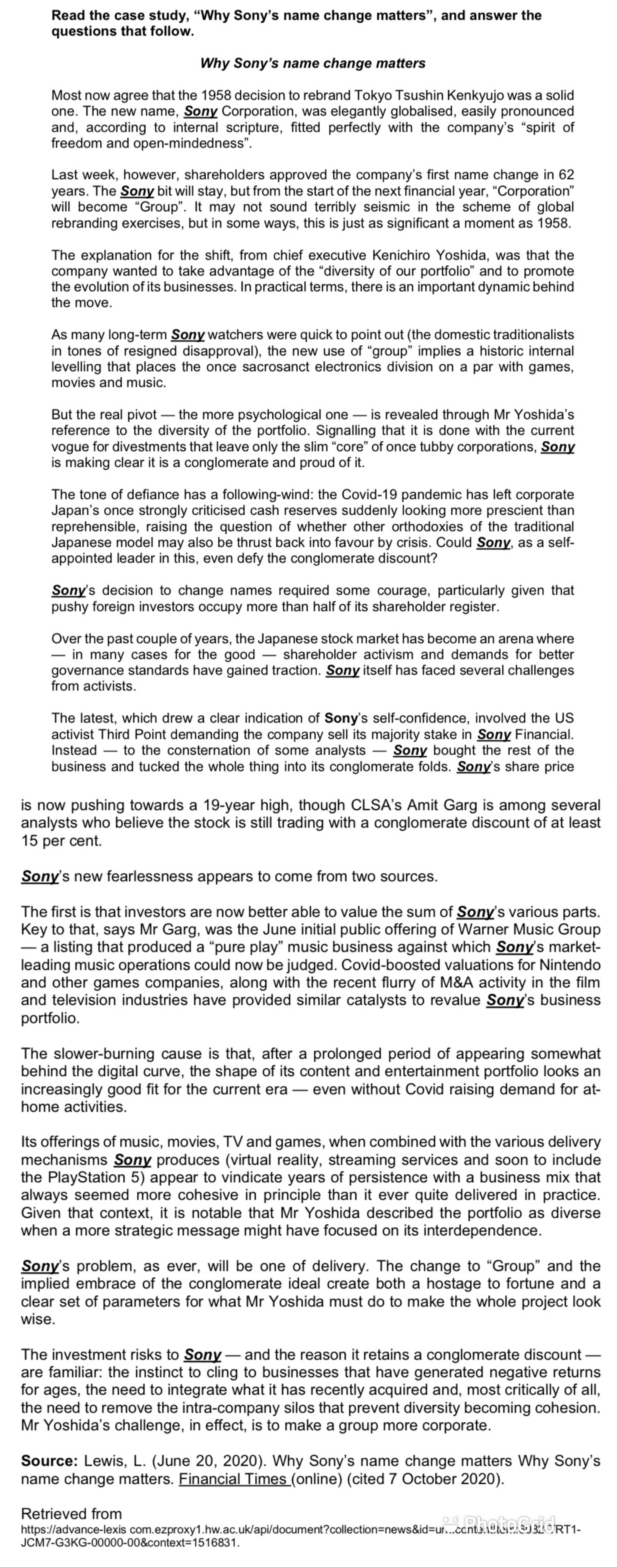
Read the case study, "Why Sony's name change matters", and answer the questions that follow. Why Sony's name change matters Most now agree that the 1958 decision to rebrand Tokyo Tsushin Kenkyujo was a solid one. The new name, My Corporation, was elegantly globalised, easily pronounced and, according to internal scripture, tted perfectly with the company's \"spirit of freedom and open-mindedness". Last week, however, shareholders approved the company's rst name change in 62 years. The My bit will stay, but from the start of the next nancial year, \"Corporation' will become \"Group\". It may not sound terribly seismic in the scheme of global rebranding exercises, but in some ways. this is just as signicant a moment as 1958. The explanation for the shift. from chief executive Kenichiro Yoshida, was that the company wanted to take advantage of the \"diversity of our portfolio" and to promote the evolution of its businesses. In practical terms, there is an important dynamic behind the move. As many long-term Sony watchers were quick to point out (the domestic traditionalists in tones of resigned disapproval), the new use of "group" implies a historic lntemal levelling that places the once sacrosanct electronics division on a par with games, movles and music. But the real pivot the more psychological one is revealed through Mr Yoshida's reference to the diversity of the portfolio. Signalling that it is done with the current vogue for divestments that leave only the slim \"core" of once tubby corporations, My is making clear it is a conglomerate and proud of it. The tone of deance has a following-wind: the Covid-19 pandemic has left corporate Japan's once strongly criticised cash reserves suddenly looking more prescient than reprehensible, raising the question of whether other orthodoxies of the traditional Japanese model may also be thrust back into favour by crisis. Could y, as a self- appointed leader in this, even defy the conglomerate discount? Sonya decision to change names required some courage, particularly given that pushy foreign investors occupy more than half of its shareholder register. Over the past couple of years. the Japanese stock market has become an arena where in many cases for the good shareholder activism and demands for better governance standards have gained traction. Sgny itself has faced several challenges from activists. The latest, which drew a clear indication of Sony's self-condence, involved the US activist Third Point demanding the company sell its majority stake in My Financial. Instead to the consternation of some analysts _o_a_y bought the rest of the business and tucked the whole thing into its conglomerate folds. We share price is now pushing towards a 19year high, though CLSA's Amit Garg is among several analysts who believe the stock is still trading with a conglomerate discount of at least 15 per cent. Sonts new fearlessness appears to come from two sources. The rst is that investors are now better able to value the sum of Ms various parts. Key to that. says Mr Garg, was the June initial public offering of Warner Music Group a listing that produced a \"pure play\" music business against which Sonys market- Ieading music operations could now be judged. Covid-boosted valuations for Nintendo and other games companies, along with the recent flurry of M&A activity in the lm and television industries have provided similar catalysts to revalue Sony's business portfolio. The slower-burning cause is that, after a prolonged period of appearing somewhat behind the digital curve, the shape of its content and entertainment portfolio looks an increasingly good t for the current era even without Covid raising demand for at- home activities. Its offerings of music, movies, TV and games, when combined with the various delivery mechanisms My produces (virtual reality, streaming services and soon to include the PlayStation 5) appear to vindicate years of persistence with a business mix that always seemed more cohesive in principle than it ever quite delivered in practice. Given that context, it is notable that Mr Yoshida described the portfolio as diverse when a more strategic message might have focused on its interdependence. Sonys problem, as ever, will be one of delivery. The change to \"Group" and the implied embrace of the conglomerate ideal create both a hostage to fortune and a clear set of parameters for what Mr Yoshida must do to make the whole project look wise. The investment risks to m and the reason it retains a conglomerate discount are familiar: the instinct to cling to businesses that have generated negative returns for ages, the need to integrate what it has recently acquired and. most critically of all, the need to remove the intra-company silos that prevent diversity becoming cohesion. Mr Yoshida's challenge, in effect, is to make a group more corporate. Source: Lewis, L. (June 20, 2020). Why Sony's name change matters Why Sony's name change matters. nancialj'ilneswnline) (cited 7 October 2020). Retrieved from _ . _ , , httpswadvance-lexls com.ezproxy1.hw.ac.uklaplldocumem?collectbn=news&ld=Lr...ccnt.t'_'b.ii-.:$'J3:!~3.RT1- JCM7-GBKG-00000~00&conte)d=1516331
Step by Step Solution
There are 3 Steps involved in it

Get step-by-step solutions from verified subject matter experts
 Study Help