Question: Based on the case study answer the following questions. The answer to each question should be between 60-80 words. 5. Briefly discuss the changes that
Based on the case study answer the following questions. The answer to each question should be between 60-80 words.
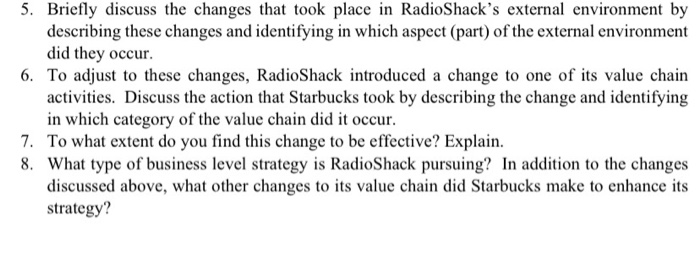
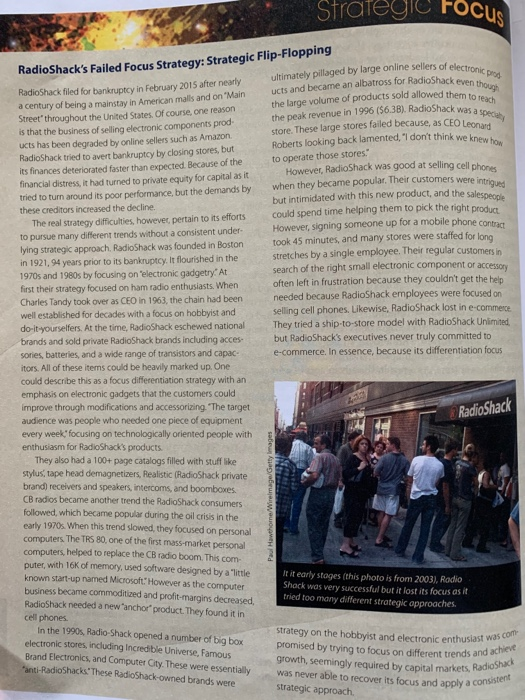
5. Briefly discuss the changes that took place in RadioShack's external environment by describing these changes and identifying in which aspect (part) of the external environment did they occur. 6. To adjust to these changes, RadioShack introduced a change to one of its value chain activities. Discuss the action that Starbucks took by describing the change and identifying in which category of the value chain did it occur. 7. To what extent do you find this change to be effective? Explain. 8. What type of business level strategy is RadioShack pursuing? In addition to the changes discussed above, what other changes to its value chain did Starbucks make to enhance its strategy? Strategic Focus 1 electronics Shack even though ck was a special RadioShack's Failed Focus Strategy: Strategic Flip-Flopping ultimately pillaged by large online sellers of electron RadioShack filed for bankruptcy in February 2015 after nearly ucts and became an albatross for RadioShack a century of being a mainstay in American malls and on "Main the large volume of products sold allowed them to Street' throughout the United States. Of course, one reason the peak revenue in 1996 (56.3B). RadioShack was a is that the business of selling electronic components prod. store. These large stores failed because, as CEO Leonard ucts has been degraded by online sellers such as Amazon Roberts looking back lamented, 'I don't think we knee RadioShack tried to avert bankruptcy by closing stores, but to operate those stores." its finances deteriorated faster than expected. Because of the However, RadioShack was good at selling cell phones financial distress, it had turned to private equity for capital as it when they became popular. Their customers were intri tried to turn around its poor performance, but the demands by but intimidated with this new product, and the salespeone these creditors increased the decline. The real strategy difficulties, however pertain to its efforts could spend time helping them to pick the right product to pursue many different trends without a consistent under- However, signing someone up for a mobile phone contra lying strategic approach. RadioShack was founded in Boston took 45 minutes, and many stores were staffed for long in 1921,94 years prior to its bankruptcy. It flourished in the stretches by a single employee. Their regular customers in 1970s and 1980s by focusing on 'electronic gadgetry. At search of the right small electronic component or accessor first their strategy focused on ham radio enthusiasts. When often left in frustration because they couldn't get the help Charles Tandy took over as CEO in 1963, the chain had been needed because RadioShack employees were focused on well established for decades with a focus on hobbyist and selling cell phones. Likewise, RadioShack lost in e-commerce do-ityourselfers. At the time, RadioShack eschewed national They tried a ship-to-store model with RadioShack Unlimited brands and sold private RadioShack brands including acces but RadioShack's executives never truly committed to sories, batteries, and a wide range of transistors and capac e-commerce. In essence, because its differentiation focus itors. All of these items could be heavily marked up. One could describe this as a focus differentiation strategy with an emphasis on electronic gadgets that the customers could improve through modifications and accessorizing. The target audience was people who needed one piece of equipment every week focusing on technologically oriented people with enthusiasm for RadioShack's products. They also had a 100+ page catalogs filled with stuff like Stylus tape head demagnetizers, Realistic (RadioShack private brand receivers and speakers, intercoms, and boomboxes. CB radios became another trend the RadioShack consumers followed, which became popular during the oil crisis in the RadioShack early 1970s. When this trend slowed, they focused on personal computers. The TRS 80, one of the first mass-market personal computers, helped to replace the CB radio boom. This com puter, with 16 of memory, used software designed by a little known start-up named Microsoft" However as the computer business became commoditized and profit-margins decreased, RadioShack needed a new anchor product. They found it in cell phones. In the 1990s, Radio Shack opened a number of bigbox electronic stores, including Incredible Universe, Famous Brand Electronics, and Computer City. These were essentially anti-RadioShacks. These RadioShack-owned brands were It it early stages (this photo is from 2003). Radio Shock was very successful but it lost its focus as it tried too many different strategic approaches. strategy on the hobbyist and electronic enthusiast was promised by trying to focus on different trends and growth, seemingly required by capital markets, Radio was never able to recover its focus and apply a cons Strategic approach. ends and achieve arkets, RadioShack and apply a consistent









 Study Help