







Question: Based on the case study attached Brief Integrative Case 4.1 IKEA's Global Renovations In late January 2013, Swedish furniture retailer IKEA which he cultivated in
Based on the case study attached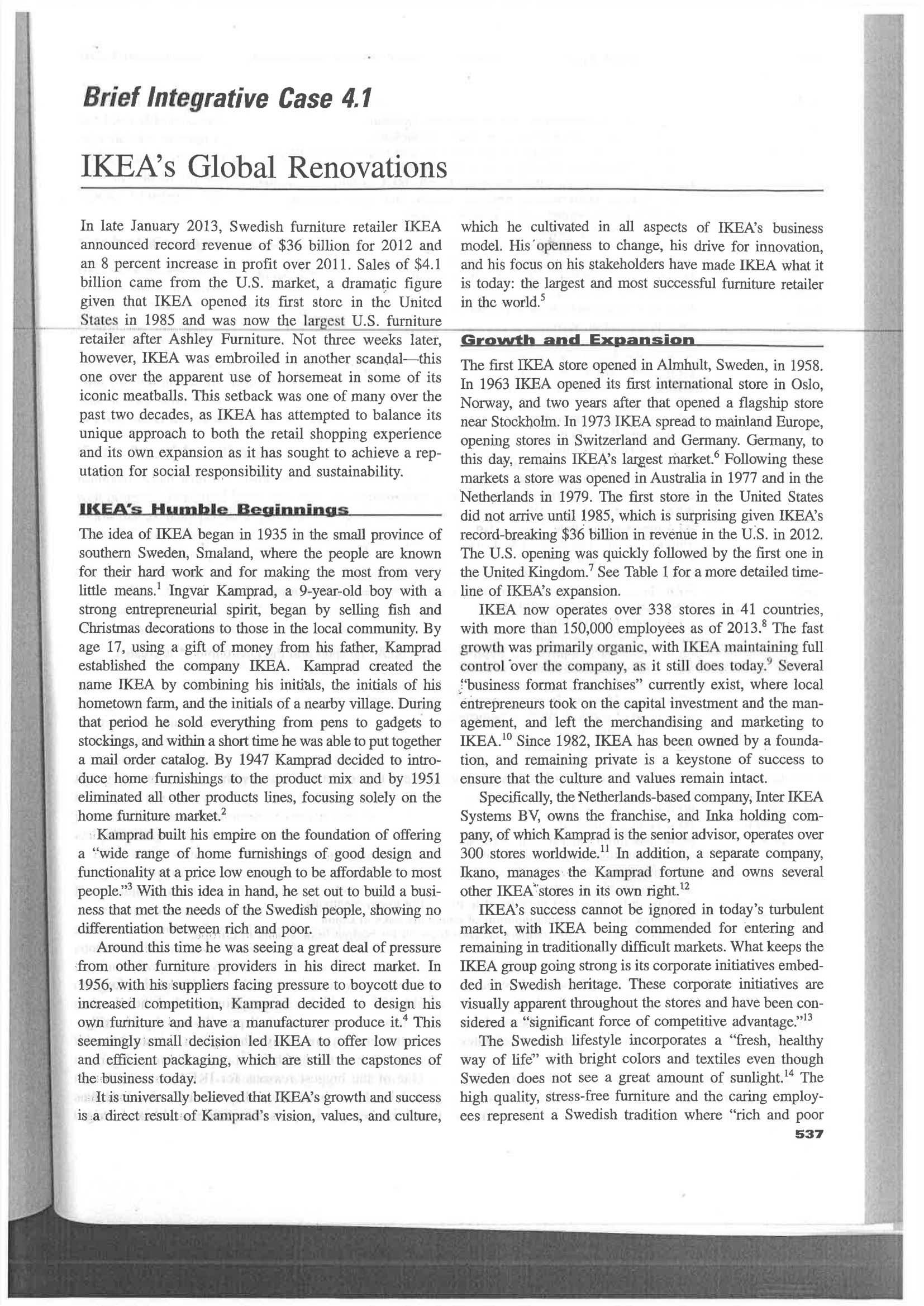
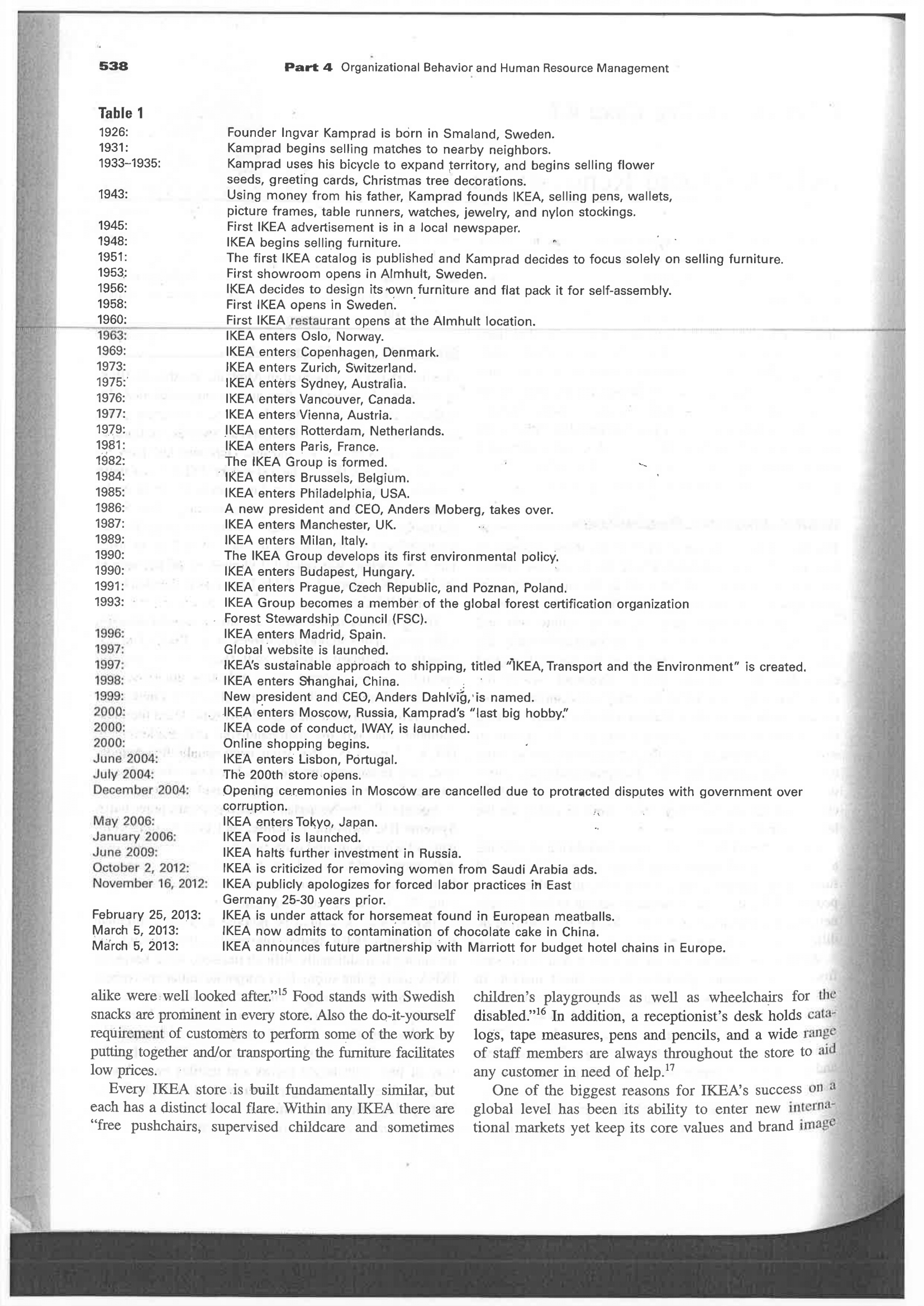
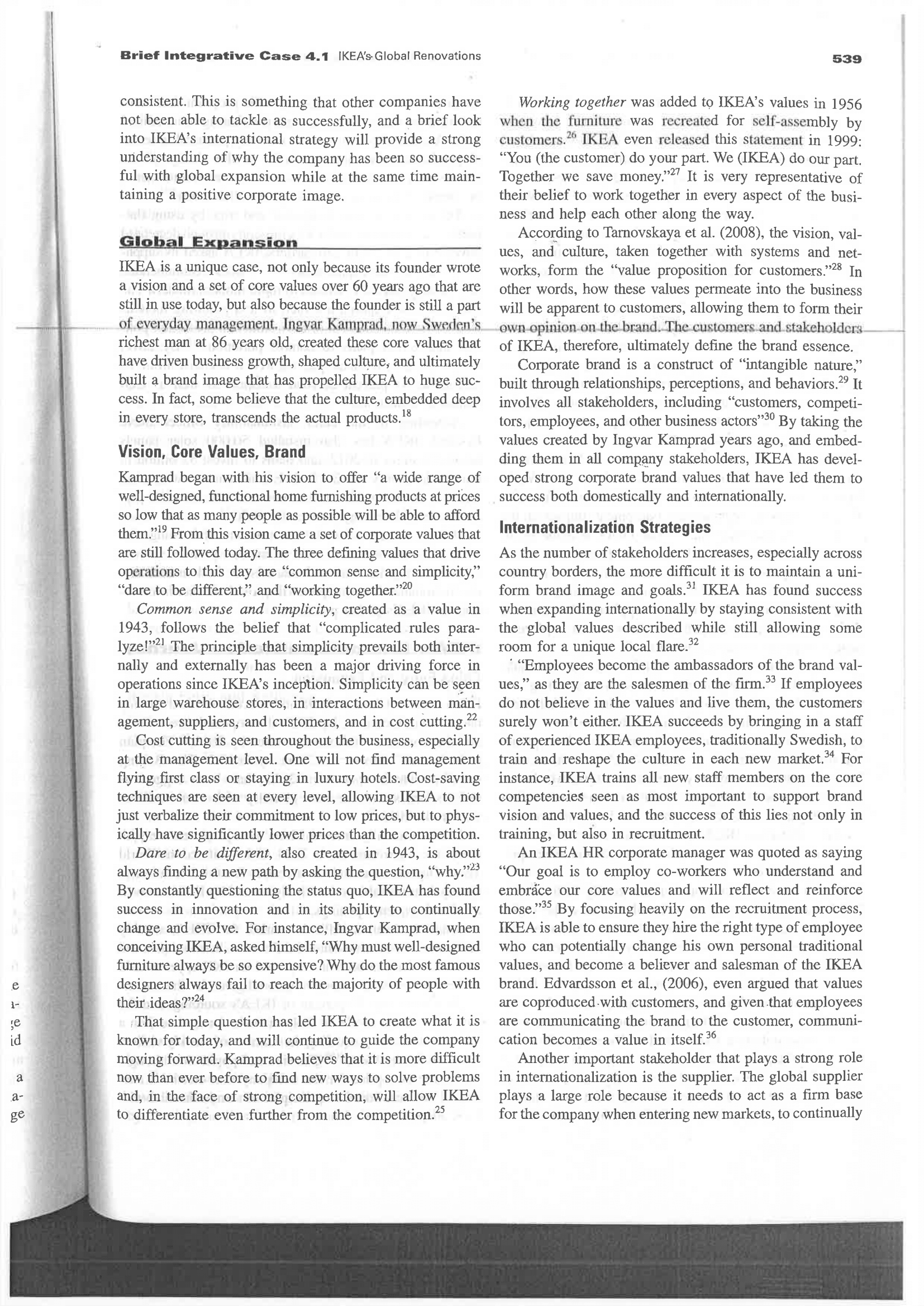
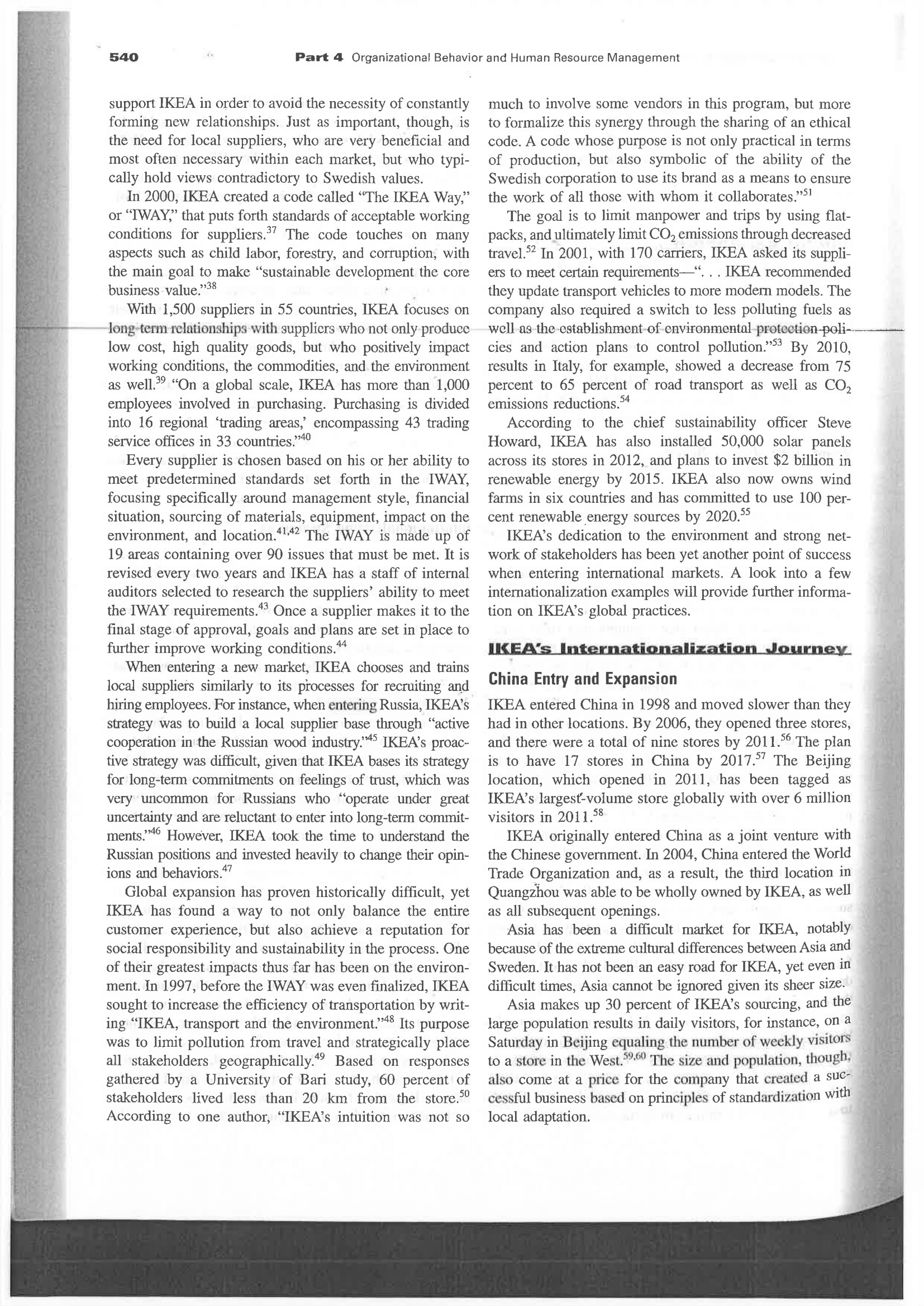
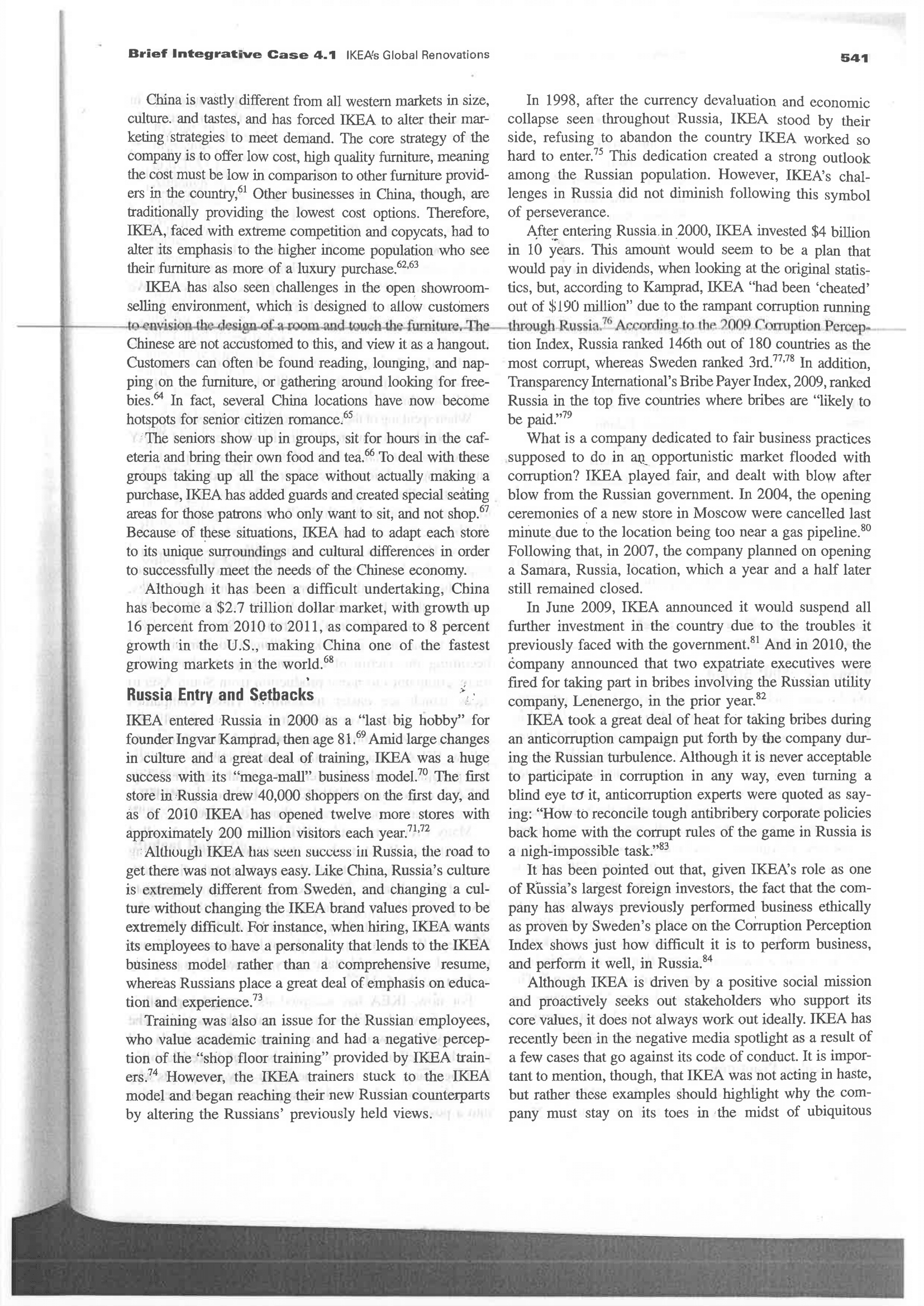
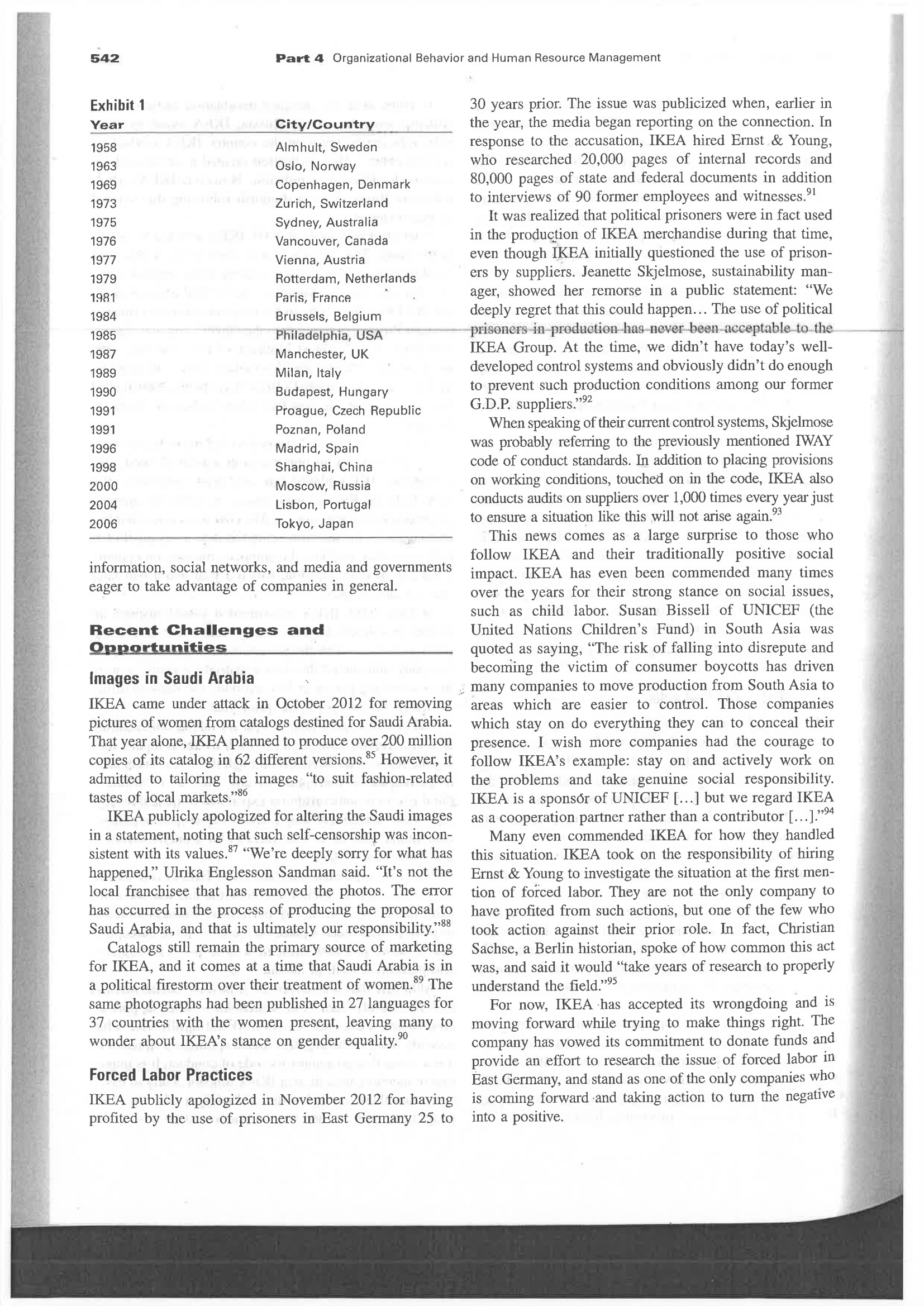
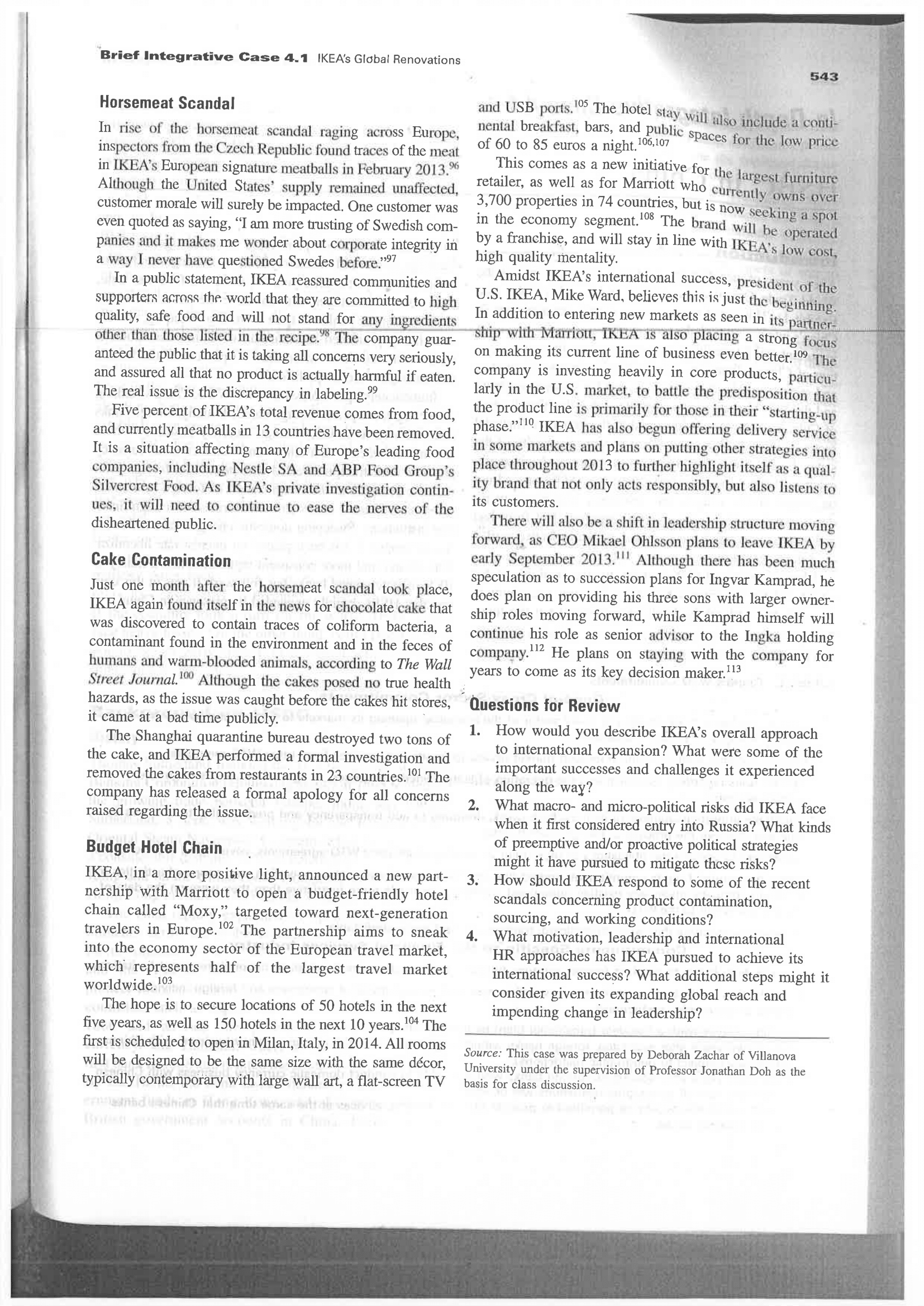
Brief Integrative Case 4.1 IKEA's Global Renovations In late January 2013, Swedish furniture retailer IKEA which he cultivated in all aspects of IKEA's business announced record revenue of $36 billion for 2012 and model. His openness to change, his drive for innovation, an 8 percent increase in profit over 2011. Sales of $4.1 and his focus on his stakeholders have made IKEA what it billion came from the U.S. market, a dramatic figure is today: the largest and most successful furniture retailer given that IKEA opened its first store in the United in the world. States in 1985 and was now the largest U.S. furniture retailer after Ashley Furniture. Not three weeks later, Growth and Expansion however, IKEA was embroiled in another scandal-this one over the apparent use of horsemeat in some of its The first IKEA store opened in Almhult, Sweden, in 1958. iconic meatballs. This setback was one of many over the In 1963 IKEA opened its first international store in Oslo, past two decades, as IKEA has attempted to balance its Norway, and two years after that opened a flagship store unique approach to both the retail shopping experience near Stockholm. In 1973 IKEA spread to mainland Europe, and its own expansion as it has sought to achieve a rep- opening stores in Switzerland and Germany. Germany, to utation for social responsibility and sustainability. this day, remains IKEA's largest market. Following these markets a store was opened in Australia in 1977 and in the IKEA's Humble Beginnings Netherlands in 1979. The first store in the United States did not arrive until 1985, which is surprising given IKEA's The idea of IKEA began in 1935 in the small province of record-breaking $36 billion in revenue in the U.S. in 2012. southern Sweden, Smaland, where the people are known The U.S. opening was quickly followed by the first one in for their hard work and for making the most from very the United Kingdom. See Table 1 for a more detailed time- little means. Ingvar Kamprad, a 9-year-old boy with a line of IKEA's expansion. strong entrepreneurial spirit, began by selling fish and IKEA now operates over 338 stores in 41 countries, Christmas decorations to those in the local community. By with more than 150,000 employees as of 2013. The fast age 17, using a gift of money from his father, Kamprad growth was primarily organic, with IKEA maintaining full established the company IKEA. Kamprad created the control over the company, as it still does today." Several name IKEA by combining his initials, the initials of his "business format franchises" currently exist, where local hometown farm, and the initials of a nearby village. During entrepreneurs took on the capital investment and the man- that period he sold everything from pens to gadgets to agement, and left the merchandising and marketing to stockings, and within a short time he was able to put together IKEA. Since 1982, IKEA has been owned by a founda- a mail order catalog. By 1947 Kamprad decided to intro- tion, and remaining private is a keystone of success to duce home furnishings to the product mix and by 1951 ensure that the culture and values remain intact. eliminated all other products lines, focusing solely on the Specifically, the Netherlands-based company, Inter IKEA home furniture market. Systems BV, owns the franchise, and Inka holding com- Kamprad built his empire on the foundation of offering pany, of which Kamprad is the senior advisor, operates over a "wide range of home furnishings of good design and 300 stores worldwide. "In addition, a separate company, functionality at a price low enough to be affordable to most Ikano, manages the Kamprad fortune and owns several people." With this idea in hand, he set out to build a busi- other IKEA stores in its own right.2 ness that met the needs of the Swedish people, showing no IKEA's success cannot be ignored in today's turbulent differentiation between rich and poor. market, with IKEA being commended for entering and Around this time he was seeing a great deal of pressure remaining in traditionally difficult markets. What keeps the from other furniture providers in his direct market. In IKEA group going strong is its corporate initiatives embed- 1956, with his suppliers facing pressure to boycott due to ded in Swedish heritage. These corporate initiatives are increased competition, Kamprad decided to design his visually apparent throughout the stores and have been con- own furniture and have a manufacturer produce it.* This sidered a "significant force of competitive advantage."13 seemingly small decision led IKEA to offer low prices The Swedish lifestyle incorporates a "fresh, healthy and efficient packaging, which are still the capstones of the business today. way of life" with bright colors and textiles even though Sweden does not see a great amount of sunlight." The It is universally believed that IKEA's growth and success high quality, stress-free furniture and the caring employ- is a direct result of Kamprad's vision, values, and culture, ees represent a Swedish tradition where "rich and poor 537538 Part 4 Organizational Behavior and Human Resource Management Table 1 1926 Founder Ingvar Kamprad is born in Smaland, Sweden. 1931: 1933-1935: Kamprad begins selling matches to nearby neighbors. Kamprad uses his bicycle to expand territory, and begins selling flower seeds, greeting cards, Christmas tree decorations. 1943 Using money from his father, Kamprad founds IKEA, selling pens, wallets, picture frames, table runners, watches, jewelry, and nylon stockings. 1945: First IKEA advertisement is in a local newspaper. 1948: 1951: IKEA begins selling furniture. The first IKEA catalog is published and Kamprad decides to focus solely on selling furniture. 1953: First showroom opens in Almhult, Sweden. 1956: IKEA decides to design its own furniture and flat pack it for self-assembly. 1958: First IKEA opens in Sweden. 1960: First IKEA restaurant opens at the Almhult location. 1963: IKEA enters Oslo, Norway. 1969: 1973: IKEA enters Copenhagen, Denmark. IKEA enters Zurich, Switzerland. 1975: IKEA enters Sydney, Australia. 1976: IKEA enters Vancouver, Canada. 1977: IKEA enters Vienna, Austria. 1979: IKEA enters Rotterdam, Netherlands. 1982: IKEA enters Paris, France. 1984 The IKEA Group is formed. IKEA enters Brussels, Belgium. 1985 IKEA enters Philadelphia, USA. 1986 A new president and CEO, Anders Moberg, takes over. 1987: IKEA enters Manchester, UK. 1989: 1990: IKEA enters Milan, Italy. The IKEA Group develops its first environmental policy. 1990 IKEA enters Budapest, Hungary. 1991: IKEA enters Prague, Czech Republic, and Poznan, Poland. 1993: IKEA Group becomes a member of the global forest certification organization Forest Stewardship Council (FSC). 1996: IKEA enters Madrid, Spain. 1997 Global website is launched. 1997 IKEA's sustainable approach to shipping, titled "IKEA, Transport and the Environment" is created. 1998 IKEA enters Shanghai, China. 1999 New president and CEO, Anders Dahlvig, is named. 2000 IKEA enters Moscow, Russia, Kamprad's "last big hobby." 2000: 2000: IKEA code of conduct, IWAY, is launched. Online shopping begins. June 2004: IKEA enters Lisbon, Portugal. July 2004: The 200th store opens. December 2004: Opening ceremonies in Moscow are cancelled due to protracted disputes with government over corruption. May 2006: IKEA enters Tokyo, Japan. January 2006: IKEA Food is launched. June 2009: KEA halts further investment in Russia. October 2, 2012: KEA is criticized for removing women from Saudi Arabia ads. November 16, 2012: IKEA publicly apologizes for forced labor practices in East Germany 25-30 years prior. February 25, 2013: March 5, 2013: IKEA is under attack for horsemeat found in European meatballs. March 5, 2013: IKEA now admits to contamination of chocolate cake in China. IKEA announces future partnership with Marriott for budget hotel chains in Europe. alike were well looked after." Food stands with Swedish children's playgrounds as well as wheelchairs for the snacks are prominent in every store. Also the do-it-yourself disabled." In addition, a receptionist's desk holds cata- requirement of customers to perform some of the work by logs, tape measures, pens and pencils, and a wide range putting together and/or transporting the furniture facilitates of staff members are always throughout the store to aid low prices. any customer in need of help.17 Every IKEA store is built fundamentally similar, but One of the biggest reasons for IKEA's success on a each has a distinct local flare. Within any IKEA there are global level has been its ability to enter new interna- "free pushchairs, supervised childcare and sometimes tional markets yet keep its core values and brand image_-_1~AJ.\\'2 Brief Integrative case 4.1 lKEA'eGlobal Renovations consistent. This is something that other companies haVe not been able to tackle as successfully, and a brief look into IKEA's international strategy will provide a strong understanding of why the company has been so success- ful with global expansion while at the same time main taining a positive corporate image. Magma. IKEA is a unique case, not only because its founder wrote a vision and a set of core values over 60 years ago that are still in use today, but also because the founder is still a part ofcveryday management. Ingvar Kamprarl..nowwrnett's richest man at 86 years old, created these core values that have driven business growth, shaped culture, and ultimately built a brand image that has propelled IKEA to huge suc cess. In fact, some believe that the culture, embedded deep in every store, transcends the actual products.13 Vision, Core Values, Brand Kamprad began with his vision to offer \"a wide range of well-designed, funcu'onal home furnishing products at prices so low that as many people as possible will be able to afford them.\"19 From this Vision came a set of corporate values that are still followed today. The three dening values that drive operations to this day are \"common sense and simplicity," \"dare to be different,'? and \"working together.\"20 Common sense and simplicity, created as a value in 1943, follows the belief that \"complicated rules para lyzel'm The principle that simplicity prevails both inter- nally and externally has been a major driving force in operations since IKEA's inception. Simplicity can be seen in large warehouse stores, in interactions between man- agement, suppliers, and customers, and in cost cutting.22 Cost cutting is seen throughout the business, especially at the management level. One will not nd management ying first class or staying in luxury hotels. Cost-saving techniques are seen at every level, alloWing IKEA to not just verbalize their commitment to low prices, but to phys- ically have signicantly lower prices than the competition. Dare 'to be different, also created in 1943, is about always nding a new path by asking the question, \"why?\"3 By constantly questioning the status quo, IKEA has found success in innovation and in its ability to continually change and evolve. For instance, Ingvar Kamprad, when conceiving IKEA, asked himself, \"Why must well-designed furniture always be so expensive? Why do the most famous designers always fail to reach the majority of people with their ideas?\"24 .That simple question has led IKEA to create what it is known for today, and will continue to guide the company moving forward. Kamprad believes that it is more difcult now than ever before to nd new ways to solve problems and, in the face of strong competition, will allow IKEA to differentiate even further from the competition.15 539 Working together was added to IKEA's values in 1956 when the furniture was recreated for self-assembly by customers.\"5 IKEA even released this statement in 1999: \"You (the customer) do your part. We (IKEA) do our part, Together we save money.\"27 It is very representatiVe 01' their belief to work together in every aspect of the busi ness and help each other along the way. According to Tamovskaya et a]. (2008), the vision, val- ues, and culture, taken together with systems and net works, form the \"value proposition for customers?\" In other words, how these values permeate into the business will be apparent to customers, allowing them to form their of IKEA, therefore, ultimately dene the brand essence. Corporate brand is a construct of \"intangible nature,\" built through relationships, perceptions, and behaviors.29 It involves all stakeholders, including \"customers, competi- tors, employees, and other business actors\"0 By taking the values created by Ingvar Kamprad years ago, and embed- ding them in all company stakeholders, IKEA has devel- oped strong corporate brand values that have led them to success both domestically and internationally. Internationalization Strategies As the number of stakeholders increases, especially across country borders, the more difcult it is to maintain a uni- form brand image and goals.\" IKEA has found success when expanding internationally by staying consistent with the global values described while still allowing some room for a unique local are.32 ' \"Employees become the ambassadors of the brand val ues,\" as they are the salesmen of the rm.33 If employees do not believe in the values and live them, the customers surely won't either. IKEA succeeds by bringing in a staff of experienced IKEA employees, traditionally Swedish, to train and reshape the culture in each new market.\" For instance, IKEA trains all new staff members on the core competencies seen as most important to support brand vision and values, and the success of this lies not only in training, but also in recruitment. An IKEA HR corporate manager was quoted as saying \"Our goal is to employ co-workers who understand and embrace our core values and will reect and reinforce those?\" By focusing heavily on the recruitment process, IKEA is able to ensure they hire the right type of employee who can potentially change his own personal traditional values, and become a believer and salesman of the IKEA brand. Edvardsson et a1., (2006), even argued that values are coproduced-with customers, and giventhat employees are communicating the brand to the customer, communi- cation becomes a value in itself.36 Another important stakeholder that plays a strong role in internationalization is the supplier. The global supplier plays a large role because it needs to act as a rm base for the company when entering new markets, to continually -tnot:u.tnatpiniorton.tliehrand..112l:ttmusturner:and.staleelmldera_"E '540 support IKEA in order to avoid the necessity of constantly forming new relationships. Just as important, though, is the need for local suppliers, who are very benecial and most often necessary within each market, but who typi cally hold views contradictory to Swedish values. In 2000, IKEA created a code called \"The IKEA Way,\" or \"IWA that puts forth standards of acceptable working conditions for suppliers.\" The code touches on many aspects such as child labor, forestry, and corruption, with the main goal to make \"sustainable development the core business value.\"38 * . With 1,500 suppliers in 55 countries, IKEA focuses on longetcrmrelntionships with suppliers who not only produce low cost, high quality goods, but who positively impact working condiu'ons, the commodities, and the environment as well.\" \"On a global scale, IKEA has more than 1,000 employees involved in purchasing. Purchasing is divided into 16 regional 'trading areas,' encompassing 43 trading service offices in 33 countries?\" Every supplier is chosen based on his or her ability to meet predetermined standards set forth in the IWAY, focusing specically around management style, nancial situation, sourcing of materials, equipment, impact on the environment, and location.\"42 The IWAY is made up of 19 areas containing ever 90 issues that must be met. It is revised every two years and IKEA has a $1311\" of internal auditors selected to research the suppliers' ability to meet the IWAY requirements.'13 Once a supplier makes it to the nal stage of approval, goals and plans are set in place to further improve working conditions.M When entering a new market, IKEA chooses and trains local suppliers similarly to its processes for recruiting and hiring employees. For instance, when entering Russia, IKEA's strategy was to build a local supplier base through "active cooperation in the Russian wood industry?\" IKEA's proac tive strategy was di'icult, given that HCEA bases its strategy for long-term commitments on feelings of trust, which was very uncommon for Russians who \"operate under great uncertainty and are reluctant to enter into long-term commit- ments.\"46 However, IKEA took the time to understand the Russian positions and invested heavily to change their opin ions and behaviors.47 Global expansion has proven historically difcult, yet IKEA has found a way to not only balance the entire customer experience, but also achieve a reputation for social responsibility and sustainability in the process. One of their greatest impacts thus far has been on the environ- ment. In 1997, before the IWAY was even nalized, IKEA sought to increase the efciency of transportation by writ- ing \"IKEA, transport and the environment.\"48 Its purpose was to limit pollution from travel and strategically place all stakeholders geographically.\"9 Based on responses gathered by a University of Bari study, 60 percent of stakeholders lived less than 20 km from the stored0 According to one author, \"IKEA's intuition was not so Part 4 Organizational Behavior and Human Resource Management much to involve some vendors in this program, but more to formalize this synergy through the sharing of an ethical code. A code whose purpose is not only practical in terms of production, but also symbolic of the ability of the Swedish corporation to use its brand as a means to ensure the work of all those with whom it collaborates?\" The goal is to limit manpower and trips by using at packs, and ultimately limit C02 emissions through decreased travel.52 In 2001, with 170 carriers, IKEA asked its suppli- ers to meet certain requirements\". . . IKEA recommended they update transport vehicles to more modern models. The company also required a switch to less polluting fuels as well as tho-establishment-of onvironmental-preteetrenpoli-w cies and action plans to control pollution.\"53 By 2010, results in Italy, for example, showed a decrease from 75 percent to 65 percent of road transport as well as CO2 emissions reductions.54 According to the chief sustainability ofcer Steve Howard, IKEA has also installed 50,000 solar panels across its stores in 2012, and plans to invest $2 billion in renewabie energy by 2015. IKEA also now owns wind farms in six countries and has committed to use 100 per- cent renewable _energy sources by 2020.55 IKEA's dedication to the environment and strong net- work of stakeholders has been yet another point of Success when entering international markets. A look into a few internationalization examples will provide further informa- tion on lKEA's global practices. mam-54mm China Entry and Expansion IKEA entered China in 1998 and moved slower than they had in other locations. By 2006, they opened three stores, and there were a total of nine stores by 2011.56 The plan is to have 17 stores in China by 2017.57 The Beijing location, which opened in 2011, has been tagged as IKEA's largest-volume store globally with over 6 million visitors in 2011.53 IKEA originally entered China as a joint venture with the Chinese government. In 2004, China entered the World Trade Organization and, as a result, the third location in Quangihou was able to be wholly owned by IKEA, as well as all subsequent openings. Asia has been a difcult market for IKEA, notably because of the extreme cultural differences between Asia and _ Sweden. It has not been an easy road for IKEA, yet even in difcult times, Asia cannot be ignored given its sheer size. Asia makes up 30 percent of IKEA's sourcing, and the large population results in daily visitors, for instance, on a. , Saturday in Beijing equaling the number of weekly visitors to a store in the West.\"\"'0 The size and populau'on, though; i also come at a price for the company that created a Slfc" cessful business based 0n principles of standardization wrth ' local adaptation. ' Brief Integrative Case 4.1 IKEA's Global Renovations 541 China is vastly different from all western markets in size, In 1998, after the currency devaluation and economic culture. and tastes, and has forced IKEA to alter their mar- keting strategies to meet demand. The core strategy of the collapse seen throughout Russia, IKEA stood by their side, refusing to abandon the country IKEA worked so company is to offer low cost, high quality furniture, meaning hard to enter." This dedication created a strong outlook the cost must be low in comparison to other furniture provid- among the Russian population. However, IKEA's chal- ers in the country, Other businesses in China, though, are lenges in Russia did not diminish following this symbol traditionally providing the lowest cost options. Therefore, IKEA, faced with extreme competition and copycats, had to of perseverance. After entering Russia in 2000, IKEA invested $4 billion alter its emphasis to the higher income population who see their furniture as more of a luxury purchase. 62,63 in 10 years. This amount would seem to be a plan that would pay in dividends, when looking at the original statis- IKEA has also seen challenges in the open showroom- tics, but, according to Kamprad, IKEA "had been 'cheated' selling environment, which is designed to allow customers out of $190 million" due to the rampant corruption running to envision the design of a room and touch the furniture. The through Russia." According to the 2009 Corruption Percep- Chinese are not accustomed to this, and view it as a hangout. tion Index, Russia ranked 146th out of 180 countries as the Customers can often be found reading, lounging, and nap- ping on the furniture, or gathering around looking for free- most corrupt, whereas Sweden ranked 3rd." In addition, bies.4 In fact, several China locations have now become Transparency International's Bribe Payer Index, 2009, ranked Russia in the top five countries where bribes are "likely to hotspots for senior citizen romance. be paid."79 The seniors show up in groups, sit for hours in the caf- What is a company dedicated to fair business practices eteria and bring their own food and tea. To deal with these supposed to do in an opportunistic market flooded with groups taking up all the space without actually making a corruption? IKEA played fair, and dealt with blow after purchase, IKEA has added guards and created special seating areas for those patrons who only want to sit, and not shop." blow from the Russian government. In 2004, the opening ceremonies of a new store in Moscow were cancelled last Because of these situations, IKEA had to adapt each store minute due to the location being too near a gas pipeline. 80 to its unique surroundings and cultural differences in order Following that, in 2007, the company planned on opening to successfully meet the needs of the Chinese economy. Although it has been a difficult undertaking, China a Samara, Russia, location, which a year and a half later still remained closed. has become a $2.7 trillion dollar market, with growth up In June 2009, IKEA announced it would suspend all 16 percent from 2010 to 2011, as compared to 8 percent further investment in the country due to the troubles it growth in the U.S., making China one of the fastest previously faced with the government. And in 2010, the growing markets in the world. 68 company announced that two expatriate executives were Russia Entry and Setbacks fired for taking part in bribes involving the Russian utility company, Lenenergo, in the prior year.82 IKEA entered Russia in 2000 as a "last big hobby" for IKEA took a great deal of heat for taking bribes during founder Ingvar Kamprad, then age 81." Amid large changes an anticorruption campaign put forth by the company dur- in culture and a great deal of training, IKEA was a huge ing the Russian turbulence. Although it is never acceptable success with its "mega-mall" business model." The first to participate in corruption in any way, even turning a store in Russia drew 40,000 shoppers on the first day, and blind eye to it, anticorruption experts were quoted as say- as of 2010 IKEA has opened twelve more stores with ing: "How to reconcile tough antibribery corporate policies approximately 200 million visitors each year. 1,12 back home with the corrupt rules of the game in Russia is Although IKEA has seen success in Russia, the road to a nigh-impossible task."83 get there was not always easy. Like China, Russia's culture It has been pointed out that, given IKEA's role as one is extremely different from Sweden, and changing a cul- of Russia's largest foreign investors, the fact that the com- ture without changing the IKEA brand values proved to be pany has always previously performed business ethically extremely difficult. For instance, when hiring, IKEA wants as proven by Sweden's place on the Corruption Perception its employees to have a personality that lends to the IKEA Index shows just how difficult it is to perform business, business model rather than a comprehensive resume, and perform it well, in Russia.4 whereas Russians place a great deal of emphasis on educa- Although IKEA is driven by a positive social mission tion and experience." and proactively seeks out stakeholders who support its Training was also an issue for the Russian employees, core values, it does not always work out ideally. IKEA has who value academic training and had a negative percep- recently been in the negative media spotlight as a result of tion of the "shop floor training" provided by IKEA train- a few cases that go against its code of conduct. It is impor- ers."4 However, the IKEA trainers stuck to the IKEA tant to mention, though, that IKEA was not acting in haste, model and began reaching their new Russian counterparts but rather these examples should highlight why the com- by altering the Russians' previously held views. pany must stay on its toes in the midst of ubiquitous542 Part 4 Organizational Behavior and Human Resource Management Exhibit 1 30 years prior. The issue was publicized when, earlier in Year City/Country the year, the media began reporting on the connection. In 1958 Almhult, Sweden response to the accusation, IKEA hired Ernst & Young, 1963 Oslo, Norway who researched 20,000 pages of internal records and 1969 Copenhagen, Denmark 80,000 pages of state and federal documents in addition 1973 Zurich, Switzerland to interviews of 90 former employees and witnesses." 1975 Sydney, Australia It was realized that political prisoners were in fact used 1976 Vancouver, Canada in the production of IKEA merchandise during that time, 1977 Vienna, Austria even though IKEA initially questioned the use of prison- 1979 Rotterdam, Netherlands ers by suppliers. Jeanette Skjelmose, sustainability man- 1981 Paris, France ager, showed her remorse in a public statement: "We 1984 Brussels, Belgium deeply regret that this could happen... The use of political 1985 Philadelphia, USA prisoners in production has never been acceptable to the 1987 Manchester, UK IKEA Group. At the time, we didn't have today's well- 1989 Milan, Italy developed control systems and obviously didn't do enough 1990 Budapest, Hungary to prevent such production conditions among our former 1991 Proague, Czech Republic G.D.P. suppliers."92 1991 Poznan, Poland When speaking of their current control systems, Skjelmose 1996 Madrid, Spain was probably referring to the previously mentioned IWAY 1998 Shanghai, China code of conduct standards. In addition to placing provisions 2000 Moscow, Russia on working conditions, touched on in the code, IKEA also 2004 Lisbon, Portugal conducts audits on suppliers over 1,000 times every year just 2006 Tokyo, Japan to ensure a situation like this will not arise again.93 This news comes as a large surprise to those who information, social networks, and media and governments follow IKEA and their traditionally positive social eager to take advantage of companies in general. impact. IKEA has even been commended many times over the years for their strong stance on social issues, such as child labor. Susan Bissell of UNICEF (the Recent Challenges and Opportunities United Nations Children's Fund) in South Asia was quoted as saying, "The risk of falling into disrepute and Images in Saudi Arabia becoming the victim of consumer boycotts has driven IKEA came under attack in October 2012 for removing many companies to move production from South Asia to pictures of women from catalogs destined for Saudi Arabia. areas which are easier to control. Those companies That year alone, IKEA planned to produce over 200 million which stay on do everything they can to conceal their copies of its catalog in 62 different versions. However, it presence. I wish more companies had the courage to follow IKEA's example: stay on and actively work on admitted to tailoring the images "to suit fashion-related tastes of local markets."86 the problems and take genuine social responsibility. IKEA publicly apologized for altering the Saudi images IKEA is a sponsor of UNICEF [.. .] but we regard IKEA in a statement, noting that such self-censorship was incon- as a cooperation partner rather than a contributor [... ]."94 Many even commended IKEA for how they handled sistent with its values. "We're deeply sorry for what has this situation. IKEA took on the responsibility of hiring happened," Ulrika Englesson Sandman said. "It's not the local franchisee that has removed the photos. The error Ernst & Young to investigate the situation at the first men- has occurred in the process of producing the proposal to tion of forced labor. They are not the only company to Saudi Arabia, and that is ultimately our responsibility." have profited from such actions, but one of the few who took action against their prior role. In fact, Christian Catalogs still remain the primary source of marketing Sachse, a Berlin historian, spoke of how common this act for IKEA, and it comes at a time that Saudi Arabia is in a political firestorm over their treatment of women. The was, and said it would "take years of research to properly understand the field."95 same photographs had been published in 27 languages for For now, IKEA has accepted its wrongdoing and is 37 countries with the women present, leaving many to wonder about IKEA's stance on gender equality.90 moving forward while trying to make things right. The company has vowed its commitment to donate funds and Forced Labor Practices provide an effort to research the issue of forced labor in East Germany, and stand as one of the only companies who IKEA publicly apologized in November 2012 for having is coming forward and taking action to turn the negative profited by the use of prisoners in East Germany 25 to into a positive.Brief Integrative Case 4.1 IKEA's Global Renovations 543 Horsemeat Scandal and USB ports. The hotel stay will also include a conti- In rise of the horsemeat scandal raging across Europe, nental breakfast, bars, and public spaces for the low price inspectors from the Czech Republic found traces of the meat of 60 to 85 euros a night. 106,107 in IKEA's European signature meatballs in February 2013.96 Although the United States' supply remained unaffected, This comes as a new initiative for the largest furniture retailer, as well as for Marriott who currently owns over customer morale will surely be impacted. One customer was 3,700 properties in 74 countries, but is now seeking a spot even quoted as saying, "I am more trusting of Swedish com- in the economy segment. The brand will be operated panies and it makes me wonder about corporate integrity in by a franchise, and will stay in line with IKEA's low cost, a way I never have questioned Swedes before."97 high quality mentality. In a public statement, IKEA reassured communities and Amidst IKEA's international success, president of the supporters across the world that they are committed to high U.S. IKEA, Mike Ward, believes this is just the beginning. quality, safe food and will not stand for any ingredients In addition to entering new markets as seen in its partner. other than those listed in the recipe." The company guar- ship with Marriott, IKEA is also placing a strong focus anteed the public that it is taking all concerns very seriously, on making its current line of business even better.109 The and assured all that no product is actually harmful if eaten. company is investing heavily in core products, particu- The real issue is the discrepancy in labeling."9 larly in the U.S. market, to battle the predisposition that Five percent of IKEA's total revenue comes from food, the product line is primarily for those in their "starting-up and currently meatballs in 13 countries have been removed. phase." IKEA has also begun offering delivery service It is a situation affecting many of Europe's leading food in some markets and plans on putting other strategies into companies, including Nestle SA and ABP Food Group's place throughout 2013 to further highlight itself as a qual- Silvercrest Food. As IKEA's private investigation contin- ity brand that not only acts responsibly, but also listens to ues, it will need to continue to ease the nerves of the its customers. disheartened public. There will also be a shift in leadership structure moving forward, as CEO Mikael Ohlsson plans to leave IKEA by Cake Contamination early September 2013." Although there has been much Just one month after the horsemeat scandal took place, speculation as to succession plans for Ingvar Kamprad, he IKEA again found itself in the news for chocolate cake that does plan on providing his three sons with larger owner- was discovered to contain traces of coliform bacteria, a ship roles moving forward, while Kamprad himself will contaminant found in the environment and in the feces of continue his role as senior advisor to the Ingka holding humans and warm-blooded animals, according to The Wall company. He plans on staying with the company for Street Journal. Although the cakes posed no true health years to come as its key decision maker. 113 hazards, as the issue was caught before the cakes hit stores, Questions for Review it came at a bad time publicly. The Shanghai quarantine bureau destroyed two tons of 1. How would you describe IKEA's overall approach the cake, and IKEA performed a formal investigation and to international expansion? What were some of the removed the cakes from restaurants in 23 countries. The important successes and challenges it experienced company has released a formal apology for all concerns along the way? raised regarding the issue. 2. What macro- and micro-political risks did IKEA face when it first considered entry into Russia? What kinds Budget Hotel Chain of preemptive and/or proactive political strategies IKEA, in a more positive light, announced a new part- might it have pursued to mitigate these risks? nership with Marriott to open a budget-friendly hotel 3. How should IKEA respond to some of the recent chain called "Moxy," targeted toward next-generation scandals concerning product contamination, sourcing, and working conditions? travelers in Europe. The partnership aims to sneak into the economy sector of the European travel market, 4. What motivation, leadership and international which represents half of the largest travel market HR approaches has IKEA pursued to achieve its worldwide. 103 international success? What additional steps might it The hope is to secure locations of 50 hotels in the next consider given its expanding global reach and five years, as well as 150 hotels in the next 10 years. 104 The impending change in leadership? first is scheduled to open in Milan, Italy, in 2014. All rooms will be designed to be the same size with the same decor, Source: This case was prepared by Deborah Zachar of Villanova typically contemporary with large wall art, a flat-screen TV University under the supervision of Professor Jonathan Doh as the basis for class discussion
Step by Step Solution
There are 3 Steps involved in it

Get step-by-step solutions from verified subject matter experts
 Study Help