Question: based on the case study below, provide fresh and detailed answers for the below questions: a) suppliers of key materials (i.e., Tyvek). Which supply chain
based on the case study below, provide fresh and detailed answers for the below questions:
a) suppliers of key materials (i.e., Tyvek). Which supply chain partners are upstream of LeapFrog? Which are downstream? Which partners are first-tier suppliers? Second-tier suppliers?
b) What were some of the material sourcing challenges Leap-Frog and Capable Toys faced? How did they resolve these problems?
c) What are the strengths and weaknesses of these solutions? If it had been August rather than December, what other options might LeapFrog have used?
*please provide answers quickly
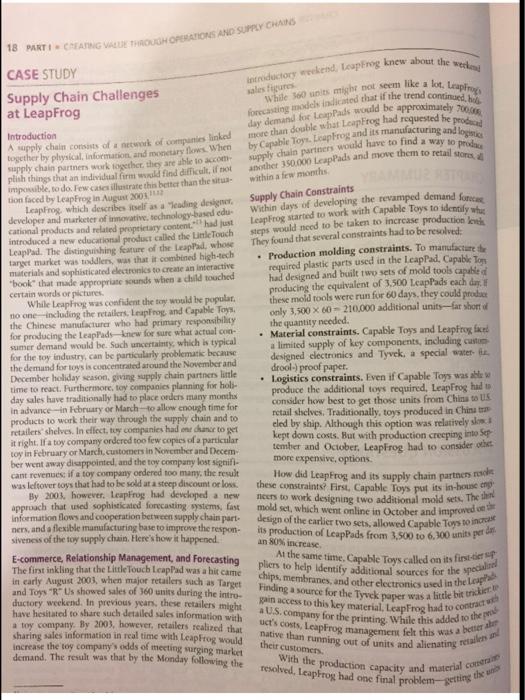
18 PARTICHEANG VALUE THROUGH OPRANONS AND SUPPLY CHAINS les figures Introductory weekend LeapFrog knew about the wees While 160 unit is not seem like a lot. Leping forecasting models indicated that if the trend continued more than double what Leapfrog had requested he pod day demand for Leap Pads would be approacimately 700.00 supply chain partners would have to find a way to produce by Capable Toys LeapFrog and its manufacturing and logistic another 350.000 Leap Pads and move them to retail stores, within a few months Supply Chain Constraints CASE STUDY Supply Chain Challenges at LeapFrog Introduction A apply chain consists of a network of companies linked together by ploysical information and mentary blows. When supply chain partners work together, they are able to acco plish things that an individual form wad find difficult, if not impossible to do Few cases illustrate this better than the situ tion faced by LeapFrog in August 2013 Leapfrog, which describes itself as a leading designer developer and marketer of imovative technology-based edu cational products and related proprietary content. had just introduced a new educational product called the LineTouch LeapPad. The distinguishing feature of the leapad whose target market was toddlers, was that it combined high-tech materials and sophisticated electronics to create an interactive "book that made appropriate sounds when a child touched certain words or pictures While Leapfrog was confident the toy would be popular no one-Including the retailers. Leapfrog, and Capable Toys the Chinese manufacturer who had primary responsibility for producing the leapPads knew for sure what actual sumer demand would be. Such uncertainty, which is typical for the toy industry, can be particularly problematic because the demand for boys is concentrated around the November and December holiday season, giving supply chain partners little time to react. Furthermore, toy companies planning for hols- day sales have traditionally had to place orders many months in advance-in February or March to allow enough time for products to work their way through the supply chain and to retailers shelves. In effect, toy companies had one damer to get it right. If a toy company ordered too few copies of a particular toy in February or March.customers in November and Decem ber went away diuppointed and the toy company lost signifi- cant revenues if a toy company ordered too many, the result was leftover toys that had to be sold at a steep discount or loss. By 2003, however. LeapFrog had developed a new approach that used sophisticated forecasting systems, fast information flows and cooperation between supply chain part- ners, and a flexible manufacturing base to improve the respon- siveness of the toy supply chain. Here's how it happened. E-commerce, Relationship Management, and Forecasting The first inkling that the Little Touch Leapad was a hit came in early August 2001, when major retailers such as Target and Toys"R"Us showed sales of 360 units during the intro ductory weekend. In previous years, these retailers might have hesitated to share such detailed sales information with a toy company. By 2003, however, retailers realized that sharing sales information in real time with LeapFrog would increase the toy company odds of meeting sarging market demand. The result was that by the Monday following the Within days of developing the revamped demand forecast LeapFrog started to work with Capable Toys to identify who steps would need to be taken to increase production link They found that several constraints had to be resolved: Production molding constraints. To manufactures required plastic parts used in the leappad. Capable Ton had designed and built two sets of mold tools capable de producing the equivalent of 3.500 LeapPads cach duri these mold tools were run for 60 days, they could probar only 3.500 X 60 - 210.000 additional units-far short the quantity needed. Material constraints. Capable Toys and Leapfrog fard a limited supply of key components, including custom designed electronics and Tyvek, a special water drool-proof paper, Logistics constraints. Even if Capable Toys was able w produce the additional toys required, LeapFrog had consider how best to get those units from China to US retail shelves. Traditionally, toys produced in China cled by ship. Although this option was relatively slow kept down costs. But with production creeping into Sep tember and October. LeapFrog had to considerohet more expensive, options. How did LeapFrog and its supply chain partners these constraints First, Capable Toys put its in-house mold set, which went online in October and improved neers to work designing two additional mold sets. The sun design of the earlier two sets, allowed Capable Toys to in At the same time. Capable Toy's called on its first plicts to help identify additional sources for the specialised chips, membranes, and other electronics used in the leap Finding a source for the Tyvek paper was a little bit tricker gain access to this key material. LeapFrog had to contracte uct's costs, Leapfrog management felt this was a better U.S.company for the printing. While this added to the native than running out of units and alienating retail With the production capacity and material com resolved. Leapfrog had one final problem getting the an 80% increase their customers









 Study Help