Question: Based on the case study Can You Win Back Online Shoppers? A brick-and-mortar retailer searches for a response to showrooming. by Thales S. Teixeira and
Based on the case study Can You Win Back Online Shoppers? A brick-and-mortar retailer searches for a response to showrooming. by Thales S. Teixeira and Sunil Gupta.
Identify the pros and cons associated with each potential tactic listed below.
| Opportunities | Pros | Cons |
| Work with manufacturers to increase prices stability through, for example, minimum prices | | |
| Improve the in-store experience via expert consultation and technical expertise, special displays or events, environment | | |
| Better link between store and retailer online experience | | |
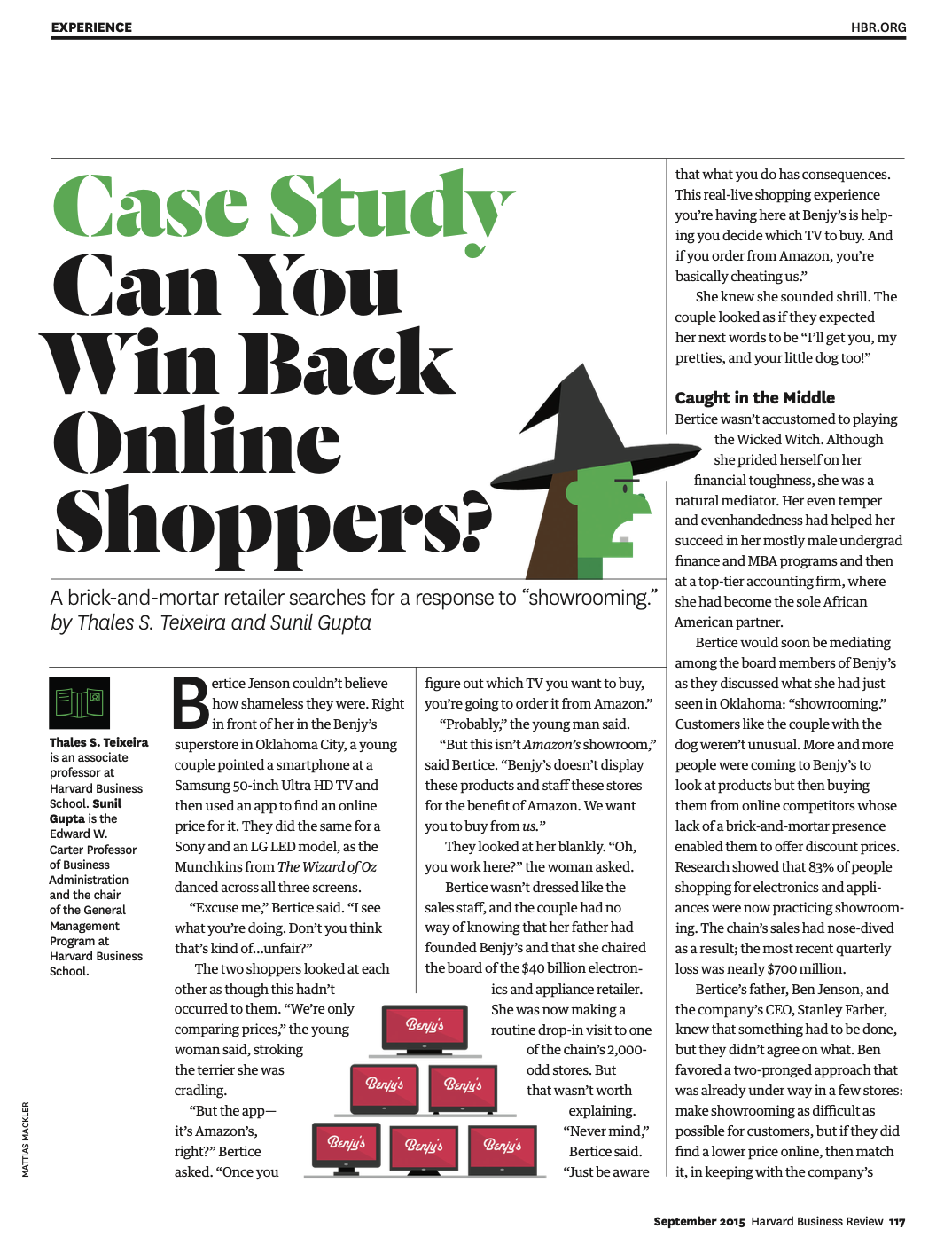
EXPERIENCE HBR.ORG that what you do has consequences. This real-live shopping experience you're having here at Benjy's is help- ing you decide which TV to buy. And if you order from Amazon, you're basically cheating us." She knew she sounded shrill. The couple looked as if they expected her next words to be "I'll get you, my pretties, and your little dog too!" Case Study Can You Win Back Online Shoppers B Caught in the Middle Bertice wasn't accustomed to playing the Wicked Witch. Although she prided herself on her financial toughness, she was a natural mediator. Her even temper and evenhandedness had helped her succeed in her mostly male undergrad finance and MBA programs and then at a top-tier accounting firm, where A brick-and-mortar retailer searches for a response to showrooming. she had become the sole African by Thales S. Teixeira and Sunil Gupta American partner. Bertice would soon be mediating among the board members of Benjy's ertice Jenson couldn't believe figure out which TV you want to buy, as they discussed what she had just how shameless they were. Right you're going to order it from Amazon." seen in Oklahoma: "showrooming." in front of her in the Benjy's "Probably," the young man said. Customers like the couple with the Thales S. Teixeira superstore in Oklahoma City, a young But this isn't Amazon's showroom," dog weren't unusual. More and more is an associate couple pointed a smartphone at a said Bertice. "Benjy's doesn't display professor at people were coming to Benjy's to Harvard Business Samsung 50-inch Ultra HD TV and these products and staff these stores look at products but then buying School. Sunil then used an app to find an online for the benefit of Amazon. We want them from online competitors whose Gupta is the price for it. They did the same for a you to buy from us. lack of a brick-and-mortar presence Edward W. Carter Professor Sony and an LG LED model, as the They looked at her blankly. Oh, enabled them to offer discount prices. of Business Munchkins from The Wizard of Oz you work here?" the woman asked. Research showed that 83% of people Administration danced across all three screens. Bertice wasn't dressed like the shopping for electronics and appli- and the chair of the General "Excuse me," Bertice said. I see sales staff, and the couple had no ances were now practicing showroom- Management what you're doing. Don't you think way of knowing that her father had ing. The chain's sales had nose-dived Program at that's kind of...unfair?" founded Benjy's and that she chaired as a result; the most recent quarterly Harvard Business School. The two shoppers looked at each the board of the $40 billion electron- loss was nearly $700 million. other as though this hadn't ics and appliance retailer. Bertice's father, Ben Jenson, and occurred to them. "We're only She was now making a the company's CEO, Stanley Farber, comparing prices," the young Berjy's routine drop-in visit to one knew that something had to be done, woman said, stroking of the chain's 2,000- but they didn't agree on what. Ben the terrier she was odd stores. But favored a two-pronged approach that Benjy's cradling. Benjy's that wasn't worth was already under way in a few stores: "But the app- explaining. make showrooming as difficult as it's Amazon's, "Never mind," possible for customers, but if they did right?" Bertice Berjy's Benjy's Berjy's Bertice said. find a lower price online, then match asked. Once you "Just be aware it, in keeping with the company's MATTIAS MACKLER September 2015 Harvard Business Review 117 EXPERIENCE 0 8 79219 3550 traditional low-cost, high-volume ethos. The CEO wanted to pursue a different strategy: He thought Benjy's should set itself apart from the competition by emphasizinga curated product mix, knowledgeable employees, and follow-up services. After her visit to Oklahoma, Bertice flew to Atlanta, where the company had its headquarters, for a regular board meeting. The first item on the agenda was how to address showrooming, and she jumped right in: "This is a serious problem for most retailers, but particularly those of us in electronics. Amazon keeps making it easier for shoppers to search for, find, and order a product online. We need to decide on a counterstrategy." Farb, as everyone called the CEO, had prepared a presentation. But the projector was balky, and Ben took advantage of the pause to share his own views. "It's obvious that we need to play both offense and defense. Offense should include providing more-aggressive discounts through the Benjy's app and matching online prices. We also need to get more sup- pliers to impose minimum advertised prices on their online retailers so that there's a price floor for every product, online or off. "As for defense, it will be a process. Some of the basic tactics, such as altering our bar codes, are now moot, because the newest price-comparison apps incorporate object-recognition software. That means shoppers don't even have to upload bar codes. All they have to do is point a smartphone at a product." There was murmuring around the table. Apparently this was news to some of the directors. "But there are ways to thwart object-recognition software," Ben continued. "We've begun creating dis- play structures within the stores that confuse the apps while still showing Case Study Teaching Notes Sunil Gupta and Thales S. Teixeira teach cases about respect, I think we should scrap the showrooming in their digital strategy and executive education defense and focus on a stronger of classes. Here Gupta shares some thoughts. fense. We need to be looking at what WHAT DREW YOU TO THIS STORY? more we can do for our customers, I teach a case on Amazon and showrooming, but I realized we should cover the topic from the perspective provide better service, knowledgeable of the brick-and-mortar retailer too. If technology is salespeople, exclusive products, and disrupting your business, what should you do? after purchase support." Ben broke in: "But now you're WHAT SUGGESTIONS DO STUDENTS MAKE? talking premium. Customers don't Match prices, use anti-showrooming tactics, improve want that from us. Our priority is customer service, ask manufacturers to create the biggest range of products at the exclusive SKUs, focus on installation and repairs, lowest prices. That's the Benjy's emphasize instant gratification. But there are problems promise. How can we make money with those approaches; this case highlights a few. by increasing our cost structure?" WHAT LESSONS DO YOU HOPE TO TEACH? "Maybe it's time to change our When the market changes, companies must reconsider promise," Farb said. He paged quickly how they create and capture value. Would consumers through the deck until he got to a slide miss Best Buy if it disappeared? Yes, because many titled "The New Benjy's." Bertice was like to see and touch products. Would manufacturers slightly miffed; Farb hadn't warned miss it? Those that don't have stores would. So Best her about this. But as ever, she kept Buy is creating value. How do you capture it? Ask the her expression neutral. I'll skip over manufacturers to pay a fee for showcasing. some of the lead-in, but here's a short report I had my team prepare," Farb off the products. There are consul- said. "As I see it, we can't beat Amazon tants that specialize in this. The costs on range, and when we try to match are relatively minor and well worth it. prices that are, on average, 8% lower I think this tactic is a no-brainer." than ours, we're in the red on most Farb caught Bertice's eye and sales. But what if we shifted away signaled that the projector was now from big-box retail to a more boutique working. Realizing that she'd allowed her father to Berry's dominate the conversation, she turned the floor over to the CEO, "As you all know," Farb said, "I spent my early career HBR's fictionalized in the hospitality industry, and one of experience? Fewer and smaller stores case studies the reasons you hired me five years with fewer but better-motivated present dilemmas faced by leaders ago was to improve our customer ser- and better-trained employees-the in real companies vice. That starts with respecting our baristas of electronics retail." and offer guests and how they like to shop." Ben sputtered: "We're not running solutions from "The way they shop is killing us," experts. This one is based on the Ben interjected. Bertice spoke up: "Let's hear him HBS Case Study Farb hesitated but continued: "Showrooming at "We have to acknowledge that the Farb gave her a grateful look. "TVS Best Buy" (case no. 9-515-019), by world has changed. Showrooming is and laptops may seem like commodi- Thales Teixeira and a fact of modern life, and if shoppers ties that people will buy only at the Elizabeth Anne sense that we're trying to stop them lowest prices, but so did coffee before Watkins, which is available at from doing it, they won't even walk Howard Schultz made Starbucks a HBR.org through our doors. So with all due destination. Why shouldn't Benjy's do cafs, Farb! out, Dad." 118 Harvard Business Review September 2015 FURTHER READING it would also be useful to have more detail on those countermeasures you mentioned. So let's table this discus- sion for now and get through the other items on our agenda. Farb can send around his deck, with plenty of supporting data, and we can all take some time to review the information. If everyone is amenable, I'd like to arrange a conference call next week to discuss only this and decide on a course of action." Learn more about showrooming. "Facing Digital Disruption" Sunil Gupta Mint, June 10, 2015 "How Pinterest Puts People in Stores" David Sevitt and Alexandra Samuel Harvard Business Review July-August 2013 Barry's the same-sell only the highest-value products and educate customers about them, instead of letting them get overwhelmed in an uncurated retail landscape?" "You're naive, Farb,"Ben said. "People will still showroom if they find better deals online." "We could still match prices," the CEO said. "How could we afford that?" Bertice asked, keen to break up the back-and-forth between the two men. "I'm glad you asked," Farb said. He paged ahead to a different slide. "You'll see we've done some modeling. Of course, fewer and smaller stores would cost less to staff and maintain. But I'd like us to think more creatively too. Before I was in hospitality, I worked for a supermarket chain. Do you know how those companies make money while cutting prices? By capitalizing on their position as sales platforms. They charge their suppliers fees for promotions and access to prime shelf space. Everyone thinks Amazon is all- powerful, but look behind the curtain and you'll find vulnerabilities. For one thing, it's a pretty poor marketing platform. Benjy's is a great marketing platform. If we curate the best and let customers experience the products, why shouldn't suppliers support us?" "There's no precedent for that in electronics retail," Ben countered. "It's a nonstarter. You'll ruin relation- ships that we've spent decades build- ing. And you're talking about huge business-model changes that, even if we wanted to make them, would take months-maybe years!-to implement. We need a solution now!" Several board members nodded in agreement. Bertice could sense the tension building between Farb and her father. "Farb, you're proposing a pretty radical change, and it's a lot for us to digest," she said quickly. Dad, "Make Customers Want to Buy Offline Sohrab Vossoughi HBR.org June 23, 2014 but people say they don't want to go through the hassle. Seems they just want to hear our spiel, try out the products, and go online. And often not to the Benjy's site." That was extremely discouraging. "What spiel?" Bertice asked. "Lately we've gotten a lot of train ing, so we can tell you everything you ever wanted to know about the sound system in the Sony Bravia TV, for instance. We're full of information. People tap into that, get educated- and then go buy from Amazon." "But I can't imagine everyone does the showrooming thing." Bertice said. "Don't some of your customers really appreciate your knowledge and purchase from us as a result?" The employee laughed nervously. "Honestly? I think service scares people-especially people who are longtime Benjy's customers," she said. "Scares them?" Bertice asked. "They assume good service equals higher prices. It's not true, but I've seen people turn around and walk out when we try to engage them." So customers weren't respond- ing to price matching, and they were being chased away by excellent service. All this put her in mind of Oz again. This time she didn't feel like the Wicked Witch; she felt like Dorothy, thrown into an unfamiliar world. But no ruby slippers were going to help her get back to the old predictability of retail. She would have to figure out herself how to move forward. New Ways to Make Money The next day, Bertice was in Huntsville, Alabama, to join in the ribbon cutting for a redevelopment project. Several big-box super- stores including a Benjy's-had been closed and replaced by a mixed-use residential-retail com- munity. Benjy's still had a presence there, but a much smaller one. "Welcome to Benjy's," a store employee said when Bertice walked in. "Did you come here today looking for something specific?" That was a nice touch-prob- ably Farb's doing. He was no doubt piloting his ideas about more helpful and attentive employees here in this smaller-store format. The previous evening she had gone over his and her father's proposals, analyzing the business cases. Ben's plan seemed a short-term but low-cost and poten- tially effective solution. Farb's was more costly and risky but possibly much better in the long run. Instead of responding to the young woman's question, Bertice explained that she was in corpo- rate management at Benjy's. Then she asked about the showrooming phenomenon. The woman's cheery expres- sion faded. "Oh, yeah. That's a big problem. We've changed the displays to make showrooming harder. And we've tried matching online prices, "Brick-and- Mortars (Still) Can't Beat the Web on Price" Rafi Mohammed HBR.org June 3, 2013 Tell us what you'd do. Go to HBR.org. Should Benjy's fight the showroomers or welcome them? See the commentaries on the next page. September 2015 Harvard Business Review 119 EXPERIENCE The Experts Respond Comments from the HBR.org community Keep the Customer Happy People are willing to pay for service. Recently I bought a new laptop at Best Buy. I suppose I could have found it online for a lower price, but then I would have lost all the support i'd get in case there was a problem-which there was. Josef Rosenfeld president, Health Flavors Roberto Leao is a finance executive for a global retail organization. Share Showroom Costs Providing a showroom is an expen- sive added-value service that is benefiting the manufacturer of the oduct. Providing this service customers is not sustainable unless the manufacturer pays for it. Martin Rapaport chairman, Rapaport Group BASED ON the environment out- lined in the case study, one can see why Ben Jenson wants to shore up the company's defenses. Without a strategy, he's probably concerned that showrooming may hurt profits. And some of Farb's ideas for going on the offense, such as having sup- pliers provide Benjy's with exclusive products, seem useful. You have to do that the right way, though. For a "unique to Benjy's" initiative to be effective, the products would have to be well differentiated from anything that could be found online. Adding a few bells and whistles wouldn't be enough. Benjy's must also keep in mind that many retailers already offer exclusive products-it's not a novel idea. One relevant piece that the com- pany is missing is direct feedback from existing and potential custom- ers as to why some visit stores while others shop online and why some of them showroom while others don't. Ben seems to assume that price is the main factor driving customers to online competitors. But perhaps it's something else. Maybe availability is the problem; a few ill-timed out- of-stock situations can have a big impact. Or maybe it's the product assortment or some other aspect of the shopping experience. The an- swers could help Benjy's figure out how to win over showroomers and how to better cater to people who Like shopping in physical stores. Those answers, too, could high- light avenues of opportunity, backed by customer research rather than just Farb's intuition. Perhaps Benjy's could indeed build competitive advantage by focusing more on the curation function and increasing its emphasis on service. Consumers do appreciate interacting with in- formed sales reps, trying out prod- ucts firsthand, and getting items immediately: You see something, you like it, and you take it home. That said, all those in-store initia- tives would need to be seamlessly integrated with an online strategy so that each experience complements the other. Customers shouldn't think "Benjy's online" or "Benjy's brick-and-mortar," but just "Benjy's." The company should use its website to expand on the in-store assort- ment and help customers find the best product and the best quality without having to do a lot of inde- pendent research. That's where the opportunity lies. Engage in Multiple Ways Customers are looking for an ideal omnichannel experience. Benjy's should offer an easy-to-use free mobile app, digital kiosks that showcase the inventory, and events such as movie nights that attract people to the store even when no purchase planned. Lata Hariharan CEO, Resource Leaders One relevant piece that the company is missing is direct feedback from existing and potential customers. 120 Harvard Business Review September 2015 Steve Conine is the cofounder and chief technology officer of Wayfair, an online retailer of home furnishings and housewares. of product-online. That's because we and other online retailers are improving the shopping experience, the prices are compelling, and digi- tal customers don't have to spend their weekends driving around and visiting showrooms. If I were an executive of any business stuck in the brick-and- mortar world, I'd be really worried I wouldn't be spending my time think- ing about how to bet- ter defend my rapidly shrinking physical ter- ritory, as Ben is. You can go only so far to obfuscate the specific isn't impossible. Wayfair has gotten pretty skilled at online selling- we do our own inspirational photog- raphy of our products-as well as fielding unfocused inquiries. Benjy's could also explore becoming a resource site for knowledge about electronics or appliances or other items it sells. That's what Wayfair did: We made ourselves, in effect, the Wikipedia of furniture, so thousands of visitors come to us for information. That's fine-over time, by providing ever-better consumer education and third-party reviews, we've encouraged people to shop our site as well as learn from it. And if you have a huge number of page views, your conversion rate doesn't have to be very high. You can still make money if even a modest percentage of visitors actually buy. If I were an executive of any business stuck in the brick-and-mortar world, I'd be really worried. I LIKE Farb's idea of transforming the Benjy's stores into paid show- rooms for manufacturers. I don't know whether the concept could work finan- cially, but at least he's thinking outside the box. The CEO is right when he says that the world of retail has dramatically changed. And like other physical stores that sell branded products, Benjy's may need to rethink its traditional business model if it wants to survive. I help lead a company that facilitates online sales of furniture and furnishings-items that many people would have once said they'd never buy online. Who could commit to a multi-thousand-dollar purchase of a sofa, say, without sit- ting on it and feeling the fabric? Low awareness of manufacturers' brands is another factor stacked against our business: Few people are going to hunt online for a particular sofa maker's products the way they'd hunt for a Samsung phone or a Stephen King novel. It's true that the vast majority of furniture sales still happen off-line, and Wayfair even experiences a good deal of reverse showroom- ing, with consumers coming to our site to research products and then going to physical stores (not ours, since we don't have any) to buy items similar to those they've seen online. Yet more and more people do buy sofas,and every other kind brands and models you're selling and thwart the price-comparison apps. So instead i'd be trying to cre- ate an exciting online business that would meet my customers' needs and capture their imagination. An online Benjy's might not be able to compete with Amazon on certain parameters, such as price and assortment, but it might be able to carve out an advantage by learning to do things differently, for example, by providing a better interface. Most online retailers are good at showing you what they've got and filling your orders, but they're not as good at selling or responding to vague queries; Benjy's could try to fill those gaps. Doing so The past couple of decades have demonstrated that the macro trend is going against the retail chains that depend on physical stores. Those of us in e-commerce, even though we face numerous obstacles, tend to feel that we're headed in the right direction-that the wind is at our backs. The leaders of Benjy's can save themselves a lot of wasted energy by turning around and mak- ing use of that wind to get out ahead of their competition. O HBR Reprint R1509K Reprint Case only R1509X Reprint Commentary only R1509Z September 2015 Harvard Business Review 121









 Study Help