Question: Based on the case study (Wal-Mart in Africa) i need some help for to find : 1. the significance of study which is the purpose
Based on the case study (Wal-Mart in Africa) i need some help for to find :
1. the significance of study which is the purpose of discussion.
i just need 4-5 points
sorry i cant attach the case study here as it against chegg.
thank you and i need your help badly.
Dear Sir/Madam try to search for case study of walmart in africa ( march 9 2012 )
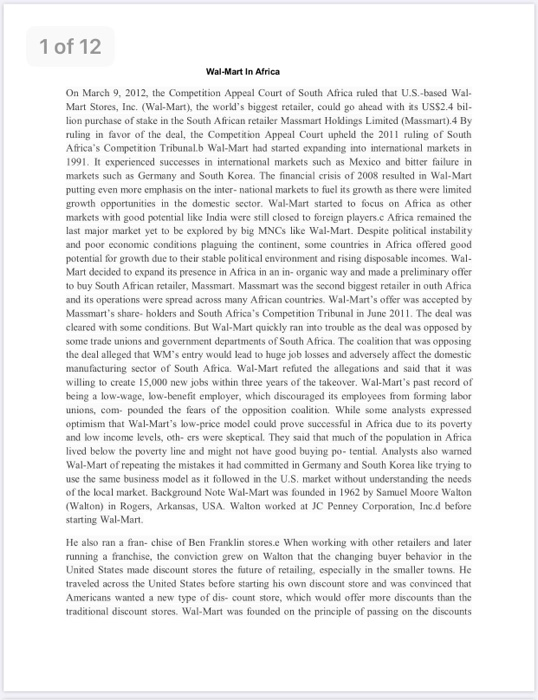
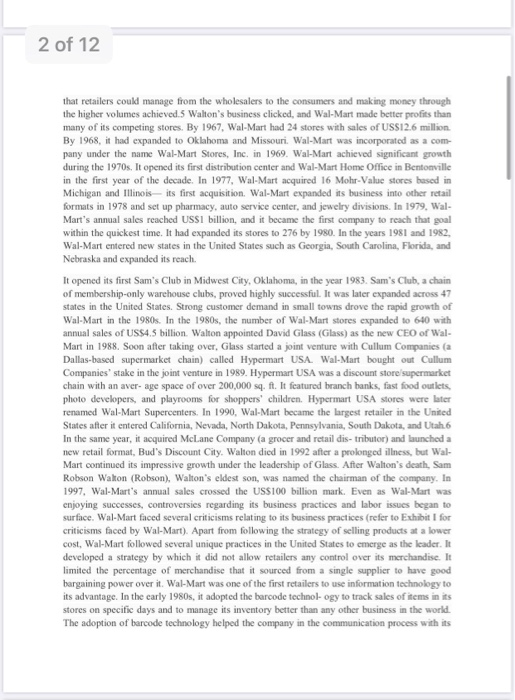
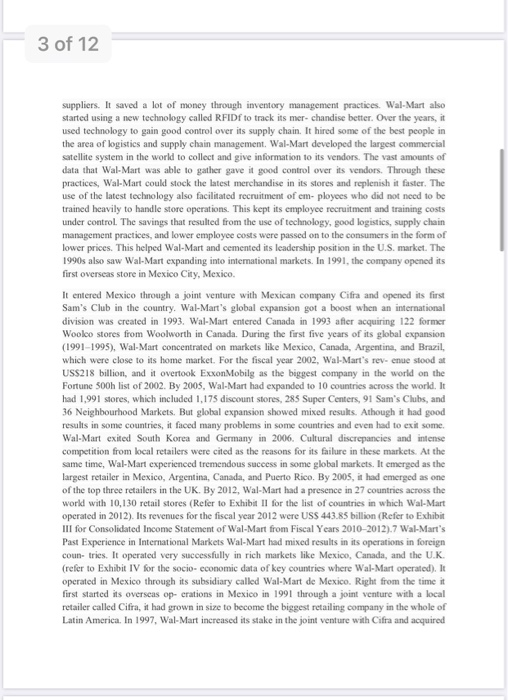
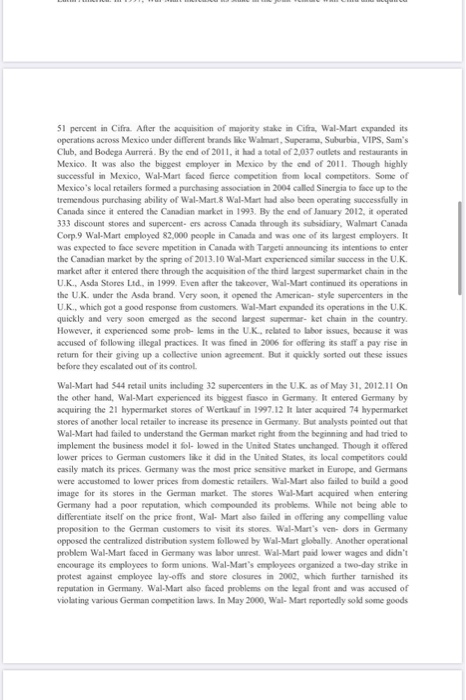
1 of 12 Wal-Mart In Africa On March 9, 2012, the Competition Appeal Court of South Africa ruled that U.S.-based Wal. Mart Stores, Inc. (Wal-Mart), the world's biggest retailer, could go ahead with its US$2.4 bil- lion purchase of stake in the South African retailer Massmart Holdings Limited (Massmart).4 By ruling in favor of the deal, the Competition Appeal Court upheld the 2011 ruling of South Africa's Competition Tribunal.b Wal-Mart had started expanding into international markets in 1991. It experienced successes in international markets such as Mexico and bitter failure in markets such as Germany and South Korea. The financial crisis of 2008 resulted in Wal-Mart putting even more emphasis on the international markets to fuel its growth as there were limited growth opportunities in the domestic sector. Wal-Mart started to focus on Africa as other markets with good potential like India were still closed to foreign players.c Africa remained the last major market yet to be explored by big MNCs like Wal-Mart. Despite political instability and poor economic conditions plaguing the continent, some countries in Africa offered good potential for growth due to their stable political environment and rising disposable incomes. Wal- Mart decided to expand its presence in Africa in an in- organic way and made a preliminary offer to buy South African retailer, Massmart. Massmart was the second biggest retailer in outh Africa and its operations were spread across many African countries. Wal-Mart's offer was accepted by Massmart's shareholders and South Africa's Competition Tribunal in June 2011. The deal was clcared with some conditions. But Wal-Mart quickly ran into trouble as the deal was opposed by some trade unions and government departments of South Africa. The coalition that was opposing the deal alleged that WM's entry would lead to huge job losses and adversely affect the domestic manufacturing sector of South Africa. Wal-Mart refuted the allegations and said that it was willing to create 15,000 new jobs within three years of the takeover. Wal-Mart's past record of being a low-wage, low-benefit employer, which discouraged its employees from forming labor unions, com. pounded the fears of the opposition coalition. While some analysts expressed optimism that Wal-Mart's low-price model could prove successful in Africa due to its poverty and low income levels, others were skeptical. They said that much of the population in Africa lived below the poverty line and might not have good buying potential. Analysts also wamed Wal-Mart of repeating the mistakes it had committed in Germany and South Korea like trying to use the same business model as it followed in the U.Smarket without understanding the needs of the local market. Background Note Wal-Mart was founded in 1962 by Samuel Moore Walton (Walton) in Rogers, Arkansas, USA Walton worked at JC Penney Corporation, Inc.d before starting Wal-Mart. He also ran a franchise of Ben Franklin stores.e When working with other retailers and later running a franchise, the conviction grew on Walton that the changing buyer behavior in the United States made discount stores the future of retailing, especially in the smaller towns. He traveled across the United States before starting his own discount store and was convinced that Americans wanted a new type of discount store, which would offer more discounts than the traditional discount stores, Wal-Mart was founded on the principle of passing on the discounts 2 of 12 that retailers could manage from the wholesalers to the consumers and making money through the higher volumes achieved 5 Walton's business clicked, and Wal-Mart made better profits than many of its competing stores. By 1967, Wal-Mart had 24 stores with sales of US$12.6 million By 1968, it had expanded to Oklahoma and Missouri. Wal-Mart was incorporated as a com- pany under the name Wal-Mart Stores, Inc. in 1969. Wal-Mart achieved significant growth during the 1970s. It opened its first distribution center and Wal-Mart Home Office in Bentonville in the first year of the decade. In 1977, Wal-Mart acquired 16 Mohr-Value stores based in Michigan and Illinois - its first acquisition. Wal-Mart expanded its business into other retail formats in 1978 and set up pharmacy, auto service center, and jewelry divisions. In 1979, Wal- Mart's annual sales reached USSI billion, and it became the first company to reach that goal within the quickest time. It had expanded its stores to 276 by 1980. In the years 1981 and 1982, Wal-Mart entered new states in the United States such as Georgia, South Carolina, Florida, and Nebraska and expanded its reach. It opened its first Sam's Club in Midwest City, Oklahoma, in the year 1983. Sam's Club, a chain of membership-only warehouse clubs, proved highly successful. It was later expanded across 47 states in the United States. Strong customer demand in small towns drove the rapid growth of Wal-Mart in the 1980s. In the 1980s, the number of Wal-Mart stores expanded to 640 with annual sales of US$4.5 billion. Walton appointed David Glass (Glass) as the new CEO of Wal- Mart in 1988. Soon after taking over, Glass started a joint venture with Cullum Companies (a Dallas-based supermarket chain) called Hypermart USA Wal-Mart bought out Cullum Companies' stake in the joint venture in 1989. Hypermart USA was a discount store supermarket chain with an average space of over 200,000 sq. ft. It featured branch banks, fast food outlets, photo developers, and playrooms for shoppers' children. Hypermart USA stores were later renamed Wal-Mart Supercenters. In 1990, Wal-Mart became the largest retailer in the United States after it entered California, Nevada, North Dakota, Pennsylvania, South Dakota, and Utah 6 In the same year, it acquired McLane Company (a grocer and retail distributor) and launched a new retail format, Bud's Discount City. Walton died in 1992 after a prolonged illness, but Wal- Mart continued its impressive growth under the leadership of Glass. After Walton's death, Sam Robson Walton (Robson), Walton's eldest son, was named the chairman of the company. In 1997, Wal-Mart's annual sales crossed the US$100 billion mark. Even as Wal-Mart was enjoying successes, controversies regarding its business practices and labor issues began to surface. Wal-Mart faced several criticisms relating to its business practices (refer to Exhibit I for criticisms faced by Wal-Mart). Apart from following the strategy of selling products at a lower cost, Wal-Mart followed several unique practices in the United States to emerge as the leader. It developed a strategy by which it did not allow retailers any control over its merchandise. It limited the percentage of merchandise that it sourced from a single supplier to have good bargaining power over it. Wal-Mart was one of the first retailers to use information technology to its advantage. In the carly 1980s, it adopted the barcode technology to track sales of items in its stores on specific days and to manage its inventory better than any other business in the world The adoption of barcode technology helped the company in the communication process with its 3 of 12 suppliers. It saved a lot of money through inventory management practices Wal-Mart also started using a new technology called RFID to track its merchandise better. Over the years, it used technology to gain good control over its supply chain. It hired some of the best people in the area of logistics and supply chain management. Wal-Mart developed the largest commercial satellite system in the world to collect and give information to its vendors. The vast amounts of data that Wal-Mart was able to gather gave it good control over its vendors. Through these practices, Wal-Mart could stock the latest merchandise in its stores and replenish it faster. The use of the latest technology also facilitated recruitment of employees who did not need to be trained heavily to handle store operations. This kept its employee recruitment and training costs under control. The savings that resulted from the use of technology, good logistics, supply chain management practices, and lower employee costs were passed on to the consumers in the form of lower prices. This helped Wal-Mart and cemented its leadership position in the U.S. market. The 1990s also saw Wal-Mart expanding into international markets. In 1991, the company opened its first overseas store in Mexico City, Mexico. It entered Mexico through a joint venture with Mexican company Cifra and opened its first Sam's Club in the country. Wal-Mart's global expansion got a boost when an international division was created in 1993. Wal-Mart entered Canada in 1993 after acquiring 122 former Wooloo stores from Woolworth in Canada. During the first five years of its global expansion (1991-1995), Wal-Mart concentrated on markets like Mexico, Canada, Argentina, and Brazil which were close to its home market. For the fiscal year 2002, Wal-Mart's revenue stood at USS218 billion, and it overtook ExxonMobilg as the biggest company in the world on the Fortune 500h list of 2002. By 2005, Wal-Mart had expanded to 10 countries across the world. It had 1,991 stores, which included 1,175 discount stores, 285 Super Centers, 91 Sam's Clubs, and 36 Neighbourhood Markets. But global expansion showed mixed results. Athough it had good results in some countries, it faced many problems in some countries and even had to exit some Wal-Mart exited South Korea and Germany in 2006. Cultural discrepancies and intense competition from local retailers were cited as the reasons for its failure in these markets. At the same time, Wal-Mart experienced tremendous success in some global markets. It emerged as the largest retailer in Mexico, Argentina, Canada, and Puerto Rico. By 2005, it had emerged as one of the top three retailers in the UK. By 2012, Wal-Mart had a presence in 27 countries across the world with 10,130 retail stores (Refer to Exhibit Il for the list of countries in which Wal-Mart operated in 2012). Its revenues for the fiscal year 2012 were USS 443.85 billion (Refer to Exhibit III for Consolidated Income Statement of Wal-Mart from Fiscal Years 2010-2012).7 Wal-Mart's Past Experience in International Markets Wal-Mart had mixed results in its operations in foreign countries. It operated very successfully in rich markets like Mexico, Canada, and the UK (refer to Exhibit IV for the socio-economic data of key countries where Wal-Mart operated) operated in Mexico through its subsidiary called Wal-Mart de Mexico. Right from the time first started its overseas opcrations in Mexico in 1991 through a joint venture with a local retailer called Cifra, it had grown in size to become the biggest retailing company in the whole of Latin America. In 1997, Wal-Mart increased its stake in the joint venture with Cifra and acquired 51 percent in Cifra. After the acquisition of majority stake in Cifra, Wal-Mart expanded its operations across Mexico under different brands like Walmart, Superma, Suburbia, VIPS, Sam's Club, and Bodega Aurrera. By the end of 2011, it had a total of 2,037 outlets and restaurants in Mexico. It was also the biggest employer in Mexico by the end of 2011. Though highly successful in Mexico, Wal-Mart faced fierce competition from local competitors. Some of Mexico's local retailers formed a purchasing association in 2004 called Sinergia to face up to the tremendous purchasing ability of Wal-Mart.& Wal-Mart had also been operating successfully in Canada since it entered the Canadian market in 1993. By the end of January 2012, it operated 333 discount stores and supercenters across Canada through its subsidiary, Walmart Canada Corp.9 Wal-Mart employed 82,000 people in Canada and was one of its largest employers. It was expected to face severe mpetition in Canada with Target announcing its intentions to enter the Canadian market by the spring of 2013.10 Wal-Mart experienced similar success in the U.K. market after it entered there through the acquisition of the third largest supermarket chain in the UK, Asda Stores Lid., in 1999. Even after the takeover, Wal-Mart continued its operations in the U.K. under the Asda brand. Very soon, it opened the American style supercenters in the UK, which got a good response from customers. Wal-Mart expanded its operations in the U.K. quickly and very soon emerged as the second largest supermarket chain in the country. However, it experienced some problems in the UK, related to labor issues, because it was accused of following illegal practices. It was fined in 2006 for offering its staff a pay rise in return for their giving up a collective union agreement. But it quickly sorted out these issues before they escalated out of its control Wal-Mart had 544 retail units including 32 supercenters in the UK as of May 31, 2012.11 On the other hand, Wal-Mart experienced its biggest fiasco in Germany. It entered Germany by acquiring the 21 hypermarket stores of Wert auf in 1997.12 It later acquired 74 hypermarket stores of another local retailer to increase its presence in Germany. But analysts pointed out that Wal-Mart had failed to understand the German market right from the beginning and had tried to implement the business model it followed in the United States unchanged. Though it offered lower prices to German customers like it did in the United States, its local competitors could casily match its prices. Germany was the most price sensitive market in Europe, and Germans were accustomed to lower prices from domestic retailers, Wal-Mart also failed to build a good image for its stores in the German market. The stores Wal-Mart acquired when entering Germany had a poor reputation, which compounded its problems. While not being able to differentiate itself on the price front, Wal-Mart also failed in offering any compelling value proposition to the German customers to visit its stores. Wal-Mart's vendors in Germany opposed the centralized distribution system followed by Wal-Mart globally. Another operational problem Wal-Mart faced in Germany was labor unrest. Wal-Mart paid lower wages and didn't encourage its employees to form unions. Wal-Mart's employees organized a two-day strike in protest against employee lay-offs and store closures in 2002, which further tarnished its reputation in Germany. Wal-Mart also faced problems on the legal front and was accused of violating various German competition laws. In May 2000, Wal-Mart reportedly sold some goods in its stores at a price that was lower than the cost price at which it bought them. Apart from regulatory issues, Wal-Mart also faced problems in integrating its culture with the culture of the retail businesses it acquired in Germany. Wal-Mart strongly discouraged office romance between employees in its stores, which many employees found to be intrusive. Commenting on Wal- Mart's attitude when it entered the German retail market, Bryan Roberts, an analyst at Planet Retailj said, "Wal-Mart was not very humble when they went in. They wanted to impose their own culture. 13 Analysts said that even by 2003, five years after it entered the German market, Wal-Mart was losing nearly USS200-300 million per annum. It remained a secondary player in the German retail market and was never able to recover.14 Unable to understand the German market, Wal-Mart excited the country in 2006. Wal-Mart similarly exited from the South Korean market retail in 2006 and struggled to establish itself in the Japanese retail market. It entered the South Korean market in 1998 and implemented its U.S. business model of low prices just as it did in Germany, but the South Korean customers did not like Wal-Mart's offerings. The South Korean retail market was highly sophisticated with lavish stores and the South Korean customers did not like the "warehouse style environment of Wal-Mart's stores. Housewives were not satisfied with the food and beverage offerings in Wal-Mart's stores. 15 As a result, sales did not pick up in Wal-Mart's South Korean stores, and the retailer could not open new stores in the country. Limited operations prevented Wal-Mart from extracting better discounts from its suppliers. 16 Analysts said that Wal-Mart failed to localize its operations to suit the needs of the South Korean market, unlike the other global retailing giant Tescok Homeplus, the South Korcan subsidiary of Tesco, emerged as the second biggest retailer in South Korea by 2006 by localizing its operations to suit the needs of South Korean customers. Wal-Mart Korea reported sales of just US$800 million and a loss of USS10 million in 2005.17 Unable to sustain its operations in South Korea, Wal-Mart sold its 16 stores in the country for US5882 million and exited the market in 2006.18 Wal-Mart struggled to establish itself in Japan since it entered the Japanese retail market in 2002, but it later started adjusting its business model to suit the needs of the Japanese retail market Japanese customers initially equated Wal-Mart's lower prices and unsophisticated stores to inferior products. 19 Wal-Mart rectified its problems in Japan through some measures like renovating its stores to look better and creating better consumer awareness about the quality of its products. Later, Wal-Mart expanded its operations in Japan and acquired a 100 percent stake in its Japanese subsidiary in 2008, Wal-Mart Embarks On An African Safari Wal-Mart started putting more emphasis on the international markets to drive its expansion since the financial crisis of 2008. The main reason for its enhanced international focus was the limited growth opportunities in its domestic (U.S.) market since the financial crisis. Strong sales growth and a record number of new stores opened made its international segment grow faster. Wal-Mart's international segment grow by 15.2 percent year on year for the fiscal year 2012.20 Its operating income from international operations for the fiscal year ending January 31, 2012, was US56,241 million (refer to Exhibit V for Wal-Mart's operating income from international operations for the fiscal years 2010-2012). According to an estimate by Forbes magazine, Wal-Mart's international segment was contributing approximately 40 percent to its stock price in March 2012. This estimate highlighted the importance of international operations for Wal-Mart. It had been trying for a long time to enter the Indian retail market due to the tremendous growth opportunities for the retail sector there. The Indian retail sector was projected to grow from USS396 billion in 2012 to US$785 billion by 2015.21 However, the Indian retail market was still closed to foreign multi-brand retailers, and Wal-Mart's operations were limited to some wholesale outlets there. That had left Wal-Mart to focus on Africa as another most important growth opportunity With most of the developed Western markets reaching saturation levels and the Asian markets becoming highly competitive, many big multinational companies (MNCs) were turning their attention toward Africa Africa was being considered the last major emerging market left to be captured by the MNCs. The unstable political environment in most of African countries made it unviable for businesses to set up shop there, but some African countries like South Africa and Nigeria with elected governments and rule of law were seen as viable options for big MNCs to enter the African continent. Wal-Mart decided o gain a foothold in the African market in an inorganic way by acquiring an established retailing company. Since 2008, Wal-Mart had been on the lookout for an acquisition target in Africa South Africa had some sophisticated retailers, such as Shoprite Holdingsn (Shoprite), Massmart, Pick 'n Pay Stores Ltdo (Pick 'n Pay), Spar,p and Woolworths. In September 2010, Wal-Mart announced that it had made a preliminary offer to buy the South African retailer, Massmart. 22 Analysts felt that Wal-Mart had gone in for Massmart rather than Africa's big. gest grocer, Shoprite, because Massmart had rapidly increased its presence in the food-retailing business and, by then, operated 40 grocery stores in South Africa 23 South Africa had a relatively mature organized retail market, and some of South Africa's leading retailers like Pepkor were planning to expand their operations to other African markets like Nigeria. 24 Commenting on the preference given by Wal-Mart to South Africa, Andy Bond (Bond), executive vice president of Wal-Mart, said, "South Africa presents a compelling growth opportunity for Wal-Mart and offers a platform for growth and expansion in other African countries. "25 The preliminary offer was nonbinding to Wal-Mart, and it could withdraw the offer anytime after conducting due diligence. Massmart was the second biggest retailer in Africa and owned several established local retail brands like Game, Makro, Builders Warehouse, and CBW.26 Massmart was founded in 1990 and the group comprised nine wholesale and retail chains (refer to Exhibit VI for the list of major retailers in South Africa) The group functioned through four operating divisions: Massdiscounters, Masswarehouse, Massbuild, and Masscash. Even though most of Massmart's operations were concentrated in South Africa, Massmart had operations across many sub-Saharan countries (refer to Exhibit VII for the list of countries in which Massmart operated in 2012). Wal-Mart hoped to gain an instant footprint across Africa through the acquisition of Massmart. Saying that "Walmart likes emerging markets and South Africa in particular,27 Bond said that Massmart hoped to open 40 new outlets a year in countries, including South Africa, Nigeria, 7 of 12 Malawi, and Zambia. It was also looking at opportunities in countries like Senegal, Cameroon, and Angola. The retailer said that its aim was not to change Massmart's strategy, but simply to put the foot on the accelerator."28 However, the news of Wal-Mart's entry in South Africa led to huge protests from powerful trade unions and some government departments in South Africa who contended that o gain a foothold in the African market in an inorganic way by acquiring an established retailing company. Since 2008, Wal-Mart had been on the lookout for an acquisition target in Africa South Africa had some sophisticated retailers, such as Shoprite Holdings (Shoprite). Massmart, Pick 'n Pay Stores Lido (Pick 'n Pay). Sparp and Woolworths. In September 2010, Wal-Mart announced that it had made a preliminary offer to buy the South African retailer, Massmart. Analysts felt that Wal-Mart had gone in for Massmart rather than Africa's biggest grocer, Shoprite, because Massmart had rapidly increased its presence in the food-retailing business and, by then, operated 40 grocery stores in South Africa 23 South Africa had a relatively mature organized retail market, and some of South Africa's leading retailers like Pepkor were planning to expand their operations to other African markets like Nigeria. 24 Commenting on the preference given by Wal-Mart to South Africa, Andy Bond (Bond), executive vice president of Wal-Mart, said, "South Africa presents a compelling growth opportunity for Wal-Mart and offers a platform for growth and expansion in other African countries. 25 The preliminary offer was nonbinding to Wal-Mart, and it could withdraw the offer anytime after conducting due diligence. Massmart was the second biggest retailer in Africa and owned several established local retail brands like Game, Makro, Builders' Warehouse, and CBW.26 Massmart was founded in 1990 and the group comprised nine wholesale and retail chains (refer to Exhibit VI for the list of major retailers in South Africa). The group functioned through four operating divisions Massdiscounters, Masswarehouse, Massbuild, and Masscash. Even though most of Massmart's operations were concentrated in South Africa, Massmart had operations across many sub- Saharan countries (refer to Exhibit VII for the list of countries in which Massmart operated in 2012). Wal-Mart hoped to gain an instant footprint across Africa through the acquisition of Massmart. Saying that "Walmart likes emerging markets and South Africa in particular, 27 Bond said that Massmart hoped to open 40 new outlets a year in countries, including South Africa, Nigeria, Malawi, and Zambia. It was also looking at opportunities in countries like Senegal, Cameroon, and Angola. The retailer said that its aim was not to change Massmart's strategy, but simply to put the foot on the accelerator." However, the news of Wal-Mart's entry in South Africa led to huge protests from powerful trade unions and some government departments in South Africa who contended that Wal-Mart hoped to create at least 15.000 new jobs within three years of the merger,34 but it started to run into trouble from various quarters in Africa that were opposed to the deal. The opposition to the deal was similar to the ones faced in markets like India against foreign participation in the retail sector. The main opposition was from some trade unions and government departments that feared job losses in the retail sector. People who were opposed to the deal included the organized labor unions of South Africa like the Congress of South African Trade Unions, the South African Commercial, and the Catering and 8 of 12 Allied Workers Union. Opposition to the deal also came from three government departments Economic Development; Trade and Industry and Agriculture, Forestry, and Fisheries. In addition to the fear of job losses, the opposition was also opposed to some of the terms of the merger. The opposition coalition to the deal claimed that there would be huge job losses due to the entry of Wal-Mart because it might import a large part of its merchandise from cheaper markets like China. It claimed that 4,000 jobs would be lost immediately even if Wal-Mart imported just one percent of its merchandise. It also claimed that importing the merchandise from cheaper markets like China would hit the manufacturing sector in South Africa. The main reason for opposition to Wal-Mart's entry into South Africa stemmed from the high levels of unemployment prevailing in that country. The South African government was wary of Wal- Mart's entry leading to huge job losses The manufacturing and agriculture sectors in South Africa had been declining just before Wal Mart decided upon entering South Africa. According to a report on the South African labor market published by the Development Policy Research Units (DPRU), the employment rate in the South African agriculture, forestry, and fishing sector contracted by 13 percent, and the employment rate in the manufacturing sector contracted by 11 percent between the second quarter of 2009 and the second quarter of 2010.35 However, Wal-Mart refuted the allegations made by the opposition coalition. Many analysts too supported the deal, arguing that the fears expressed by the opposition coalition were ill founded. Some said that the fears raised by the opposition were misguided because the retrenchment ban forming part of the terms of the deal made it difficult for Wal-Mart to cut any jobs for at least two years after the merger. Some industry observers said that the supplier development program agreed upon by Wal-Mart at the time of the merger would help in improving the efficiency of South Africa's manufacturing sector. Wal-Mart was also known for being a low-wage and low-benefit employer in the United States. Its founder, Walton, feared and hated worker unions, and Wal-Mart's workers were often discouraged from forming themselves into any labor unions. The opposition coalition feared that Wal-Mart might bring the same work culture to South Africa and other African countries African countries like South Africa, Kenya, and Nigeria traditionally had a culture of very strong labor unions. The three government departments opposed to the deal criticized South Africa's Competition Tribunal approval of the deal, saying that the commission had failed to consider some vital issues relating to public interest. Many labor unions in South Africa to voiced their opposition to the deal. Patrick Craven, spokesperson for the South African workers' union, Cosatu, said, "Walmart however is more likely to destroy jobs, by using its competitive advantage to force its competitors out of business, and destroying South African manufacturing businesses, which will not be able to compete with a flood of cheap imports...36 The group opposed to the deal approached the Competition Appeal Court of South Africa for a review of the ruling by South Africa's Competition Tribunal However, the Competition Appeal Court of South Africa ruled in favor of the deal on March 9, 2012, saying that the fears expressed over the deal were founded. The ruling by the appeals court finally paved the way for Wal-Mart to enter the South African retail market. Ruling in favor of the deal, the appeals court said, "There 9 of 12 was insufficient evidence to conclude that the detrimental effects of the merger would outweigh the clear benefits."37 As part of the ruling, the appeal court also ordered Wal-Mart to conduct a study to determine the best possible way to safeguard the interests of small producers who would not be able to compete against low-cost foreign producers from which Wal-Mart would be importing goods at cheaper rates. Based on this study, the court would decide how Wal-Mart should use the 100 million and fund that it had earmarked for improving the competitiveness of local industry. The court also ordered the retailer to reinstate the 503 workers who had been fired just before the merger. Smooth Ride? As the court was deliberating on the appeal against the merger, Wal-Mart and Massmart were busy moving ahead with their integration, which included aliening product sourcing 40 McMillon said, Massmart is currently located in 12 markets so that's our focus. Building our business in the markets that we are currently in is our primary focus.... We are excited about the region. We have a long-term view. 41 Analysts were divided in their opinion about Wal-Mart's prospects in Africa. Just before the Competition Appeal Court of South Africa ruled in favor of Wal-Mart's deal with Massmart, Masumant announced that it was going to expand and open 20 more stores in Nigeria Nigeria was another major market for retailing business in Africa, with a population of 160 million Announcing the expansion plans in Nigeria, Grant Pattison, CEO of Massmart, said that Nigeria had the potential to be a bigpermarket than South Africa. He said, "By all simple metrics, Nigeria has the potential to be larger than South Africa, but it has some way to go in terms of infrastructure and political stability.142 This showed Massmart's desire to expand in all the major markets across Africa, which co m ately benefit Wal-Mart in its quest to gain a foothold across the African continent. Some analysts said that Wal-Mart's financial muscle could help Massmart expand across the content faster. Nevertheless, some analysts expressed the view that Wal-Mart could face more problems in Africa than it had faced in countries like Germany. Because the market potential of many individual African countries was limited, Wal-Mart would have to expand its operations to many countries across Africa to achieve good economies of scale and make its operations viable Rampant poverty and low income levels would make operations in some African countries simply unable to Wal-Mart, they said (refer to Exhibit VIII for the socio-economic data of countries where Massmart operated) Nearly 61 percent of Nigeria's population lived on less than USSI per day, which could limit the country's potential.43 Some other problems cited by critics to the deal were the unstable political environment and poor infrastructure in many parts of Africa that might hit Wal-Mart's ambitions there. David Strasser, an analyst at Janney Montgomery Scott 44 sid. "For this deal to drive returns, we believe it is essential to succeed by using this acquisition as a springboard. For every relatively stable country like Botswana, there is a Zimbabwe. Some analysts were optimistic about the viability of Wal-Mart's U.S. business model in Africa. They said that its business model of offering everyday low pricing for its customers would be very successful in a market like Africa where high poverty and very low income levels prevailed. Wal-Mart might not face the problem of being seen as a low-quality retailer as it was seen in countries like Germany and South Korea. However, others warned Wal-Martinst repeating the mistakes it had made in countries like Germany and South Korea ke n g to understand the needs of the local markets and trying to follow the same business model it followed in the United States