







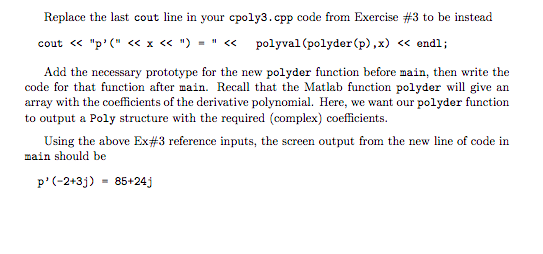
Question: Based on the code which has given , we need to write down a polyder function which will give an array with the Coefficients of
Based on the code which has given , we need to write down a polyder function which will give an array with the Coefficients
of the derivative polynomia. please take a look at the description .
#include
#include
using namespace std;
// Test case:
// Degree of polynomial: 5
// Coefficients (real then imag for each):
// -1 2
// 2 -3
// 3 -4
// 4 0
// 0 5
// 1 1
// Value of x (real then imag): 3 -2
// p(3-2j) = 63-1089j
struct Complex {
float a; // Used to hold real part of complex number
float b; // Used to hold imag part of complex number
};
struct Poly {
Complex* c; // Coefficient array for poly (highest power first)
int deg; // Degree of poly
};
// Operator overloads for Complex structures
Complex operator+(Complex,Complex);
Complex operator+(Complex,float);
Complex operator+(float,Complex);
Complex operator*(Complex,Complex);
Complex operator*(Complex,float);
Complex operator*(float,Complex);
Complex operator^(Complex,int);
ostream& operator
istream& operator>>(istream&,Complex&);
// Initializer and operator overload for Poly
Poly polyInit(int);
istream& operator>>(istream&,Poly&);
// polyval function prototype
Complex polyval(Poly,Complex);
int main(void) {
int n;
Complex x, res;
cout
cin >> n;
Poly p = polyInit(n);
cout
cin >> p;
cout
cin >> x;
res=polyval(p,x);
cout
return 0;
}
// Write code for polyval function here --
Complex polyval(Poly p, Complex s) {
Complex r=p.c[p.deg];
for (int k=1;k
return r;
}
Poly polyInit(int sz) {
Poly p;
p.deg=sz;
p.c = new Complex[sz+1];
for (int i=0;i
p.c[i].a=0;
p.c[i].b=0;
}
return p;
}
istream& operator>>(istream& i, Poly& p) {
for (int k=0;k> p.c[k];
return i;
}
// Overload for float*Complex
Complex operator*(float bar, Complex foo) {
Complex bas;
bas.a = bar*foo.a;
bas.b = bar*foo.b;
return bas;
}
// Overload for Complex*float
Complex operator*(Complex foo, float bar) {
return bar*foo; // Use previous overload and commutativity
}
// Overload for Complex+Complex
Complex operator+(Complex foo, Complex bar) {
Complex bas;
bas.a = foo.a + bar.a;
bas.b = foo.b + bar.b;
return bas;
}
// Overload for Complex+float
Complex operator+(Complex foo, float bar) {
Complex bas;
bas.a = foo.a + bar;
bas.b = foo.b;
return bas;
}
// Overload for float+Complex
Complex operator+(float foo, Complex bar) {
return bar+foo; // Use previous overload and commutativity
}
// Overload for Complex*Complex
Complex operator*(Complex foo, Complex bar) {
Complex bas;
bas.a = foo.a*bar.a-foo.b*bar.b;
bas.b = foo.a*bar.b+bar.a*foo.b;
return bas;
}
// Overload for Complex^int (for exponentiation)
Complex operator^(Complex z, int pwr) {
Complex r={1};
for (int k=1;k
return r;
}
// Overload for output operator (
ostream& operator
o
if (z.b>0) {
o
}
else if (z.b
o
}
return o;
}
// Overload for input operator (>> Complex)
istream& operator>>(istream& i, Complex& z) {
i >> z.a >> z.b;
return i;
}
// Complex conjugate
Complex conj(Complex foo) {
Complex bar={foo.a,-foo.b};
return bar;
}
// Complex magnitude (absolute value)
float abs(Complex z) {
Complex res;
res = (z*conj(z))^0.5;
return res.a;
}
Replace the last cout line in your cpoly3.cpp code from Exercise #3 to be instead cout
Step by Step Solution
There are 3 Steps involved in it

Get step-by-step solutions from verified subject matter experts
 Study Help