







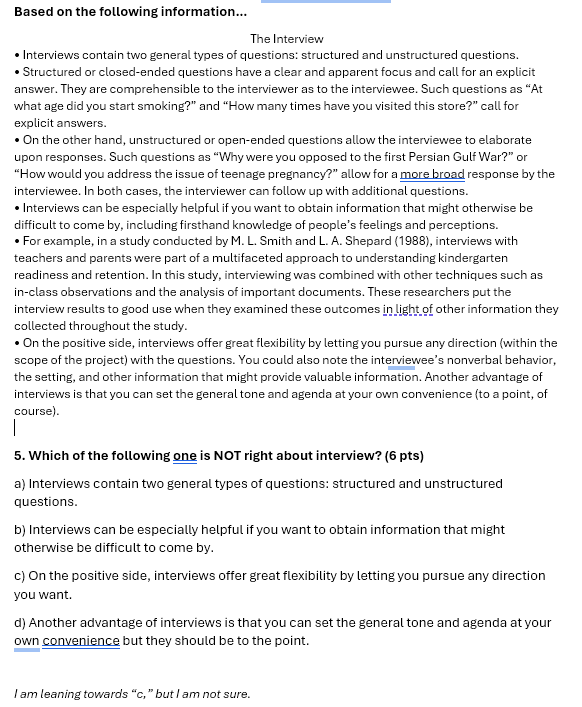
Question: Based on the following information... The Interview Interviews contain two general types of questions: structured and unstructured questions. Structured or closed - ended questions have
Based on the following information...
The Interview
Interviews contain two general types of questions: structured and unstructured questions.
Structured or closedended questions have a clear and apparent focus and call for an explicit answer. They are comprehensible to the interviewer as to the interviewee. Such questions as At what age did you start smoking? and How many times have you visited this store? call for explicit answers.
On the other hand, unstructured or openended questions allow the interviewee to elaborate upon responses. Such questions as Why were you opposed to the first Persian Gulf War? or How would you address the issue of teenage pregnancy? allow for a more broad response by the interviewee. In both cases, the interviewer can follow up with additional questions.
Interviews can be especially helpful if you want to obtain information that might otherwise be difficult to come by including firsthand knowledge of peoples feelings and perceptions.
For example, in a study conducted by M L Smith and L A Shepard interviews with teachers and parents were part of a multifaceted approach to understanding kindergarten readiness and retention. In this study, interviewing was combined with other techniques such as inclass observations and the analysis of important documents. These researchers put the interview results to good use when they examined these outcomes in light of other information they collected throughout the study.
On the positive side, interviews offer great flexibility by letting you pursue any direction within the scope of the project with the questions. You could also note the interviewees nonverbal behavior, the setting, and other information that might provide valuable information. Another advantage of interviews is that you can set the general tone and agenda at your own convenience to a point, of course
Which of the following one is NOT right about interview? pts
a Interviews contain two general types of questions: structured and unstructured questions.
b Interviews can be especially helpful if you want to obtain information that might otherwise be difficult to come by
c On the positive side, interviews offer great flexibility by letting you pursue any direction you want.
d Another advantage of interviews is that you can set the general tone and agenda at your own convenience but they should be to the point.
I am leaning towards c but I am not sure.
Step by Step Solution
There are 3 Steps involved in it
1 Expert Approved Answer
Step: 1 Unlock

Question Has Been Solved by an Expert!
Get step-by-step solutions from verified subject matter experts
Step: 2 Unlock
Step: 3 Unlock
 Study Help