







Question: Based on the information attached provided in this scenario, identify what you believe will be the four most effective ways one might manage resistance to
- Based on the information attached provided in this scenario, identify what you believe will be the four most effective ways one might manage resistance to change in implementing the new training program.
- Justify your choice of tactics by explaining how it is most appropriate in this circumstance.
- Utilize at least two external sources as part of your research.
- Your submission should include a introduction, main body, conclusion, and a reference list.
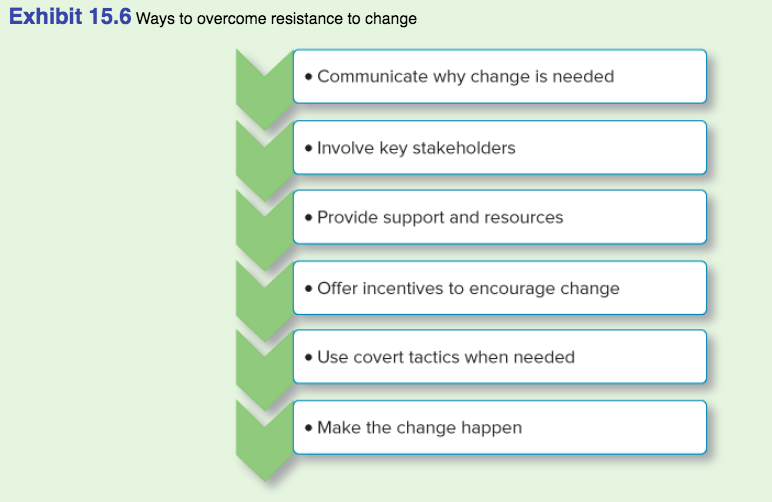
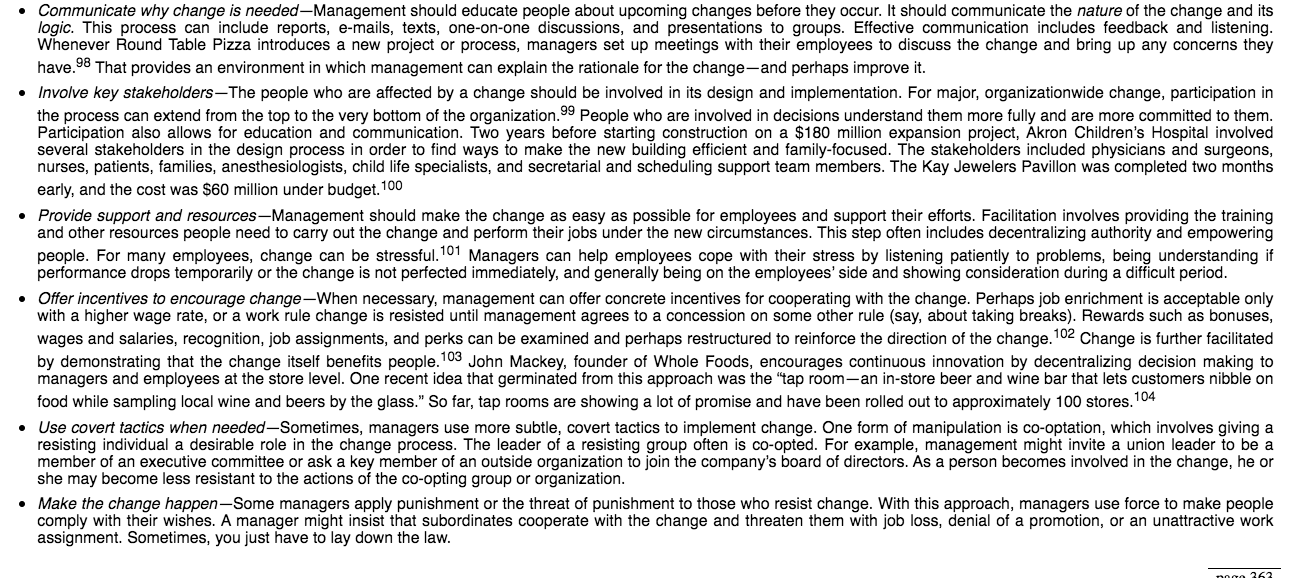
Exhibit 15.6 Ways to overcome resistance to change . Communicate why change is needed . Involve key stakeholders . Provide support and resources . Offer incentives to encourage change . Use covert tactics when needed . Make the change happenCommunicate why change is neededManagement should educate people about upcoming changes before they occur. It should communicate the nature of the change and its logic. This process can include reports, e-mails, texts, one-on-one discussions, and presentations to groups. Effective communication includes feedback and listening. Whenever Round Table Pizza introduces a new proiect or process, managers set up meetings with their employees to discuss the change and bring up any concerns they have.98 That provides an environment in which management can explain the rationale for the changeiand perhaps improve it. involve key stakeholdersThe people who are affected by a change should be involved in its design and implementation. For major, organizationwide change, participation in the process can extend from the top to the very bottom of the organization.\" People who are involved in decisions understand them more fully and are more committed to them. Participation also allows for education and communication. Two years before starting construction on a $180 million expansion project, Akron Children's Hospital involved several stakeholders in the design process in order to find ways to make the new building efficient and family-focused. The stakeholders included physicians and surgeons, nurses, patients, families, anesthesiologists, child life specialists, and secretarial and scheduling support team members. The Kay Jewelers Pavilion was completed two months early, and the cost was $60 million under budgetmn Prow'de support and resourcesManagement should make the change as easy as possible for employees and support their efforts. Facilitation involves providing the training and other resources people need to carry out the change and perform their jobs under the new circumstances. This step often includes decentralizing authority and empowering people. For many employees, change can be stressful.101 Managers can help employees cope with their stress by listening patiently to problems, being understanding if performance drops temporarily or the change is not perfected immediately, and generally being on the employees' side and showing consideration during a difficult period. O'er incentives to encourage changeiWhen necessary, management can offer concrete incentives for cooperating with the change. Perhaps job enrichment is acceptable only with a higher wage rate. or a work rule change is resisted until management agrees to a concession on some other rule (say, about taking breaks). Rewards such as bonuses, wages and salaries, recognition, iob assignments, and perks can be examined and perhaps restructured to reinforce the direction of the change.\"2 Change is further facilitated by demonstrating that the change itself benefits peoplems John Mackey, founder of Whole Foods, encourages continuous innovation by decentralizing decision making to managers and employees at the store level. One recent idea that germinated from this approach was the l'tap rooman in-store beer and wine bar that lets customers nibble on food while sampling local wine and beers by the glass." So far, tap rooms are showing a lot of promise and have been rolled out to approximately 100 stores.104 Use covert tactics when neededSometimes, managers use more subtle, covert tactics to implement change. One form of manipulation is co-optation, which involves giving a resisting individual a desirable role in the change process. The leader of a resisting group often is oo-opted. For example, management might invite a union leader to be a member of an executive committee or ask a key member of an outside organization to join the company's board of directors. As a person becomes involved in the change, he or she may become less resimant to the actions of the co-opting group or organization. Make the change happen iSome managers apply punishment or the threat of punishment to those who resist change. With this approach, managers use force to make people comply with their wishes. A manager might insist that subordinates cooperate with the change and threaten them with job loss, denial of a promotion, or an unattractive work assignment. Sometimes, you just have to lay down the law. Mm. 1:.1
Step by Step Solution
There are 3 Steps involved in it

Get step-by-step solutions from verified subject matter experts
 Study Help