



Question: Based on the information in this case, 1. Discuss what it means to be socially responsible and what factors influence that decision. 2. Explain green
Based on the information in this case,
1. Discuss what it means to be socially responsible and what factors influence that decision.
2. Explain green management and how organizations can go green.
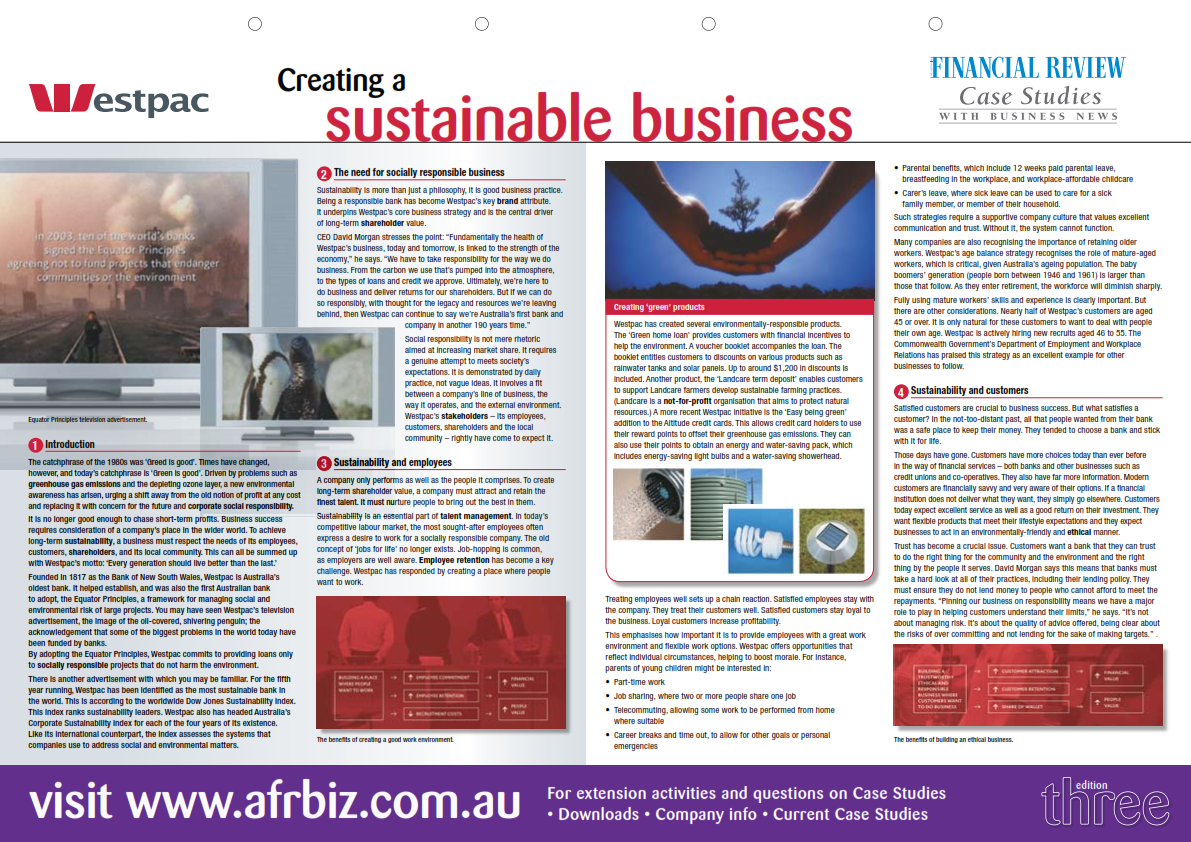
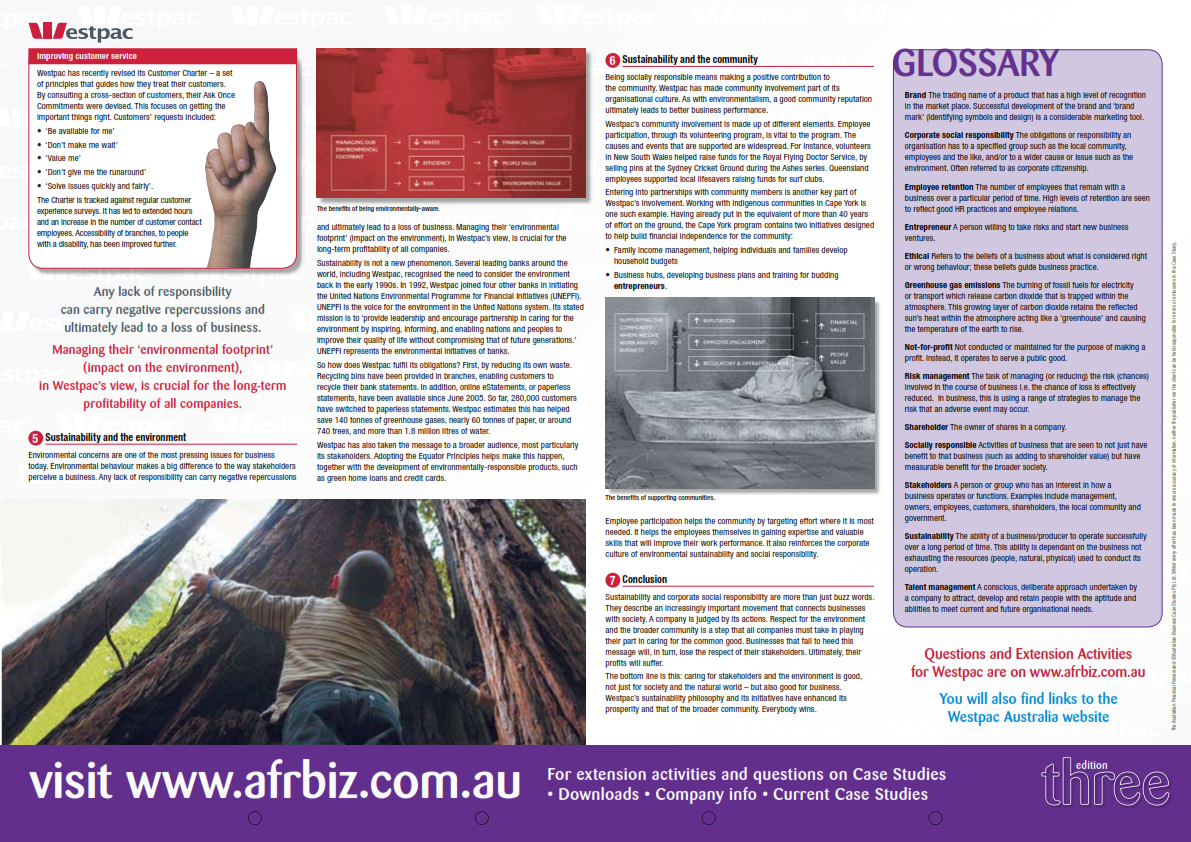
Westpac Creating a FINANCIAL REVIEW Case Studies sustainable business WITH BUSINESS NEWS in 2003, ten of the world's Banks signed the Equator Principles agreeing not to fund projects that endanger communities or the environment The need for socially responsible business Sustainability is more than just a philosophy. It is good business practice. Being a responsible bank has become Westpac's key brand attribute. t underpins Westpac's core business strategy and is the central driver of long-term shareholder value. CEO David Morgan stresses the point: "Fundamentally the health of Westpac's business, today and tomorrow, is linked to the strength of the economy," he says. "We have to take responsibility for the way we do business. From the carbon we use that's pumped into the atmosphere, to the types of loans and credit we approve. Ultimately, we're here to do business and deliver returns for our shareholders. But if we can do so responsibly, with thought for the legacy and resources we're leaving behind then Westpac can continue to say we're Australia's first bank and company in another 190 years time. Social responsibility is not mere rhetoric aimed at increasing market share. It requires a genuine attempt to meets society's expectations. It is demonstrated by dally practice, not vague ideas. It involves a fit between a company's line of business, the way It operates, and the external environment. Westpac's stakeholders - its employees, customers, shareholders and the local community-rightly have come to expect it. Creating green products Westpac has created several environmentally-responsible products. The 'Green home loan provides customers with financial Incentives to . help the environment. A voucher booklet accompanies the loan. The booklet entities customers to discounts on various products such as rainwater tanks and solar panels. Up to around $1,200 in discounts is Included. Another product, the 'Landcare term deposit enables customers to support Landcare farmers develop sustainable farming practices. Landcare is a not-for-profit organisation that alms to protect natural resources.) A more recent Westpac Initiative is the 'Easy being green addition to the Altitude credit cards. This allows credit card holders to use their reward points to offset their greenhouse gas emissions. They can also use their points to obtain an energy and water-saving pack, which Includes energy-saving light bulbs and a water-saving showerhead. Parental benefits, which include 12 weeks pald parental leave, breastfeeding in the workplace, and workplace-affordable childcare Carer's leave, where sick leave can be used to care for a sick family member, or member of their household. Such strategies require a supportive company culture that values excellent communication and trust. Without it, the system cannot function. Many companies are also recognising the importance of retaining older workers. Westpac's age balance strategy recognises the role of mature-aged workers, which is critical, given Australia's ageing population. The baby boomers' generation people born between 1946 and 1961) is larger than those that follow. As they enter retirement, the workforce will diminish sharply. Fully using mature workers' skills and experience is clearly important. But there are other considerations. Nearly half of Westpac's customers are aged 45 or over. It is only natural for these customers to want to deal with people their own age. Westpac is actively hiring new recruits aged 46 to 55. The Commonwealth Government's Department of Employment and Workplace Relations has praised this strategy as an excellent example for other businesses to follow Sustainability and customers Satisfied customers are crucial to business success. But what satisfies a customer? In the not-too-distant past, all that people wanted from their bank was a safe place to keep their money. They tended to choose a bank and stick with it for life. Those days have gone. Customers have more choices today than ever before In the way of financial services - both banks and other businesses such as credit unions and co-operatives. They also have far more information. Modern customers are financially savvy and very aware of their options. If a financial Institution does not deliver what they want, they simply go elsewhere. Customers today expect excellent service as well as a good return on their investment. They want flexible products that meet their lifestyle expectations and they expect businesses to act in an environmentally-friendly and ethical manner. Trust has become a crucial Issue. Customers want a bank that they can trust to do the right thing for the community and the environment and the right thing by the people it serves. David Morgan says this means that banks must take a hard look at all of their practices, including their lending policy. They must ensure they do not lend money to people who cannot afford to meet the repayments. "Pinning our business on responsibility means we have a major role to play in helping customers understand their limits," he says. "It's not about managing risk. It's about the quality of advice offered, being clear about the risks of over committing and not lending for the sake of making targets." Equator Principles television advertisement 3 Sustainability and employees A company only performs as well as the people it comprises. To create long-term shareholder value, a company must attract and retain the finest talent. It must nurture people to bring out the best in them. Sustainability is an essential part of talent management. In today's competitive labour market, the most sought-after employees often express a desire to work for a socially responsible company. The old concept of jobs for life' no longer exists. Job-hopping is common, as employers are well aware. Employee retention has become a key challenge. Westpac has responded by creating a place where people want to work. Introduction The catchphrase of the 1980s was "Greed is good. Times have changed, however, and today's catchphrase Is "Green is good'. Driven by problems such as greenhouse gas emissions and the depleting ozone layer, a new environmental awareness has arisen, urging a shift away from the old notion of profit at any cost and replacing it with concern for the future and corporate social responsibility. It is no longer good enough to chase short-term profits. Business success requires consideration of a company's place in the wider world. To achieve long-term sustainability, a business must respect the needs of its employees, customers, shareholders, and its local community. This can all be summed up with Westpac's motto: "Every generation should live better than the last. Founded in 1817 as the Bank of New South Wales, Westpac Is Australia's oldest bank. It helped establish, and was also the first Australian bank to adopt the Equator Principles, a framework for managing social and environmental risk of large projects. You may have seen Westpac's television advertisement, the image of the oil-covered, shivering penguin; the acknowledgement that some of the biggest problems in the world today have been funded by banks. By adopting the Equator Principles, Westpac commits to providing loans only to socially responsible projects that do not harm the environment. There is another advertisement with which you may be familiar. For the fifth year running Westpac has been identified as the most sustainable bank in the world. This is according to the worldwide Dow Jones Sustainability Index. This Index ranks sustainability leaders. Westpac also has headed Australia's Corporate Sustainability Index for each of the four years of its existence. Like Its International counterpart, the Index assesses the systems that companies use to address social and environmental matters. Treating employees well sets up a chain reaction. Satisfied employees stay with the company. They treat their customers well. Satisfied customers stay loyal to the business. Loyal customers increase profitability This emphasises how important it is to provide employees with a great work environment and flexible work options. Westpac offers opportunities that reflect Individual circumstances, helping to boost morale. For instance, parents of young children might be interested in: Part-time work Job sharing, where two or more people share one job Telecommuting, allowing some work to be performed from home where suitable Career breaks and time out, to allow for other goals or personal emergencies TWO WANT TO WA GOST TO BOSS The benefits of creating a good work environment The benefits of building an ethical business. edition visit www.afrbiz.com.au For extension activities and questions on Case Studies Downloads - Company info . Current Case Studies three CEL Westpac SER GLOSSARY Improving customer service Westpac has recently revised its Customer Charter - a set of principles that guides how they treat their customers. By consulting a cross-section of customers, their Ask Once Commitments were devised. This focuses on getting the Important things right. Customers' requests included. . Be available for me . Don't make me wait Value me . 'Don't give me the runaround Solve issues quickly and fairly The Charter is tracked against regular customer experience surveys. It has led to extended hours and an increase in the number of customer contact employees. Accessibility of branches, to people with a disability, has been improved further VIDAL FOR UROC 6 Sustainability and the community Being socially responsible means making a positive contribution to the community. Westpac has made community Involvement part of its organisational culture. As with environmentallsm, a good community reputation ultimately leads to better business performance Westpac's community Involvement is made up of different elements. Employee participation, through its volunteering program, is vital to the program. The causes and events that are supported are widespread. For instance, volunteers In New South Wales helped raise funds for the Royal Flying Doctor Service, by seling pins at the Sydney Cricket Ground during the Ashes series. Queensland employees supported local lifesavers raising funds for surf clubs. Entering into partnerships with community members is another key part of Westpac's Involvement. Working with Indigenous communities in Cape York is one such example. Having already put in the equivalent of more than 40 years of effort on the ground, the Cape York program contains two Initiatives designed to help build financial Independence for the community Family Income management, helping Individuals and familles develop household budgets Business hubs, developing business plans and training for budding entrepreneurs + STATION FINANCIAL WA The benefits of being environmentally-aware and ultimately lead to a loss of business. Managing their environmental footprint (Impact on the environment), in Westpac's view, is crucial for the long-term profitability of all companies. Sustainability is not a new phenomenon. Several leading banks around the world, including Westpac, recognised the need to consider the environment back in the early 1990s. In 1992, Westpac joined four other banks In Initiating the United Nations Environmental Programme for Financial Initiatives (UNEPFI). UNEPFI is the voice for the environment in the United Nations system. Its stated mission is to provide leadership and encourage partnership in caring for the environment by Inspiring, informing, and enabling nations and peoples to Improve their quality of life without compromising that of future generations. UNEPFI represents the environmental Initiatives of banks. So how does Westpac fuifll its obligations? First, by reducing its own waste. Recycling bins have been provided in branches, enabling customers to recycle their bank statements. In addition, online eStatements, or paperless statements, have been available since June 2005. So far, 280,000 customers have switched to paperless statements. Westpac estimates this has helped save 140 tonnes of greenhouse gases, nearly 60 tonnes of paper or around 740 trees, and more than 1.8 million litres of water. Westpac has also taken the message to a broader audience, most particularly its stakeholders. Adopting the Equator Principles helps make this happen, together with the development of environmentally-responsible products, such as green home loans and credit cards. Any lack of responsibility can carry negative repercussions and ultimately lead to a loss of business. Managing their 'environmental footprint (impact on the environment), in Westpac's view, is crucial for the long-term profitability of all companies. + SINGAGEMENE FOR Brand The trading name of a product that has a high level of recognition In the market place. Successful development of the brand and brand mark Identifying symbols and design is a considerable marketing tool. Corporate social responsibility The obligations or responsibility an organisation has to a specified group such as the local community employees and the like, and/or to a wider cause or issue such as the environment. Often referred to as corporate citizenship. Employee retention The number of employees that remain with a business over a particular period of time. High levels of retention are seen to reflect good HR practices and employee relations Entrepreneur A person willing to take risks and start new business ventures. Ethical Refers to the beliefs of a business about what is considered right or wrong behaviour, these beliefs gulde business practice. Greenhouse gas emissions The burning of fossil fuels for electricity or transport which release carbon dioxide that is trapped within the atmosphere. This growing layer of carbon dioxide retains the reflected sun's heat within the atmosphere acting like a greenhouse' and causing the temperature of the earth to rise. Not-for-profit Not conducted or maintained for the purpose of making a profit. Instead, It operates to serve a public good. Risk management The task of managing (or reducing the risk (chances) Involved in the course of business l.e. the chance of loss is effectively reduced. In business, this is using a range of strategies to manage the risk that an adverse event may occur. . Shareholder The owner of shares in a company Socially responsible Activities of business that are seen to not just have benefit to that business (such as adding to shareholder value) but have measurable benefit for the broader society. Stakeholders A person or group who has an interest in how a business operates or functions. Examples include management, owners, employees, customers, shareholders, the local community and government Sustainability The ability of a business/producer to operate successfully over a long period of time. This ability is dependent on the business not exhausting the resources (people, natural, physical) used to conduct its operation Talent management A conscious, deliberate approach undertaken by a company to attract, develop and retain people with the aptitude and abilities to meet current and future organisational needs. BERSTAGRAM 5 Sustainability and the environment Environmental concerns are one of the most pressing issues for business today. Environmental behaviour makes a big difference to the way stakeholders percelve a business. Any lack of responsibility can carry negative repercussions The benefits of supporting communities Employee participation helps the community by targeting effort where it is most needed. It helps the employees themselves in galning expertise and valuable Skills that will improve their work performance. It also reinforces the corporate culture of environmental sustainability and social responsibility Conclusion Sustainability and corporate social responsibility are more than just buzz words. They describe an increasingly important movement that connects businesses with society. A company is judged by its actions. Respect for the environment and the broader community is a step that all companies must take in playing their part in caring for the common good. Businesses that fail to heed this message will. In turn, lose the respect of their stakeholders.Ultimately, their profits will suffer. The bottom line is this: caring for stakeholders and the environment is good, not just for society and the natural world - but also good for business. Westpac's sustainability philosophy and Its Initiatives have enhanced its prosperity and that of the broader community. Everybody wins. Questions and Extension Activities for Westpac are on www.afrbiz.com.au You will also find links to the Westpac Australia website edition visit www.afrbiz.com.au For extension activities and questions on Case Studies Downloads - Company info . Current Case Studies threeStep by Step Solution
There are 3 Steps involved in it
1 Expert Approved Answer
Step: 1 Unlock

Question Has Been Solved by an Expert!
Get step-by-step solutions from verified subject matter experts
Step: 2 Unlock
Step: 3 Unlock