Question: Based on the mentioned case study, please make an pareto chart representing all the data provided. Introduction This case study explores why delays in deliveries
Based on the mentioned case study, please make an pareto chart representing all the data provided.
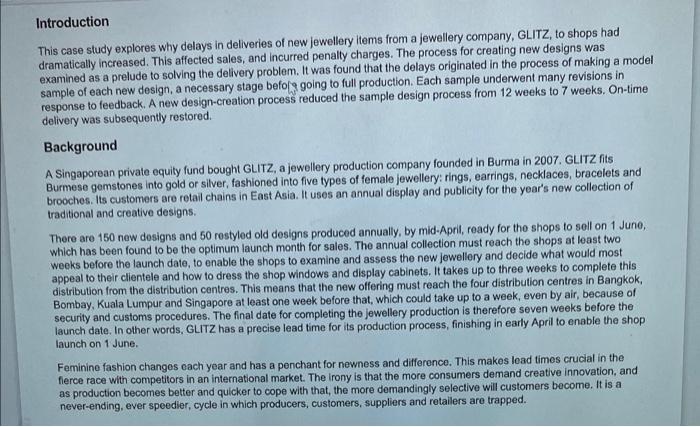
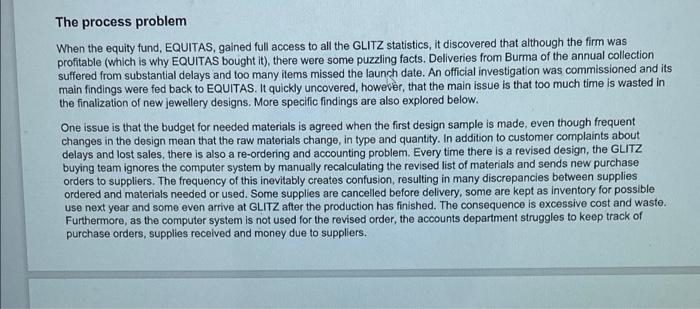
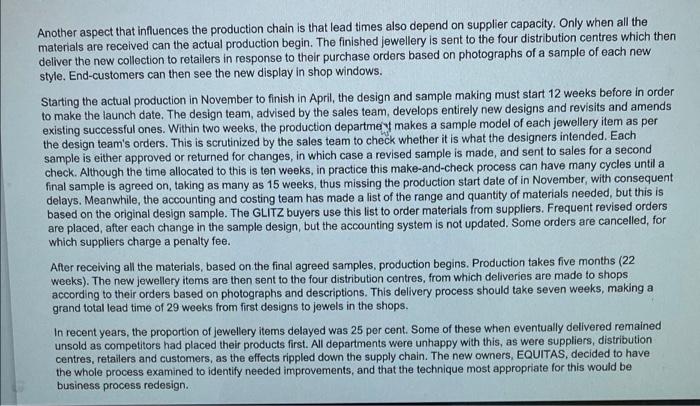
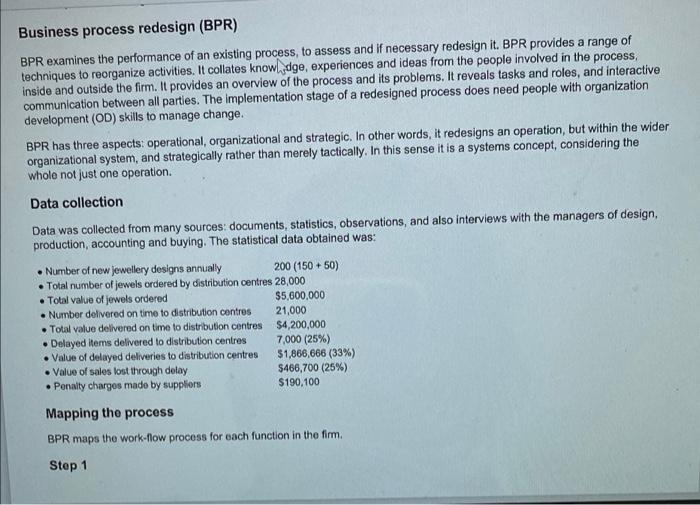
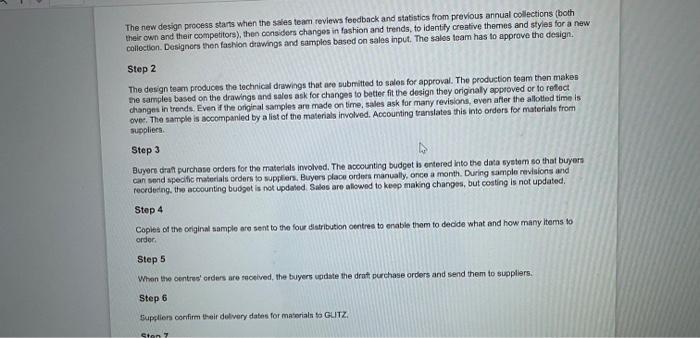
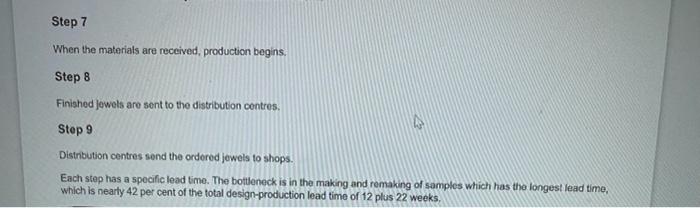
Introduction This case study explores why delays in deliveries of new jewellery items from a jewellery company, GLITZ, to shops had dramatically increased. This affected sales, and incurred penalty charges. The process for creating new designs was examined as a prelude to solving the delivery problem. It was found that the delays originated in the process of making a model sample of each new design, a necessary stage before going to full production. Each sample underwent many revisions in response to feedback. A new design-creation process reduced the sample design process from 12 weeks to 7 weeks. On-time delivery was subsequently restored Background A Singaporean private equity fund bought GLITZ, a jewellery production company founded in Burma in 2007. GLITZ fits Burmese gemstones into gold or silver, fashioned into five types of female jewellery: rings, earrings, necklaces, bracelets and brooches. Its customers are retail chains in East Asia. It uses an annual display and publicity for the year's new collection of traditional and creative designs. There are 150 new designs and 50 rostyled old designs produced annually, by mid-April, ready for the shops to sell on 1 June, which has been found to be the optimum launch month for sales. The annual collection must reach the shops at least two weeks before the launch date, to enable the shops to examine and assess the new jewellery and decide what would most appeal to their clientele and how to dress the shop windows and display cabinets. It takes up to three weeks to complete this distribution from the distribution centres. This means that the new offering must reach the four distribution centres in Bangkok, Bombay, Kuala Lumpur and Singapore at least one week before that, which could take up to a week, even by air, because of security and customs procedures. The final date for completing the jewellery production is therefore seven weeks before the launch date. In other words, GLITZ has a precise lead time for its production process, finishing in early April to enable the shop launch on 1 June. Feminino fashion changes each year and has a penchant for nowness and difference. This makes lead times crucial in the flerce race with competitors in an international market. The Irony is that the more consumers demand creative innovation, and as production becomes better and quicker to cope with that, the more demandingly selective will customers become. It is a never-ending, ever speedier, cycle in which producers, customers, suppliers and retailers are trapped. The process problem When the equity fund, EQUITAS, gained full access to all the GLITZ statistics, it discovered that although the firm was profitable (which is why EQUITAS bought it), there were some puzzling facts. Deliveries from Burma of the annual collection suffered from substantial delays and too many items missed the launch date. An official investigation was commissioned and its main findings were fed back to EQUITAS. It quickly uncovered, however, that the main issue is that too much time is wasted in the finalization of new jewellery designs. More specific findings are also explored below. One issue is that the budget for needed materials is agreed when the first design sample is made, even though frequent changes in the design mean that the raw materials change, in type and quantity. In addition to customer complaints about delays and lost sales, there is also a re-ordering and accounting problem. Every time there is a revised design, the GLITZ buying team ignores the computer system by manually recalculating the revised list of materials and sends new purchase orders to suppliers. The frequency of this inevitably creates confusion, resulting in many discrepancies between supplies ordered and materials needed or used. Some supplies are cancelled before delivery, some are kept as inventory for possible use next year and some even arrive at GLITZ after the production has finished. The consequence is excessive cost and waste. Furthermore, as the computer system is not used for the revised order, the accounts department struggles to keep track of purchase orders, supplies recelved and money due to suppliers. Another aspect that influences the production chain is that lead times also depend on supplier capacity. Only when all the materials are received can the actual production begin. The finished Jewellery is sent to the four distribution centres which then deliver the new collection to retailers in response to their purchase orders based on photographs of a sample of each new style. End-customers can then see the new display in shop windows. Starting the actual production in November to finish in April, the design and sample making must start 12 weeks before in order to make the launch date. The design team, advised by the sales team develops entirely new designs and revisits and amends existing successful ones. Within two weeks, the production departmey makes a sample model of each jewellery item as per the design team's orders. This is scrutinized by the sales team to check whether it is what the designers intended. Each sample is either approved or returned for changes, in which case a revised sample is made, and sent to sales for a second check. Although the time allocated to this is ten weeks, in practice this make-and-check process can have many cycles until a final sample is agreed on, taking as many as 15 weeks, thus missing the production start date of in November, with consequent delays. Meanwhile, the accounting and costing team has made a list of the range and quantity of materials needed, but this is based on the original design sample. The GLITZ buyers use this list to order materials from suppliers. Frequent revised orders are placed, after each change in the sample design, but the accounting system is not updated. Some orders are cancelled, for which suppliers charge a penalty fee. After receiving all the materials, based on the final agreed samples, production begins. Production takes five months (22 weeks). The new jewellery items are then sent to the four distribution centres, from which deliveries are made to shops according to their orders based on photographs and descriptions. This delivery process should take seven weeks, making a grand total lead time of 29 weeks from first designs to jewels in the shops. In recent years, the proportion of jewellery items delayed was 25 per cent. Some of these when eventually delivered remained unsold as competitors had placed their products first. All departments were unhappy with this, as were suppliers, distribution centres, retailers and customers, as the effects rippled down the supply chain. The new owners, EQUITAS, decided to have the whole process examined to identify needed improvements, and that the technique most appropriate for this would be business process redesign. Business process redesign (BPR) BPR examines the performance of an existing process, to assess and if necessary redesign it. BPR provides a range of techniques to reorganize activities. It collates knowl,dge, experiences and ideas from the people involved in the process, inside and outside the firm. It provides an overview of the process and its problems. It reveals tasks and roles, and interactive communication between all parties. The implementation stage of a redesigned process does need people with organization development (OD) skills to manage change. BPR has three aspects: operational organizational and strategic. In other words, it redesigns an operation, but within the wider organizational system, and strategically rather than merely tactically. In this sense it is a systems concept, considering the whole not just one operation. Data collection Data was collected from many sources: documents, statistics, observations, and also interviews with the managers of design, production, accounting and buying. The statistical data obtained was: Number of new jewellery designs annually 200 (150 + 50) Total number of jewels ordered by distribution centres 28,000 Total value of jewels ordered $5,000,000 Number delivered on time to distribution centres 21,000 Total value delivered on time to distribution centres $4,200,000 Delayed items delivered to distribution centres 7,000 (25%) Value of delayed deliveries to distribution centres $1,866,666 (33%) Value of sales lost through dolay $466,700 (25%) Penalty charges made by suppliers $190,100 Mapping the process BPR maps the work-flow process for each function in the firm Step 1 The new design process starts when the sales team reviews feedback and statistics from previous annual collections (both their own and their competitors), then considers changes in fashion and trends, to identify creative themes and styles for a new collection Designers then fashion drawings and samples based on sales input. The sales team has to approve the design. Step 2 The design team produces the technical drawings that are submitted to sales for approval. The production team then makes the samples based on the drawings and sales ask for changes to better fit the design they originaly approved or to reflect changes in trends. Even the original samples are made on time, sales ask for many revisions, even after the allotted time is over. The sample is accompanied by a list of the materials involved. Accounting translates this into orders for materials from suppliers Step 3 Buyers draft purchase orders for the materials involved. The accounting budget is entered into the data system so that buyers can send specific materials orders to suppliers, Buyers place orders manually, once a month. During sample revisions and reordering the accounting budget is not updated Sales are allowed to keep making changes, but costing is not updated, Step 4 Copies of the original sample are sent to the four distribution centres to enable them to decide what and how many items to order: Step 5 When the centres' orders are received, the buyers update the dratt purchase orders and send them to suppliers Step 6 Suppliers confirm their delivery dates for materials to GUTZ Son 7 Step 7 When the materials are received, production begins. Step 8 Finished Jowels are sent to the distribution contres. Step 9 Distribution centres send the ordered jewels to shops. Each step has a specific lead time. The bottleneck is in the making and remaking of samples which has the longest load time, which is nearly 42 per cent of the total design-production lead time of 12 plus 22 weeks









 Study Help