Question: Based on this person's feedback on the essay, improve the essay by their feedbacks? Past, Present, or Future?, (make sure your using one tense and
Based on this person's feedback on the essay, improve the essay by their feedbacks?
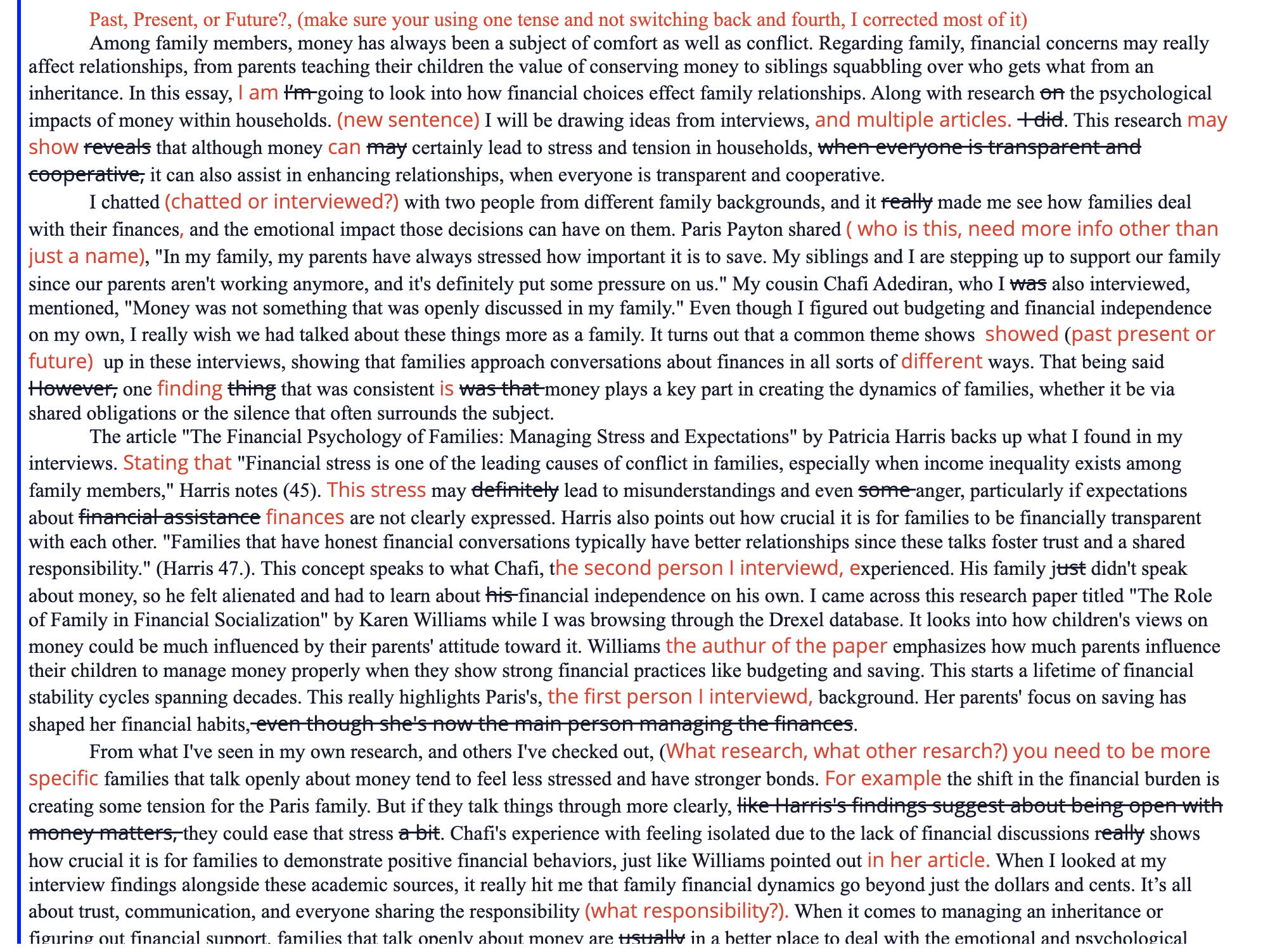
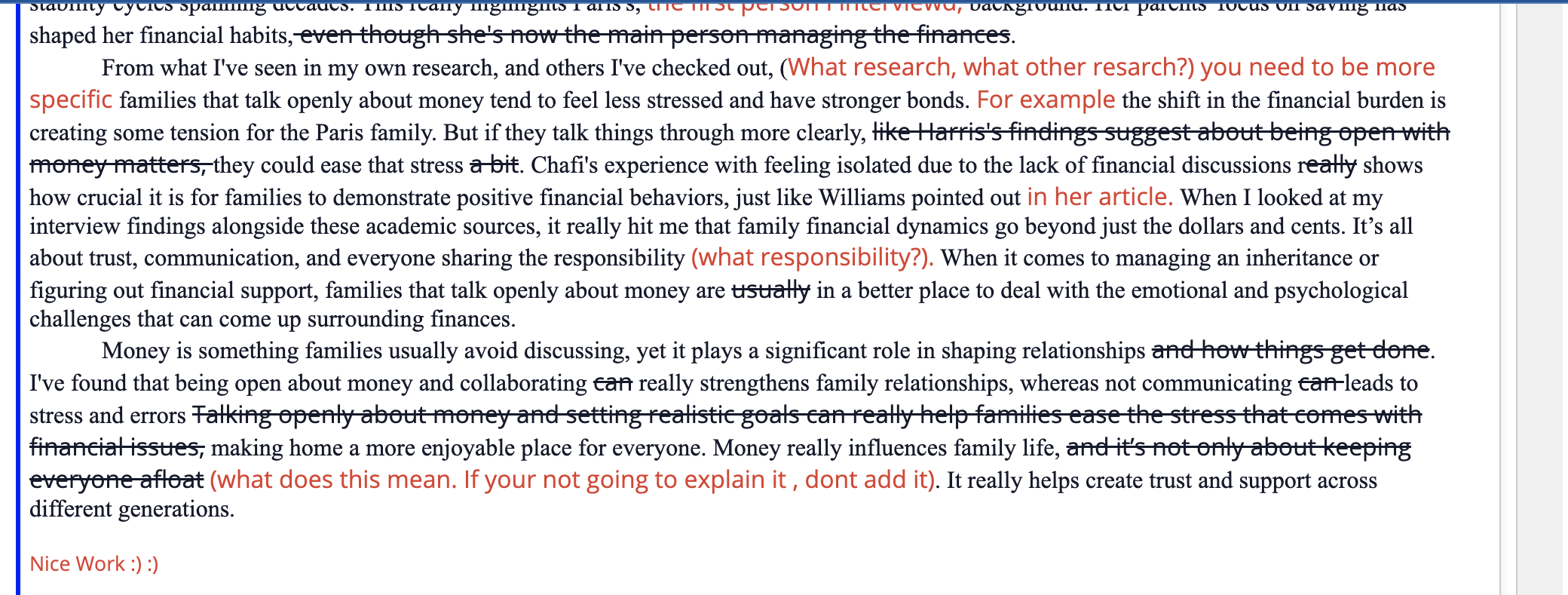
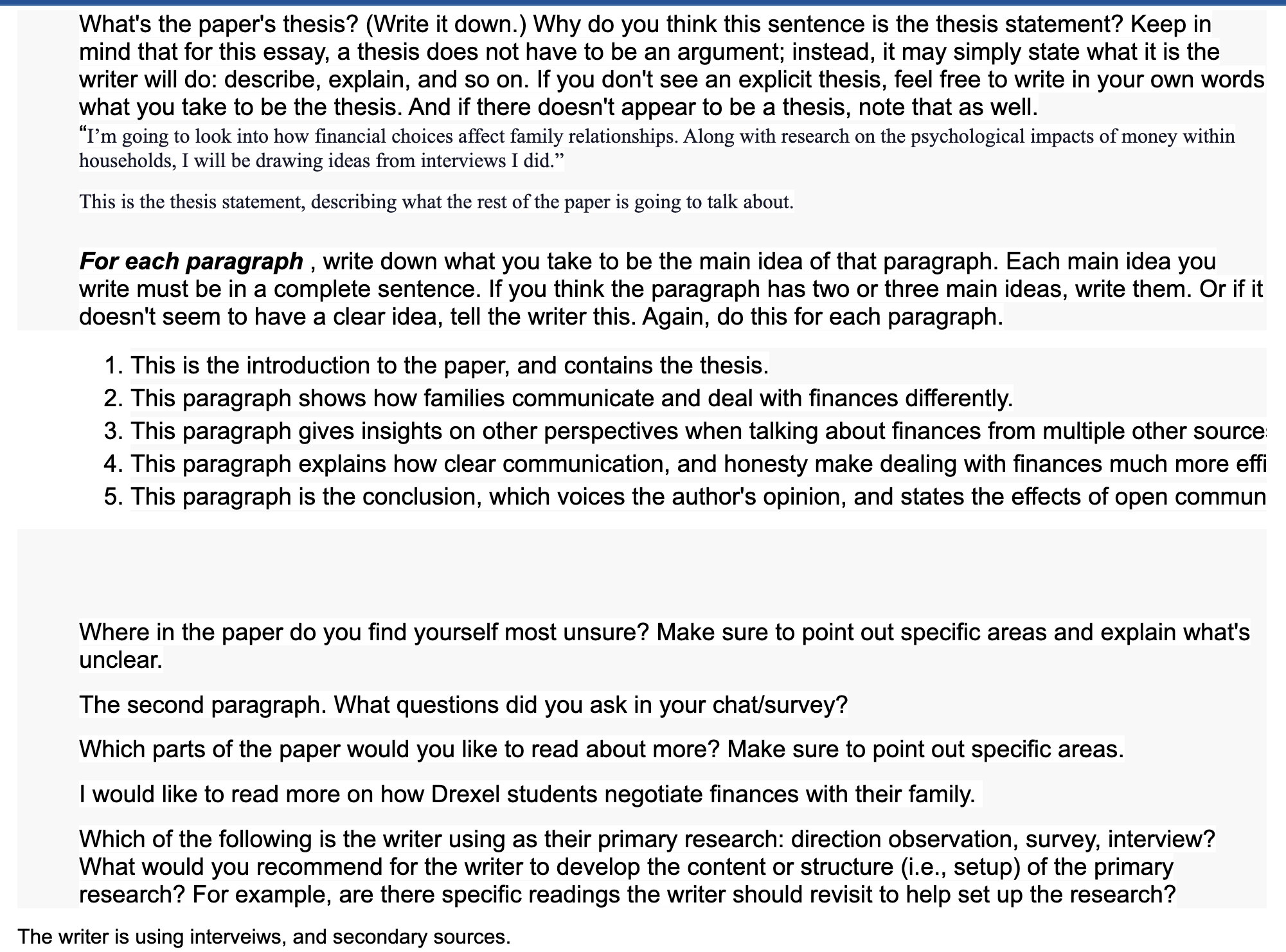
Past, Present, or Future?, (make sure your using one tense and not switching back and fourth, I corrected most of it) Among family members, money has always been a subject of comfort as well as conflict. Regarding family, financial concerns may really affect relationships, from parents teaching their children the value of conserving money to siblings squabbling over who gets what from an inheritance. In this essay, I am I'm going to look into how financial choices effect family relationships. Along with research on the psychological impacts of money within households. (new sentence) I will be drawing ideas from interviews, and multiple articles. +did. This research may show reveals that although money can may certainly lead to stress and tension in households, when everyone is transparent and cooperative, it can also assist in enhancing relationships, when everyone is transparent and cooperative. I chatted (chatted or interviewed?) with two people from different family backgrounds, and it really made me see how families deal with their finances, and the emotional impact those decisions can have on them. Paris Payton shared ( who is this, need more info other than just a name), "In my family, my parents have always stressed how important it is to save. My siblings and I are stepping up to support our family since our parents aren't working anymore, and it's definitely put some pressure on us." My cousin Chafi Adediran, who I was also interviewed, mentioned, "Money was not something that was openly discussed in my family." Even though I figured out budgeting and financial independence on my own, I really wish we had talked about these things more as a family. It turns out that a common theme shows showed (past present or future) up in these interviews, showing that families approach conversations about finances in all sorts of different ways. That being said However, one finding thing that was consistent is was that money plays a key part in creating the dynamics of families, whether it be via shared obligations or the silence that often surrounds the subject. The article "The Financial Psychology of Families: Managing Stress and Expectations" by Patricia Harris backs up what I found in my interviews. Stating that "Financial stress is one of the leading causes of conflict in families, especially when income inequality exists among family members," Harris notes (45). This stress may definitely lead to misunderstandings and even some anger, particularly if expectations about financial assistance finances are not clearly expressed. Harris also points out how crucial it is for families to be financially transparent with each other. "Families that have honest financial conversations typically have better relationships since these talks foster trust and a shared responsibility." (Harris 47.). This concept speaks to what Chafi, the second person I interviewd, experienced. His family just didn't speak about money, so he felt alienated and had to learn about his financial independence on his own. I came across this research paper titled "The Role of Family in Financial Socialization" by Karen Williams while I was browsing through the Drexel database. It looks into how children's views on money could be much influenced by their parents' attitude toward it. Williams the authur of the paper emphasizes how much parents influence their children to manage money properly when they show strong financial practices like budgeting and saving. This starts a lifetime of financial stability cycles spanning decades. This really highlights Paris's, the first person I interviewd, background. Her parents' focus on saving has shaped her financial habits, even though she's now the main person managing the finances. From what I've seen in my own research, and others I've checked out, (What research, what other resarch?) you need to be more specific families that talk openly about money tend to feel less stressed and have stronger bonds. For example the shift in the financial burden is creating some tension for the Paris family. But if they talk things through more clearly, like Harris's findings suggest about being open with money matters, they could ease that stress a bit. Chafi's experience with feeling isolated due to the lack of financial discussions really shows how crucial it is for families to demonstrate positive financial behaviors, just like Williams pointed out in her article. When I looked at my interview findings alongside these academic sources, it really hit me that family financial dynamics go beyond just the dollars and cents. It's all about trust, communication, and everyone sharing the responsibility (what responsibility?). When it comes to managing an inheritance or figuring out financial sunnort. families that talk onenlv about money are usually in a better place to deal with the emotional and navchologicalTewu, background. THI parties Tots Off saving Has shaped her financial habits, even though she's now the main person managing the finances. From what I've seen in my own research, and others I've checked out, (What research, what other resarch?) you need to be more specific families that talk openly about money tend to feel less stressed and have stronger bonds. For example the shift in the financial burden is creating some tension for the Paris family. But if they talk things through more clearly, like Harris's findings suggest about being open with money matters, they could ease that stress a bit. Chafi's experience with feeling isolated due to the lack of financial discussions really shows how crucial it is for families to demonstrate positive financial behaviors, just like Williams pointed out in her article. When I looked at my interview findings alongside these academic sources, it really hit me that family financial dynamics go beyond just the dollars and cents. It's all about trust, communication, and everyone sharing the responsibility (what responsibility?). When it comes to managing an inheritance or figuring out financial support, families that talk openly about money are usually in a better place to deal with the emotional and psychological challenges that can come up surrounding finances. Money is something families usually avoid discussing, yet it plays a significant role in shaping relationships and how things get done. I've found that being open about money and collaborating can really strengthens family relationships, whereas not communicating can-leads to stress and errors Talking openly about money and setting realistic goals can really help families ease the stress that comes with financial issues, making home a more enjoyable place for everyone. Money really influences family life, and it's not only about keeping everyone afloat (what does this mean. If your not going to explain it , dont add it). It really helps create trust and support across different generations. Nice Work :) :)What's the paper's thesis? (Write it down.) Why do you think this sentence is the thesis statement? Keep in mind that for this essay, a thesis does not have to be an argument; instead, it may simply state what it is the writer will do: describe, explain, and so on. If you don't see an explicit thesis, feel free to write in your own words what you take to be the thesis. And if there doesn't appear to be a thesis, note that as well. \"I''m going to look into how financial choices affect family relationships. Along with research on the psychological impacts of money within households, I will be drawing ideas from interviews I did.\" This is the thesis statement, describing what the rest of the paper is going to talk about. For each paragraph , write down what you take to be the main idea of that paragraph. Each main idea you write must be in a complete sentence. If you think the paragraph has two or three main ideas, write them. Or if it doesn't seem to have a clear idea, tell the writer this. Again, do this for each paragraph. 1. This is the introduction to the paper, and contains the thesis. 2. This paragraph shows how families communicate and deal with finances differently. 3. This paragraph gives insights on other perspectives when talking about finances from multiple other source 4. This paragraph explains how clear communication, and honesty make dealing with finances much more effi 5. This paragraph is the conclusion, which voices the author's opinion, and states the effects of open commun Where in the paper do you find yourself most unsure? Make sure to point out specific areas and explain what's unclear. The second paragraph. What questions did you ask in your chat/survey? Which parts of the paper would you like to read about more? Make sure to point out specific areas. | would like to read more on how Drexel students negotiate finances with their family. Which of the following is the writer using as their primary research: direction observation, survey, interview? What would you recommend for the writer to develop the content or structure (i.e., setup) of the primary research? For example, are there specific readings the writer should revisit to help set up the research? The writer is using interveiws, and secondary sources
Step by Step Solution
There are 3 Steps involved in it
1 Expert Approved Answer
Step: 1 Unlock
Question Has Been Solved by an Expert!
Get step-by-step solutions from verified subject matter experts
Step: 2 Unlock
Step: 3 Unlock
Students Have Also Explored These Related Business Writing Questions!









 Study Help