







Question: Based upon the case study, Merging American Airlines and US Airways (A) By: David G. Fubini , David A. Garvin and Carin-Isabel Knoop Summarize the
Based upon the case study, Merging American Airlines and US Airways (A)
By: David G. Fubini, David A. Garvin and Carin-Isabel Knoop
Summarize the following screenshots of the case study with important relevant points, under the individual headings
1. Integration Management Leader/office
2. initial launch activity
3. designing staffing and running the integration management office
4. one or two in the box
5. Adopt and Go or Best of Both
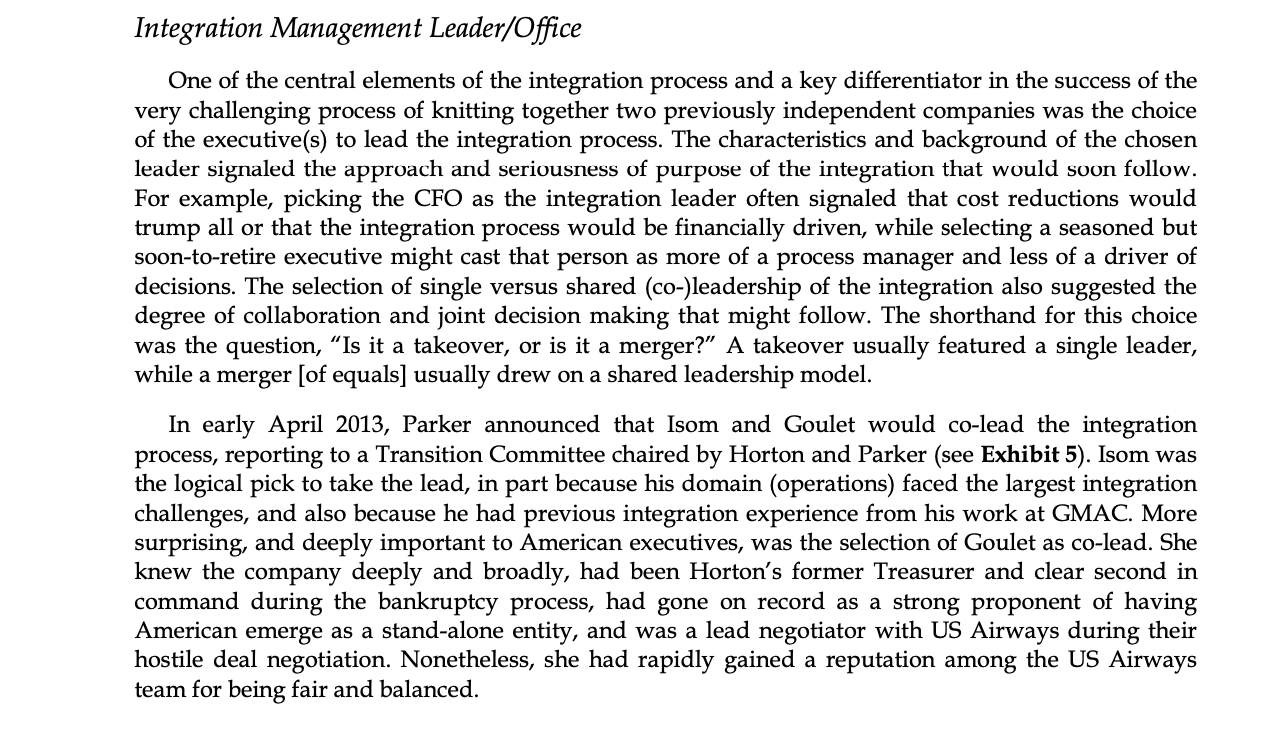
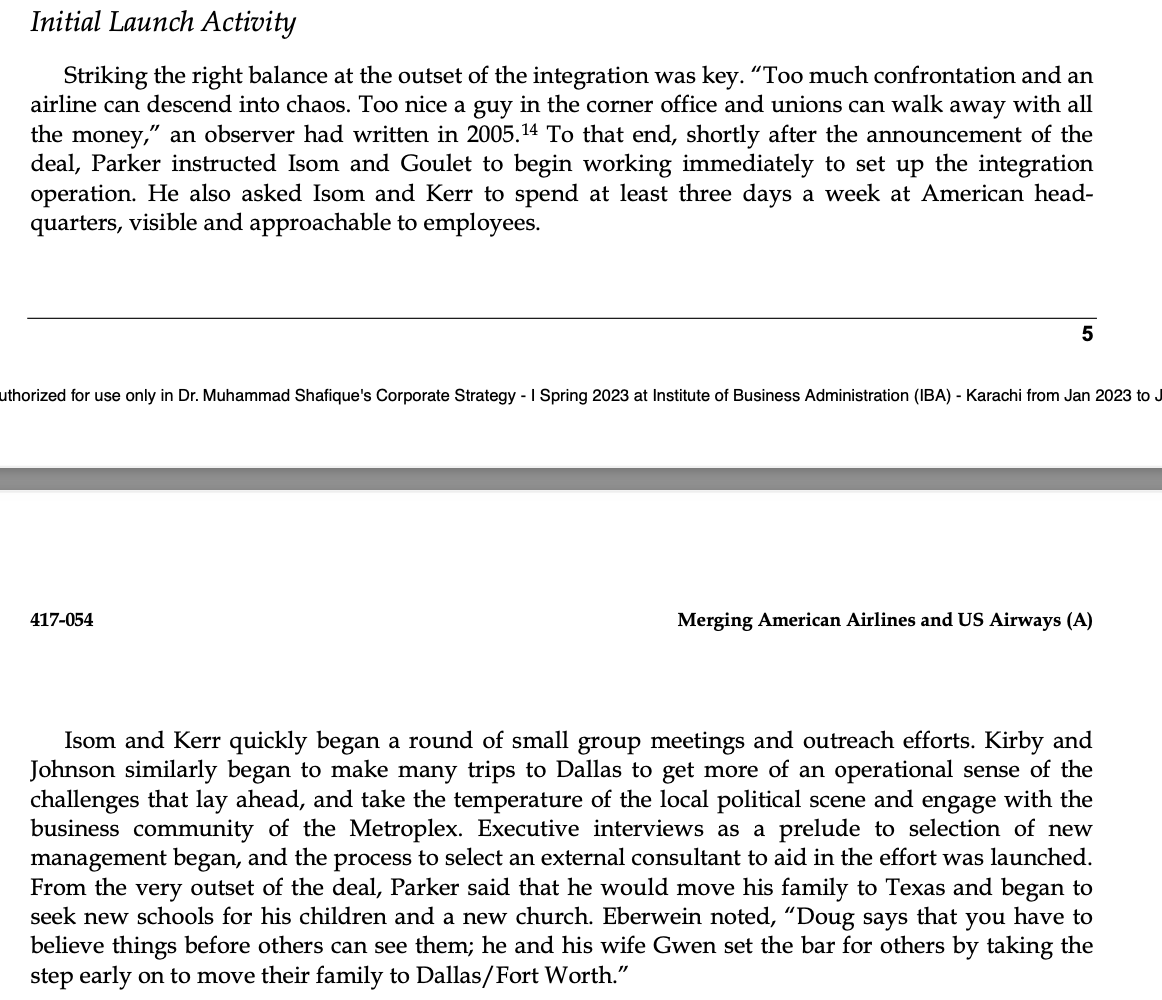
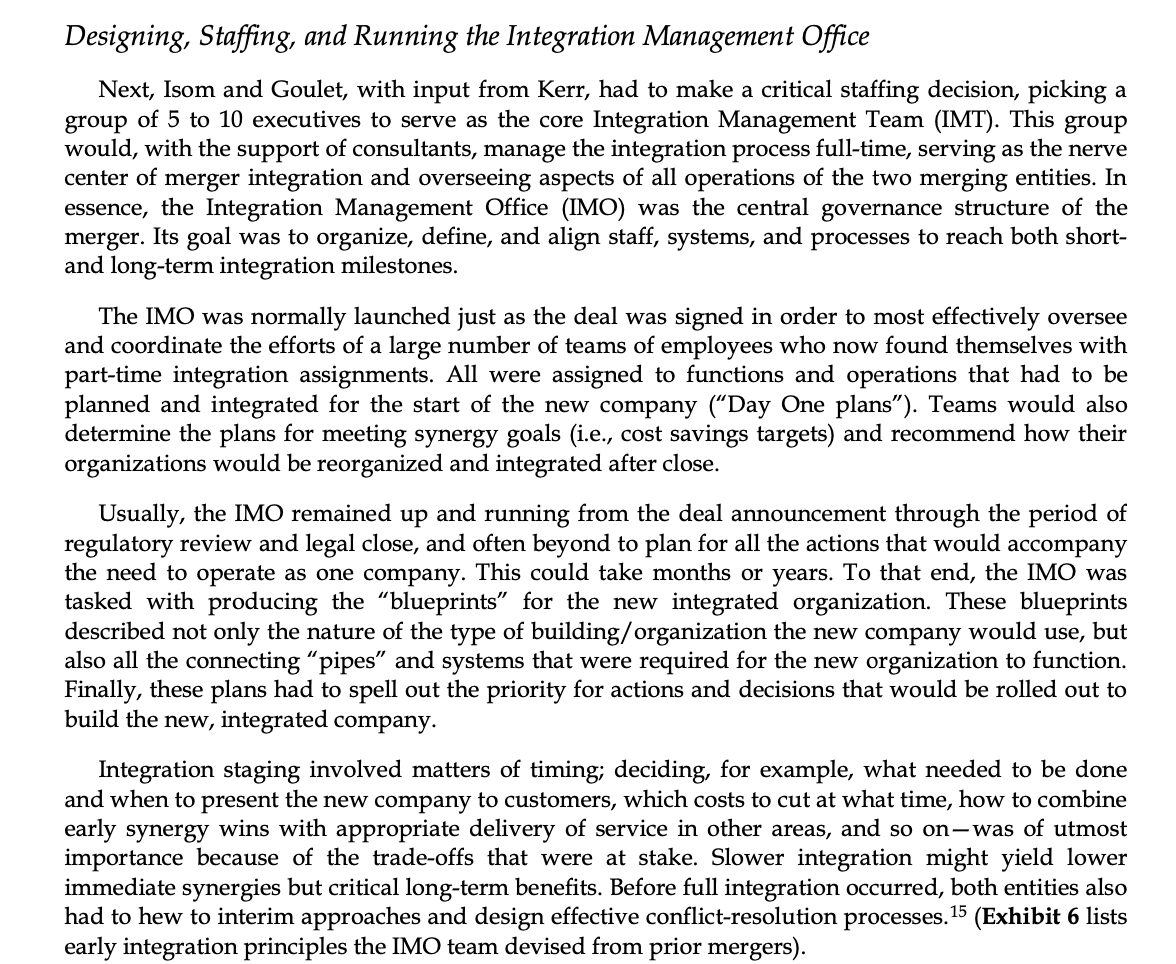
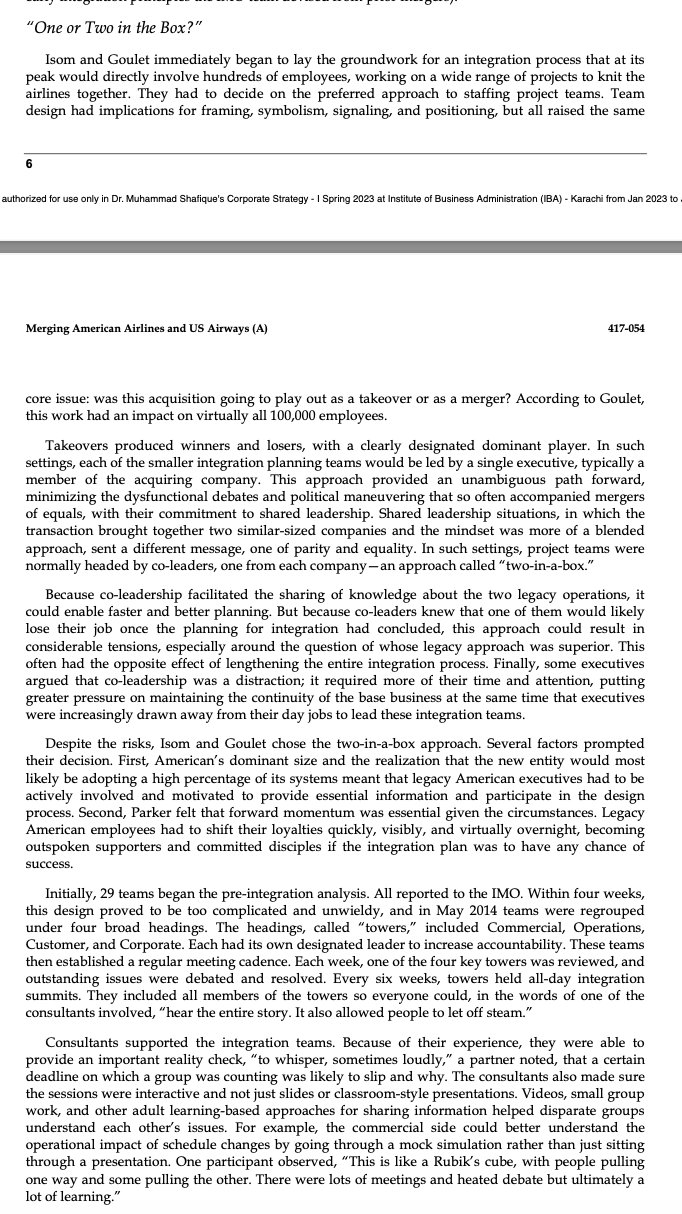
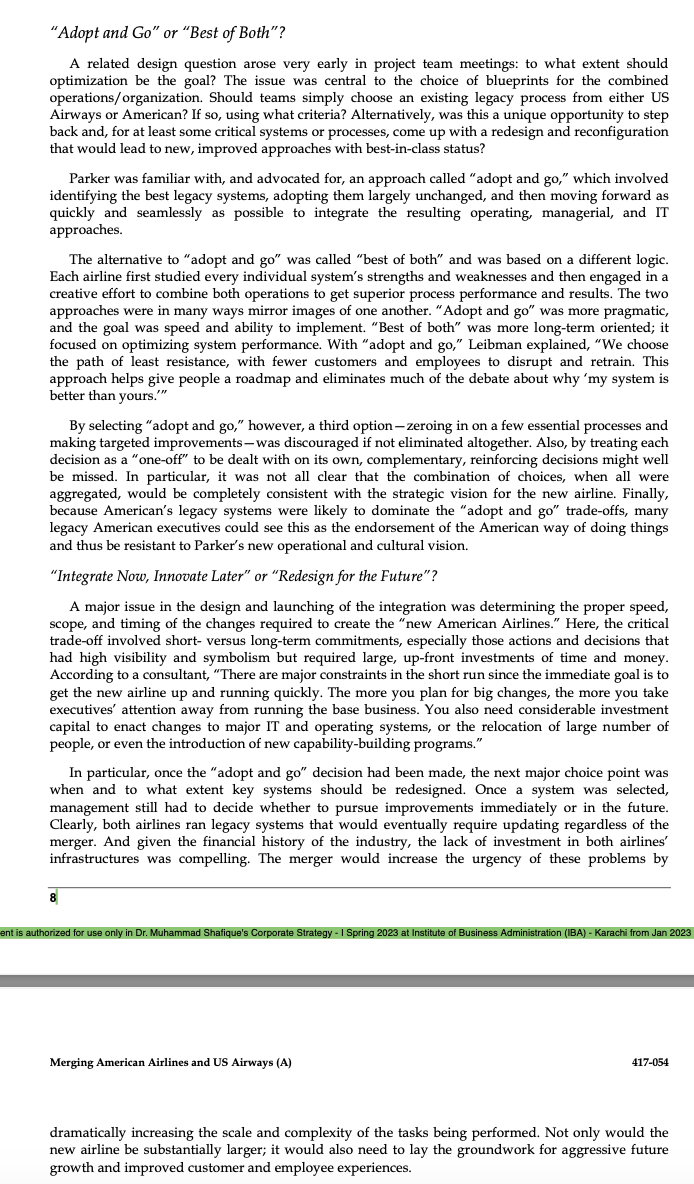
Integration Management Leader/Oce One of the central elements of the integration process and a key differentiator in the success of the very challenging process of knitting together two previously independent companies was the choice of the executive(s) to lead the integration process. The characteristics and background of the chosen leader signaled the approach and seriousness of purpose of the integration that would soon follow. For example, picking the CFO as the integration leader often signaled that cost reductions would trump all or that the integration process would be financially driven, while selecting a seasoned but soon-to-retire executive might cast that person as more of a process manager and less of a driver of decisions. The selection of single versus shared (co-)leadership of the integration also suggested the degree of collaboration and joint decision making that might follow. The shorthand for this choice was the question, \"Is it a takeover, or is it a merger?" A takeover usually featured a single leader, while a merger [of equals] usually drew on a shared leadership model. In early April 2013, Parker announced that Isom and Goulet would co-lead the integration process, reporting to a Transition Committee chaired by Horton and Parker (see Exhibit 5). Isom was the logical pick to take the lead, in part because his domain (operations) faced the largest integration challenges, and also because he had previous integration experience from his work at GMAC. More surprising, and deeply important to American executives, was the selection of Goulet as co-lead. She knew the company deeply and broadly, had been Horton's former Treasurer and clear second in command during the bankruptcy process, had gone on record as a strong proponent of having American emerge as a standalone entity, and was a lead negotiator with US Airways during their hostile deal negotiation. Nonetheless, she had rapidly gained a reputation among the US Airways team for being fair and balanced. Initial Launch Activity Striking the right balance at the outset of the integration was key. \"Too much confrontation and an airline can descend into chaos. Too nice a guy in the comer office and unions can walk away with all the money," an observer had written in 2005.14 To that end, shortly after the announcement of the deal, Parker instructed Isom and Goulet to begin working immediately to set up the integration operation. He also asked Isom and Kerr to spend at least three days a week at American head quarters, visible and approachable to employees. uthorized for use only in Dr. Muhammad Shaque's Corporate Strategy - | Spring 2023 at Institute of Business Administration (IBA} - Karachi irom Jan 2023 to J 417-054 Merging American Airlines and US Airways (A) Isom and Kerr quickly began a round of small group meetings and outreach efforts. Kirby and Johnson similarly began to make many trips to Dallas to get more of an operational sense of the challenges that lay ahead, and take the temperature of the local political scene and engage with the business community of the Metroplex. Executive interviews as a prelude to selection of new management began, and the process to select an external consultant to aid in the effort was launched. From the very outset of the deal, Parker said that he would move his family to Texas and began to seek new schools for his children and a new church. Eberwein noted, "Doug says that you have to believe things before others can see them; he and his wife Gwen set the bar for others by taking the step early on to move their family to Dallas / Fort Worth. " Designing, Sta'ing, and Running the Integration Management Oice Next, Isom and Goulet, with input from Kerr, had to make a critical staffing decision, picking a group of 5 to 10 executives to serve as the core Integration Management Team (IMT). This group would, with the support of consultants, manage the integration process full-time, serving as the nerve center of merger integration and overseeing aspects of all operations of the two merging entities. In essence, the Integration Management Office (IMO) was the central governance structure of the merger. Its goal was to organize, define, and align staff, systems, and processes to reach both short- and long-term integration milestones. The IMO was normally launched just as the deal was signed in order to most effectively oversee and coordinate the efforts of a large number of teams of employees who now found themselves with part-time integration assignments. All were assigned to functions and operations that had to be planned and integrated for the start of the new company ("Day One plans"). Teams would also determine the plans for meeting synergy goals (i.e., cost savings targets) and recommend how their organizations would be reorganized and integrated after close. Usually, the IMO remained up and running from the deal announcement through the period of regulatory review and legal close, and often beyond to plan for all the actions that would accompany the need to operate as one company. This could take months or years. To that end, the IMO was tasked with producing the \"blueprints" for the new integrated organization. These blueprints described not only the nature of the type of building/ organization the new company would use, but also all the connecting "pipes\" and systems that were required for the new organization to function. Finally, these plans had to spell out the priority for actions and decisions that would be rolled out to build the new, integrated company. Integration staging involved matters of timing; deciding, for example, what needed to be done and when to present the new company to customers, which costs to cut at what time, how to combine early synergy wins with appropriate delivery of service in other areas, and so onwas of utmost importance because of the trade-offs that were at stake. Slower integration might yield lower immediate synergies but critical long-term benefits. Before full integration occurred, both entities also had to hew to interim approaches and design effective conflict-resolution processes.15 (Exhibit 6 lists early integration principles the IMO team devised from prior mergers). _"J ""o'"r"""r'' " "" '"' ' "' ""' r'' "'\"o'r' \"One or Two in the Box?" lsom and Goulet immediately began to lay the groundwork for an integration process that at its peak would directly involve hundreds of employees, working on a wide range of projects to knit the airlines together. They had to decide on the preferred approach to staffing project teams. Team design had implications for framing, symbolism, signaling, and positioning, but all raised the same \"aimed for use only in Dr. When-Intent Shalique's Corporate Strategy - | Spring 2023 at Institute of Business Administration [IBM - Karadi from Jan 2023 to. Merging American Airlines and US Airways [A] 417-054 core issue: was this acquisition going to play out as a takeover or as a merger? According to Goulet, this work had an impact on virtually all 100,000 employees. Takeovers produced winners and losers, with a clearly designated dominant player. In such settings, each of the smaller integration planning teams would be led by a single executive, typically a member of the acquiring company. This approach provided an unambiguous path forward, minimizing the dysfunctional debates and political maneuvering that so often accompanied mergers of equals, with their commitment to shared leadership. Shared leadership situations, in which the transaction brought together two similarsized companies and the mindset was more of a blended approach, sent a different message, one of parity and equality. In such settings, project teams were normally headed by coleaders, one from each company an approach called "twoinabox.\" Because coleadership facilitated the sharing of knowledge about the two legacy operations, it could enable faster and better planning. But because coleaders knew that one of them would likely lose their job once the planning for integration had concluded, this approach could result in considerable tensions, especially around the question of whose legacy approach was superior. This often had the opposite effect of lengthening the entire integration process. Finally, some executives argued that coleadership was a distraction,- it required more of their time and attention, putting greater pressure on maintaining the continuity of the base business at the same time that executives were increasingly drawn away from their day jobs to lead these integration teams. Despite the risks, lsom and Goulet chose the twoinabox approach. Several factors prompted their decision. First, American's dominant size and the realization that the new entity would most likely be adopting a high percentage of its systems meant that legacy American executives had to be actively involved and motivated to provide essential information and participate in the design process. Second, Parker felt that forward momentum was essential given the circumstances. Legacy American employees had to shift their loyalties quickly, visibly, and virtually overnight, becoming outspoken supporters and committed disciples if the integration plan was to have any chance of success. Initially, 29 teams began the preintegration analysis. All reported to the IMO. Within four weeks, this design proved to be too complicated and unwieldy, and in May 2014 teams were regrouped under four broad headings. The headings, called "towers," included Commercial, Operations, Customer, and Corporate. Each had its own designated leader to increase accountability. These teams then established a regular meeting cadence. Each week, one of the four key towers was reviewed, and outstanding issues were debated and resolved. Every six weeks, towers held allday integration summits. They included all members of the towers so everyone could, in the words of one of the consultants involved, "hear the entire story. It also allowed people to let off steam." Consultants supported the integration teams. Because of their experience, they were able to provide an important reality check, \"to whisper, sometimes loudly," a partner noted, that a certain deadline on which a group was counting was likely to slip and why. The consultants also made sure the sessions were interactive and not just slides or classroomstyle presentations. Videos, small group work, and other adult learningbased approaches for sharing information helped disparate groups understand each other' s issues. For example, the commercial side could better understand the operational impact of schedule changes by going through a mock simulation rather than just sitting through a presentation. One participant observed, \"This is like a Rubik's cube, with people pulling one way and some pulling the other. There were lots of meetings and heated debate but ultimately a lot of learning." \"Adapt and Go\" or \"Best quot"? A related design question arose very early in project team meetings: to what extent should optimization be the goal? The issue was central to the choice of blueprints for the combined operations/organization. Should teams simply choose an existing legacy process from either US Airways or American? If so, using what criteria? Alternatively, was this a unique opportunity to step back and, for at least some critical systems or processes, come up with a redesign and reconfiguration that would lead to new, improved approaches with bestinclass status? Parker was familiar with, and advocated for, an approach called \"adopt and go," which involved identifying the best legacy systems, adopting them largely unchanged, and then moving forward as quickly and seamlessly as possible to integrate the resulting operating, managerial, and IT approaches. The alternative to "adopt and go\" was called \"best of both" and was based on a different logic. Each airline first studied every individual system's strengths and weaknesses and then engaged in a creative effort to combine both operations to get superior process performance and results. The two approaches were in many ways mirror images of one another. "Adopt and go\" was more pragmatic, and the goal was speed and ability to implement. \"Best of both\" was more longterm oriented; it focused on optimizing system performance. With \"adopt and go," Leibman explained, \"We choose the path of least resistance, with fewer customers and employees to disrupt and retrain. This approach helps give people a roadmap and eliminates much of the debate about why 'my system is better than yours.' " By selecting \"adopt and go,\" however, a third optionzeroing in on a few essential processes and making targeted improvementswas discouraged if not eliminated altogether. Also, by treating each decision as a \"oneoff" to be dealt with on its own, complementary, reinforcing decisions might well be missed. In particular, it was not all clear that the combination of choices, when all were aggregated, would be completely consistent with the strategic vision for the new airline. Finally, because American's legacy systems were likely to dominate the "adopt and go" tradeoffs, many legacy American executives could see this as the endorsement of the American way of doing things and thus be resistant to Parkerr s new operational and cultural vision. \"Integrate New, Inmate Later\" or \"Redesignfor 1.31.8 F attire"? A major issue in the design and launching of the integration was determining the proper speed, scope, and timing of the changes required to create the \"new American Airlines.\" Here, the critical tradeoff involved short versus longterm commitments, especially those actions and decisions that had high visibility and symbolism but required large, upfront investments of time and money. According to a consultant, \"There are major constraints in the short run since the immediate goal is to get the new airline up and running quickly. The more you plan for big changes, the more you take executives' attention away from running the base business. You also need considerable investment capital to enact changes to major IT and operating systems, or the relocation of large number of people, or even the introduction of new capabilitybuilding programs." In particular, once the \"adopt and go\" decision had been made, the next major choice point was when and to what extent key systems should be redesigned. Once a system was selected, management still had to decide whether to pursue improvements immediately or in the future. Clearly, both airlines ran legacy systems that would eventually require updating regardless of the merger. And given the financial history of the industry, the lack of investment in both airlines' infrastructures was compelling. The merger would increase the urgency of these problems by autumn-mummaul-mumWanW-Iswmmmmmmslmmmmlm-Wmmm Mary'ng American Airlines and US Airways [A] 417-054 dramatically increasing the scale and complexity of the tasks being performed. Not only would the new airline be substantially larger; it would also need to lay the groundwork for aggressive future growth and improved customer and employee experiences
Step by Step Solution
There are 3 Steps involved in it

Get step-by-step solutions from verified subject matter experts
 Study Help