Question: basic elements of control: managing control in organizations 3. The five Characteristics of Effective Control discussed in the chapter-integration with planning, flexibility, accuracy, timeliness, and
basic elements of control: managing control in organizations
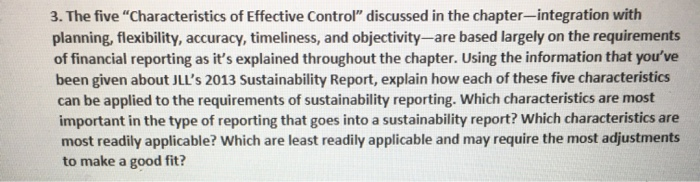
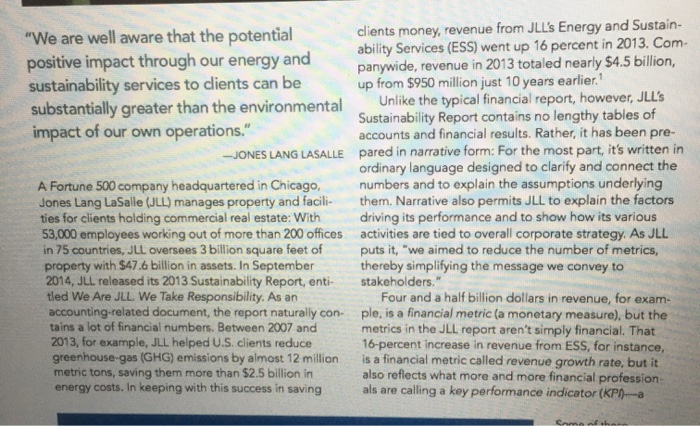
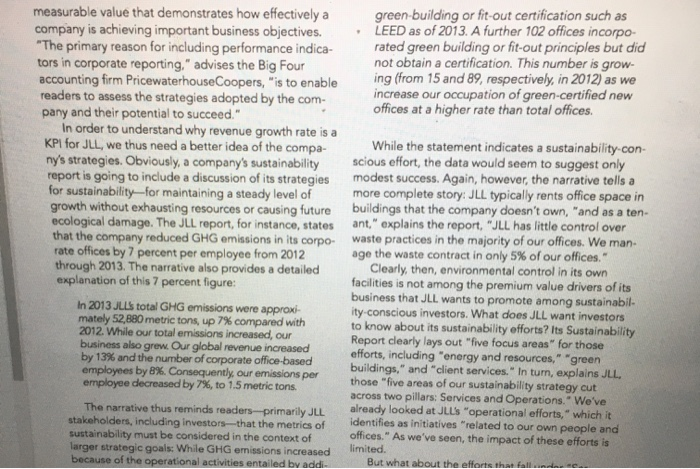
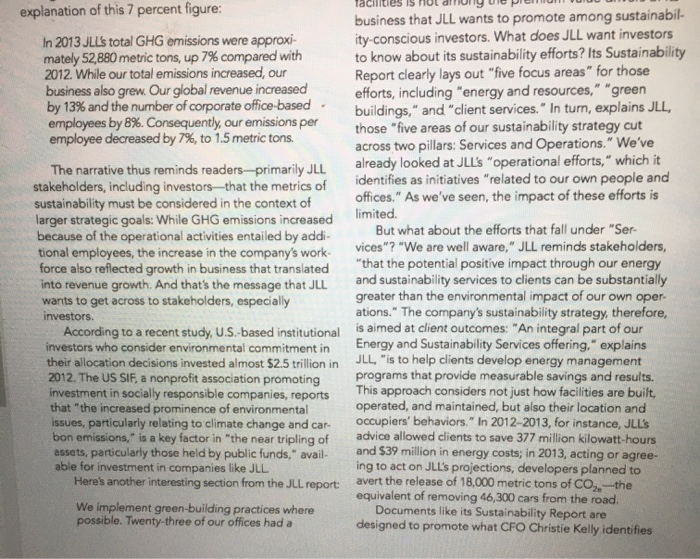
3. The five "Characteristics of Effective Control" discussed in the chapter-integration with planning, flexibility, accuracy, timeliness, and objectivity-are based largely on the requirements of financial reporting as it's explained throughout the chapter. Using the information that you've been given about JLL's 2013 Sustainability Report, explain how each of these five characteristics can be applied to the requirements of sustainability reporting. Which characteristics are most important in the type of reporting that goes into a sustainability report? Which characteristics are most readily applicable? Which are least readily applicable and may require the most adjustments to make a good fit? "We are well aware that the potential clients money, revenue from JLL's Energy and Sustain- ability Services (ESS) went up 16 percent in 2013. Com- positive impact through our energy and panywide, revenue in 2013 totaled nearly $4.5 billion, sustainability services to clients can be up from $950 million just 10 years earlier.' substantially greater than the environmental Unlike the typical financial report, however, JLL'S Sustainability Report contains no lengthy tables of impact of our own operations." accounts and financial results. Rather, it has been pre- -JONES LANG LASALLE pared in narrative form: For the most part, it's written in ordinary language designed to clarify and connect the A Fortune 500 company headquartered in Chicago, numbers and to explain the assumptions underlying Jones Lang LaSalle (JLL) manages property and facili them. Narrative also permits JLL to explain the factors ties for clients holding commercial real estate: With driving its performance and to show how its various 53,000 employees working out of more than 200 offices activities are tied to overall corporate strategy. As JLL in 75 countries, JLL oversees 3 billion square feet of puts it, "we aimed to reduce the number of metrics, property with $47.6 billion in assets. In September thereby simplifying the message we convey to 2014, JLL released its 2013 Sustainability Report, enti stakeholders." tled We Are JLL. We Take Responsibility. As an Four and a half billion dollars in revenue, for exam accounting-related document, the report naturally con- ple, is a financial metric (a monetary measure), but the tains a lot of financial numbers. Between 2007 and metrics in the JLL report aren't simply financial. That 2013, for example, JLL helped U.S. clients reduce 16-percent increase in revenue from ESS, for instance, greenhouse-gas (GHG) emissions by almost 12 million is a financial metric called revenue growth rate, but it metric tons, saving them more than $2.5 billion in also reflects what more and more financial profession- energy costs. In keeping with this success in saving als are calling a key performance indicator (KP-a green-building or fit-out certification such as LEED as of 2013. A further 102 offices incorpo- rated green building or fit-out principles but did not obtain a certification. This number is grow ing (from 15 and 89, respectively, in 2012) as we increase our occupation of green-certified new offices at a higher rate than total offices. measurable value that demonstrates how effectively a company is achieving important business objectives. "The primary reason for including performance indica- tors in corporate reporting," advises the Big Four accounting firm PricewaterhouseCoopers, "is to enable readers to assess the strategies adopted by the com- pany and their potential to succeed." In order to understand why revenue growth rate is a KPI for JLL, we thus need a better idea of the compa- ny's strategies. Obviously, a company's sustainability report is going to include a discussion of its strategies for sustainability for maintaining a steady level of growth without exhausting resources or causing future ecological damage. The JLL report, for instance, states that the company reduced GHG emissions in its corpo rate offices by 7 percent per employee from 2012 through 2013. The narrative also provides a detailed explanation of this 7 percent figure: In 2013 JLLS total GHG emissions were approxi- mately 52,880 metric tons, up 7% compared with 2012. While our total emissions increased, our business also grow. Our global revenue increased by 13% and the number of corporate office-based employees by 8%. Consequently, our emissions per employee decreased by 7%, to 1.5 metric tons While the statement indicates a sustainability con- scious effort, the data would seem to suggest only modest success. Again, however, the narrative tells a more complete story: JLL typically rents office space in buildings that the company doesn't own, "and as a ten- ant," explains the report, "ULL has little control over waste practices in the majority of our offices. We man age the waste contract in only 5% of our offices." Clearly, then, environmental control in its own facilities is not among the premium value drivers of its business that JLL wants to promote among sustainabil- ity conscious investors. What does JLL want investors to know about its sustainability efforts? Its Sustainability Report clearly lays out "five focus areas for those efforts, including "energy and resources," "green buildings," and "client services." In turn, explains JLL those "five areas of our sustainability strategy cut across two pillars: Services and Operations. We've already looked at JLLS "operational efforts," which it identifies as initiatives "related to our own people and offices." As we've seen the impact of these efforts is imited But what about the efforts that fall The narrative thus reminds readers primarily JLL stakeholders, including investors that the metrics of sustainability must be considered in the context of larger strategic goals: While GHG emissions increased because of the operational activities entailed by addin Tacilities IS FIUL DIUMU U PITUUUUUUU explanation of this 7 percent figure: In 2013 JLL's total GHG emissions were approxi- mately 52,880 metric tons, up 7% compared with 2012. While our total emissions increased, our business also grew. Our global revenue increased by 13% and the number of corporate office-based employees by 8%. Consequently, our emissions per employee decreased by 7%, to 1.5 metric tons. The narrative thus reminds readers primarily JLL stakeholders, including investors-that the metrics of sustainability must be considered in the context of larger strategic goals: While GHG emissions increased because of the operational activities entailed by addi- tional employees, the increase in the company's work- force also reflected growth in business that translated into revenue growth. And that's the message that JLL wants to get across to stakeholders, especially investors. According to a recent study, U.S.-based institutional investors who consider environmental commitment in their allocation decisions invested almost $2.5 trillion in 2012. The US SIF, a nonprofit association promoting investment in socially responsible companies, reports that "the increased prominence of environmental issues, particularly relating to climate change and car bon emissions," is a key factor in "the near tripling of assets, particularly those held by public funds," avail able for investment in companies like JLL Here's another interesting section from the JLL report: business that JLL wants to promote among sustainabil- ity-conscious investors. What does JLL want investors to know about its sustainability efforts? Its Sustainability Report clearly lays out "five focus areas" for those efforts, including "energy and resources," "green buildings," and "client services." In turn, explains JLL, those "five areas of our sustainability strategy cut across two pillars: Services and Operations." We've already looked at JLL'S "operational efforts," which it identifies as initiatives "related to our own people and offices." As we've seen, the impact of these efforts is limited. But what about the efforts that fall under "Ser- vices"? "We are well aware," JLL reminds stakeholders, that the potential positive impact through our energy and sustainability services to clients can be substantially greater than the environmental impact of our own oper ations." The company's sustainability strategy, therefore, is aimed at client outcomes: "An integral part of our Energy and Sustainability Services offering," explains JLL, "is to help clients develop energy management programs that provide measurable savings and results. This approach considers not just how facilities are built, operated, and maintained, but also their location and occupiers' behaviors." In 2012-2013, for instance, JLL'S advice allowed clients to save 377 million kilowatt-hours and $39 million in energy costs; in 2013, acting or agree- ing to act on JLL's projections, developers planned to avert the release of 18,000 metric tons of Co, the equivalent of removing 46,300 cars from the road. Documents like its Sustainability Report are designed to promote what CFO Christie Kelly identifies We implement green-building practices where possible. Twenty-three of our offices had a CHAPTER 19 Basic Elements of Control as "the premium value drivers in JLL's business and how we measure them." In another report, entitled Sustain- ability: The Measurement and Reporting Challenge, the company explains its commitment to the reporting process itselfa process which JLL also regards as criti- cal to its overall sustainability strategy: "Proper measurement and reporting processes," argues the report, Ware vital for corporations in order to be accountable and to demonstrate the improvements that they are able to achieve for their stakeholders and the community, while validating their investment in sus- tainability initiatives." 3. The five "Characteristics of Effective Control" discussed in the chapter-integration with planning, flexibility, accuracy, timeliness, and objectivity-are based largely on the requirements of financial reporting as it's explained throughout the chapter. Using the information that you've been given about JLL's 2013 Sustainability Report, explain how each of these five characteristics can be applied to the requirements of sustainability reporting. Which characteristics are most important in the type of reporting that goes into a sustainability report? Which characteristics are most readily applicable? Which are least readily applicable and may require the most adjustments to make a good fit? "We are well aware that the potential clients money, revenue from JLL's Energy and Sustain- ability Services (ESS) went up 16 percent in 2013. Com- positive impact through our energy and panywide, revenue in 2013 totaled nearly $4.5 billion, sustainability services to clients can be up from $950 million just 10 years earlier.' substantially greater than the environmental Unlike the typical financial report, however, JLL'S Sustainability Report contains no lengthy tables of impact of our own operations." accounts and financial results. Rather, it has been pre- -JONES LANG LASALLE pared in narrative form: For the most part, it's written in ordinary language designed to clarify and connect the A Fortune 500 company headquartered in Chicago, numbers and to explain the assumptions underlying Jones Lang LaSalle (JLL) manages property and facili them. Narrative also permits JLL to explain the factors ties for clients holding commercial real estate: With driving its performance and to show how its various 53,000 employees working out of more than 200 offices activities are tied to overall corporate strategy. As JLL in 75 countries, JLL oversees 3 billion square feet of puts it, "we aimed to reduce the number of metrics, property with $47.6 billion in assets. In September thereby simplifying the message we convey to 2014, JLL released its 2013 Sustainability Report, enti stakeholders." tled We Are JLL. We Take Responsibility. As an Four and a half billion dollars in revenue, for exam accounting-related document, the report naturally con- ple, is a financial metric (a monetary measure), but the tains a lot of financial numbers. Between 2007 and metrics in the JLL report aren't simply financial. That 2013, for example, JLL helped U.S. clients reduce 16-percent increase in revenue from ESS, for instance, greenhouse-gas (GHG) emissions by almost 12 million is a financial metric called revenue growth rate, but it metric tons, saving them more than $2.5 billion in also reflects what more and more financial profession- energy costs. In keeping with this success in saving als are calling a key performance indicator (KP-a green-building or fit-out certification such as LEED as of 2013. A further 102 offices incorpo- rated green building or fit-out principles but did not obtain a certification. This number is grow ing (from 15 and 89, respectively, in 2012) as we increase our occupation of green-certified new offices at a higher rate than total offices. measurable value that demonstrates how effectively a company is achieving important business objectives. "The primary reason for including performance indica- tors in corporate reporting," advises the Big Four accounting firm PricewaterhouseCoopers, "is to enable readers to assess the strategies adopted by the com- pany and their potential to succeed." In order to understand why revenue growth rate is a KPI for JLL, we thus need a better idea of the compa- ny's strategies. Obviously, a company's sustainability report is going to include a discussion of its strategies for sustainability for maintaining a steady level of growth without exhausting resources or causing future ecological damage. The JLL report, for instance, states that the company reduced GHG emissions in its corpo rate offices by 7 percent per employee from 2012 through 2013. The narrative also provides a detailed explanation of this 7 percent figure: In 2013 JLLS total GHG emissions were approxi- mately 52,880 metric tons, up 7% compared with 2012. While our total emissions increased, our business also grow. Our global revenue increased by 13% and the number of corporate office-based employees by 8%. Consequently, our emissions per employee decreased by 7%, to 1.5 metric tons While the statement indicates a sustainability con- scious effort, the data would seem to suggest only modest success. Again, however, the narrative tells a more complete story: JLL typically rents office space in buildings that the company doesn't own, "and as a ten- ant," explains the report, "ULL has little control over waste practices in the majority of our offices. We man age the waste contract in only 5% of our offices." Clearly, then, environmental control in its own facilities is not among the premium value drivers of its business that JLL wants to promote among sustainabil- ity conscious investors. What does JLL want investors to know about its sustainability efforts? Its Sustainability Report clearly lays out "five focus areas for those efforts, including "energy and resources," "green buildings," and "client services." In turn, explains JLL those "five areas of our sustainability strategy cut across two pillars: Services and Operations. We've already looked at JLLS "operational efforts," which it identifies as initiatives "related to our own people and offices." As we've seen the impact of these efforts is imited But what about the efforts that fall The narrative thus reminds readers primarily JLL stakeholders, including investors that the metrics of sustainability must be considered in the context of larger strategic goals: While GHG emissions increased because of the operational activities entailed by addin Tacilities IS FIUL DIUMU U PITUUUUUUU explanation of this 7 percent figure: In 2013 JLL's total GHG emissions were approxi- mately 52,880 metric tons, up 7% compared with 2012. While our total emissions increased, our business also grew. Our global revenue increased by 13% and the number of corporate office-based employees by 8%. Consequently, our emissions per employee decreased by 7%, to 1.5 metric tons. The narrative thus reminds readers primarily JLL stakeholders, including investors-that the metrics of sustainability must be considered in the context of larger strategic goals: While GHG emissions increased because of the operational activities entailed by addi- tional employees, the increase in the company's work- force also reflected growth in business that translated into revenue growth. And that's the message that JLL wants to get across to stakeholders, especially investors. According to a recent study, U.S.-based institutional investors who consider environmental commitment in their allocation decisions invested almost $2.5 trillion in 2012. The US SIF, a nonprofit association promoting investment in socially responsible companies, reports that "the increased prominence of environmental issues, particularly relating to climate change and car bon emissions," is a key factor in "the near tripling of assets, particularly those held by public funds," avail able for investment in companies like JLL Here's another interesting section from the JLL report: business that JLL wants to promote among sustainabil- ity-conscious investors. What does JLL want investors to know about its sustainability efforts? Its Sustainability Report clearly lays out "five focus areas" for those efforts, including "energy and resources," "green buildings," and "client services." In turn, explains JLL, those "five areas of our sustainability strategy cut across two pillars: Services and Operations." We've already looked at JLL'S "operational efforts," which it identifies as initiatives "related to our own people and offices." As we've seen, the impact of these efforts is limited. But what about the efforts that fall under "Ser- vices"? "We are well aware," JLL reminds stakeholders, that the potential positive impact through our energy and sustainability services to clients can be substantially greater than the environmental impact of our own oper ations." The company's sustainability strategy, therefore, is aimed at client outcomes: "An integral part of our Energy and Sustainability Services offering," explains JLL, "is to help clients develop energy management programs that provide measurable savings and results. This approach considers not just how facilities are built, operated, and maintained, but also their location and occupiers' behaviors." In 2012-2013, for instance, JLL'S advice allowed clients to save 377 million kilowatt-hours and $39 million in energy costs; in 2013, acting or agree- ing to act on JLL's projections, developers planned to avert the release of 18,000 metric tons of Co, the equivalent of removing 46,300 cars from the road. Documents like its Sustainability Report are designed to promote what CFO Christie Kelly identifies We implement green-building practices where possible. Twenty-three of our offices had a CHAPTER 19 Basic Elements of Control as "the premium value drivers in JLL's business and how we measure them." In another report, entitled Sustain- ability: The Measurement and Reporting Challenge, the company explains its commitment to the reporting process itselfa process which JLL also regards as criti- cal to its overall sustainability strategy: "Proper measurement and reporting processes," argues the report, Ware vital for corporations in order to be accountable and to demonstrate the improvements that they are able to achieve for their stakeholders and the community, while validating their investment in sus- tainability initiatives









 Study Help