Question: Basic Inventory Management: When to Order & How Much to Order Learning objectives. 1. Building initial skills to solve basic inventory management problems. 2. Learning
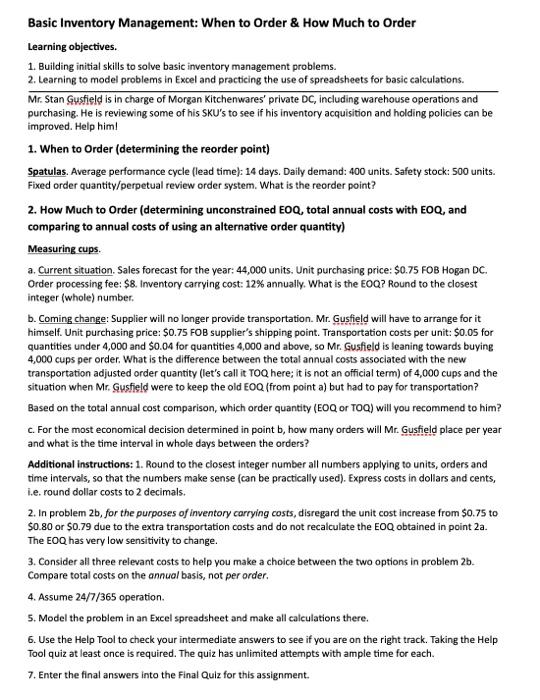
Basic Inventory Management: When to Order & How Much to Order Learning objectives. 1. Building initial skills to solve basic inventory management problems. 2. Learning to model problems in Excel and practicing the use of spreadsheets for basic calculations. Mr. Stan Gusfield is in charge of Morgan Kitchenwares' private DC, including warehouse operations and purchasing. He is reviewing some of his SKU's to see if his inventory acquisition and holding policies can be improved. Help him! 1. When to Order (determining the reorder point) Spatulas. Average performance cycle (lead time): 14 days. Daily demand: 400 units. Safety stock: 500 units. Fixed order quantity/perpetual review order system. What is the reorder point? 2. How Much to Order (determining unconstrained EOQ, total annual costs with EOQ, and comparing to annual costs of using an alternative order quantity) Measuring cups. a. Current situation Sales forecast for the year: 44,000 units. Unit purchasing price: $0.75 FOB Hogan DC. Order processing fee: $8. Inventory carrying cost: 12% annually. What is the EOQ? Round to the closest integer (whole) number. b. Coming change: Supplier will no longer provide transportation. Mr. Gusfield will have to arrange for it himself. Unit purchasing price: $0.75 FOB supplier's shipping point. Transportation costs per unit: $0.05 for quantities under 4,000 and $0.04 for quantities 4,000 and above, so Mr. Gusfield is leaning towards buying 4,000 cups per order. What is the difference between the total annual costs associated with the new transportation adjusted order quantity (let's call it TOQ here; it is not an official term) of 4,000 cups and the situation when Mr. Gusfield were to keep the old EOQ (from point a) but had to pay for transportation? Based on the total annual cost comparison, which order quantity (EOQ or TOQ) will you recommend to him? c. For the most economical decision determined in point b, how many orders will Mr. Gusfield place per year and what is the time interval in whole days between the orders? Additional instructions: 1. Round to the closest integer number all numbers applying to units, orders and time intervals, so that the numbers make sense (can be practically used). Express costs in dollars and cents, i.e. round dollar costs to 2 decimals. 2. In problem 2b, for the purposes of inventory carrying costs, disregard the unit cost increase from $0.75 to $0.80 or $0.79 due to the extra transportation costs and do not recalculate the EOQ obtained in point 2a. The EOQ has very low sensitivity to change. 3. Consider all three relevant costs to help you make a choice between the two options in problem 2b. Compare total costs on the annual basis, not per order. 4. Assume 24/7/365 operation. 5. Model the problem in an Excel spreadsheet and make all calculations there. 6. Use the Help Tool to check your intermediate answers to see if you are on the right track. Taking the Help Tool quiz at least once is required. The quiz has unlimited attempts with ample time for each. 7. Enter the final answers into the Final Quiz for this assignment. Basic Inventory Management: When to Order & How Much to Order Learning objectives. 1. Building initial skills to solve basic inventory management problems. 2. Learning to model problems in Excel and practicing the use of spreadsheets for basic calculations. Mr. Stan Gusfield is in charge of Morgan Kitchenwares' private DC, including warehouse operations and purchasing. He is reviewing some of his SKU's to see if his inventory acquisition and holding policies can be improved. Help him! 1. When to Order (determining the reorder point) Spatulas. Average performance cycle (lead time): 14 days. Daily demand: 400 units. Safety stock: 500 units. Fixed order quantity/perpetual review order system. What is the reorder point? 2. How Much to Order (determining unconstrained EOQ, total annual costs with EOQ, and comparing to annual costs of using an alternative order quantity) Measuring cups. a. Current situation Sales forecast for the year: 44,000 units. Unit purchasing price: $0.75 FOB Hogan DC. Order processing fee: $8. Inventory carrying cost: 12% annually. What is the EOQ? Round to the closest integer (whole) number. b. Coming change: Supplier will no longer provide transportation. Mr. Gusfield will have to arrange for it himself. Unit purchasing price: $0.75 FOB supplier's shipping point. Transportation costs per unit: $0.05 for quantities under 4,000 and $0.04 for quantities 4,000 and above, so Mr. Gusfield is leaning towards buying 4,000 cups per order. What is the difference between the total annual costs associated with the new transportation adjusted order quantity (let's call it TOQ here; it is not an official term) of 4,000 cups and the situation when Mr. Gusfield were to keep the old EOQ (from point a) but had to pay for transportation? Based on the total annual cost comparison, which order quantity (EOQ or TOQ) will you recommend to him? c. For the most economical decision determined in point b, how many orders will Mr. Gusfield place per year and what is the time interval in whole days between the orders? Additional instructions: 1. Round to the closest integer number all numbers applying to units, orders and time intervals, so that the numbers make sense (can be practically used). Express costs in dollars and cents, i.e. round dollar costs to 2 decimals. 2. In problem 2b, for the purposes of inventory carrying costs, disregard the unit cost increase from $0.75 to $0.80 or $0.79 due to the extra transportation costs and do not recalculate the EOQ obtained in point 2a. The EOQ has very low sensitivity to change. 3. Consider all three relevant costs to help you make a choice between the two options in problem 2b. Compare total costs on the annual basis, not per order. 4. Assume 24/7/365 operation. 5. Model the problem in an Excel spreadsheet and make all calculations there. 6. Use the Help Tool to check your intermediate answers to see if you are on the right track. Taking the Help Tool quiz at least once is required. The quiz has unlimited attempts with ample time for each. 7. Enter the final answers into the Final Quiz for this assignment









 Study Help