







Question: Basic loss budgeting = 6) Consider a wireless transmitter with PTx 0 dBm and a channel loss of Lch = 80 dB. Calculate the
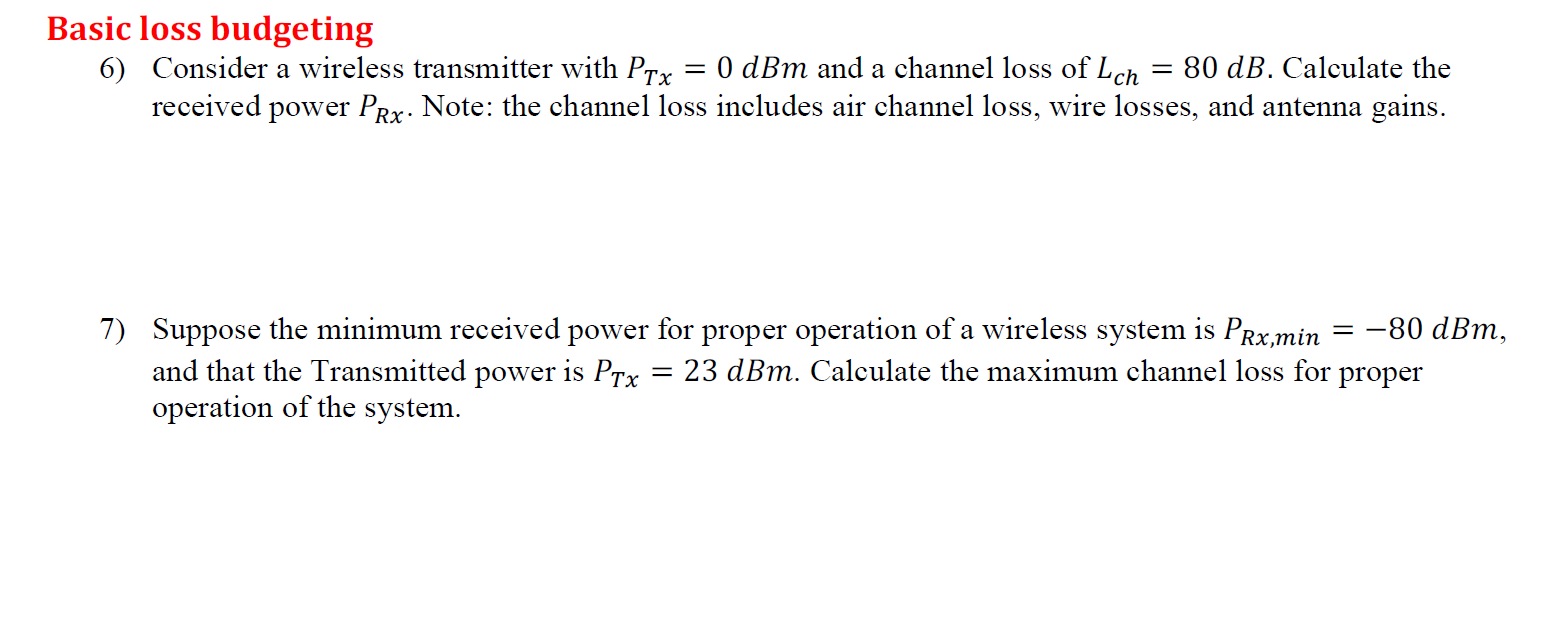
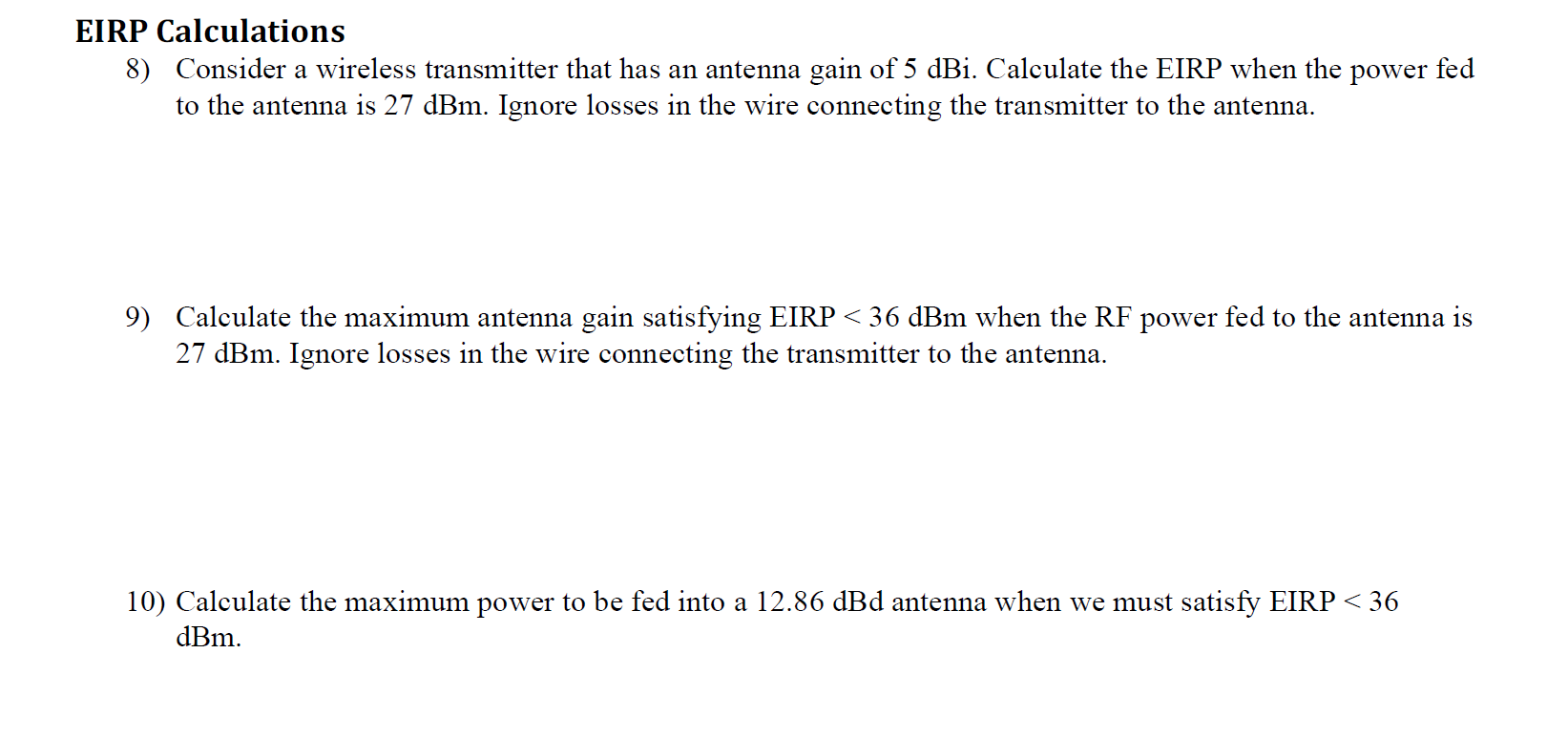
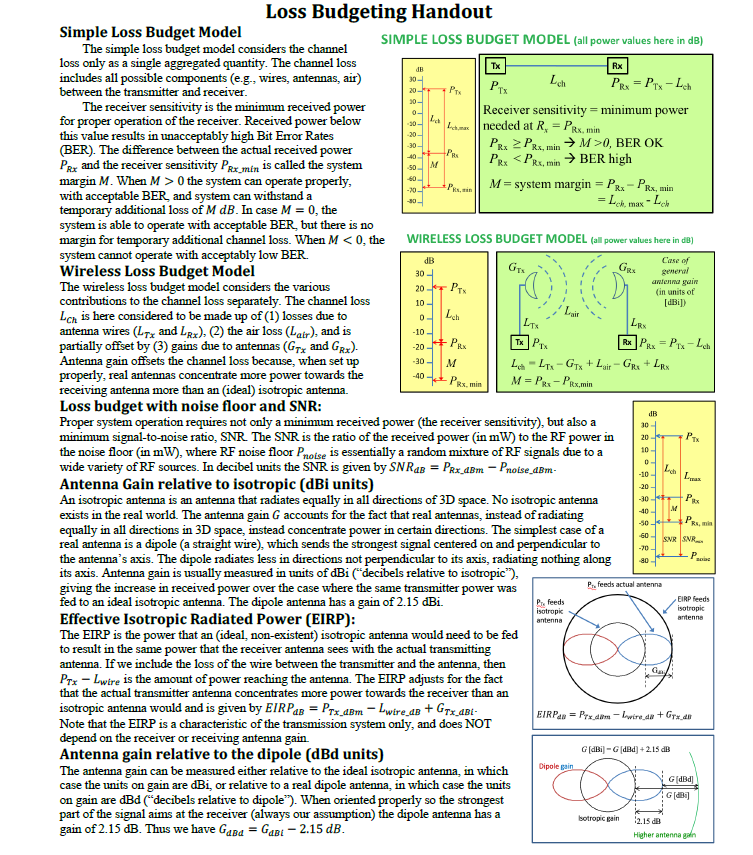
Basic loss budgeting = 6) Consider a wireless transmitter with PTx 0 dBm and a channel loss of Lch = 80 dB. Calculate the received power PRx. Note: the channel loss includes air channel loss, wire losses, and antenna gains. -80 dBm, 7) Suppose the minimum received power for proper operation of a wireless system is PRx,min and that the Transmitted power is PTx 23 dBm. Calculate the maximum channel loss for proper operation of the system. = == EIRP Calculations 8) Consider a wireless transmitter that has an antenna gain of 5 dBi. Calculate the EIRP when the power fed to the antenna is 27 dBm. Ignore losses in the wire connecting the transmitter to the antenna. 9) Calculate the maximum antenna gain satisfying EIRP < 36 dBm when the RF power fed to the antenna is 27 dBm. Ignore losses in the wire connecting the transmitter to the antenna. 10) Calculate the maximum power to be fed into a 12.86 dBd antenna when we must satisfy EIRP < 36 dBm. Loss Budgeting Handout Simple Loss Budget Model The simple loss budget model considers the channel loss only as a single aggregated quantity. The channel loss includes all possible components (e.g., wires, antennas, air) between the transmitter and receiver. SIMPLE LOSS BUDGET MODEL (all power values here in dB) 30- 20- 30- 0- -30- -20- -30- 40- -50 M -60- The receiver sensitivity is the minimum received power for proper operation of the receiver. Received power below this value results in unacceptably high Bit Error Rates (BER). The difference between the actual received power PRx and the receiver sensitivity Pax min is called the system margin M. When M > 0 the system can operate properly, with acceptable BER, and system can withstand a temporary additional loss of M dB. In case M = 0, the system is able to operate with acceptable BER, but there is no margin for temporary additional channel loss. When M < 0, the system cannot operate with acceptably low BER. Wireless Loss Budget Model The wireless loss budget model considers the various contributions to the channel loss separately. The channel loss Lch is here considered to be made up of (1) losses due to antenna wires (LTx and LRx), (2) the air loss (Lair), and is partially offset by (3) gains due to antennas (GTX and GRX)- Antenna gain offsets the channel loss because, when set up properly, real antennas concentrate more power towards the receiving antenna more than an (ideal) isotropic antenna. Loss budget with noise floor and SNR: Proper system operation requires not only a minimum received power (the receiver sensitivity), but also a minimum signal-to-noise ratio, SNR. The SNR is the ratio of the received power (in mW) to the RF power in the noise floor (in mW), where RF noise floor Pnoise is essentially a random mixture of RF signals due to a wide variety of RF sources. In decibel units the SNR is given by SNRAB = PRx_dBm - Pnoise_dBm- Antenna Gain relative to isotropic (dBi units) An isotropic antenna is an antenna that radiates equally in all directions of 3D space. No isotropic antenna exists in the real world. The antenna gain G accounts for the fact that real antennas, instead of radiating equally in all directions in 3D space, instead concentrate power in certain directions. The simplest case of a real antenna is a dipole (a straight wire), which sends the strongest signal centered on and perpendicular to the antenna's axis. The dipole radiates less in directions not perpendicular to its axis, radiating nothing along its axis. Antenna gain is usually measured in units of dBi ("decibels relative to isotropic"), giving the increase in received power over the case where the same transmitter power was fed to an ideal isotropic antenna. The dipole antenna has a gain of 2.15 dBi. Pr, feeds actual antenna -70- La -30 dB 30- PT 10- 0- PRI -10- PRs.in 20-PTX Lich Tx Lich PTX Receiver sensitivity = minimum power needed at R = PRx, min PRx PRx, min M>0, BER OK PRx
Step by Step Solution
There are 3 Steps involved in it

Get step-by-step solutions from verified subject matter experts
 Study Help