







Question: Basic Stock Valuation: Free Cash Flow Valuation Model The recognition that dividends are dependent on esmings, so a reliable divisend forecast is based on an
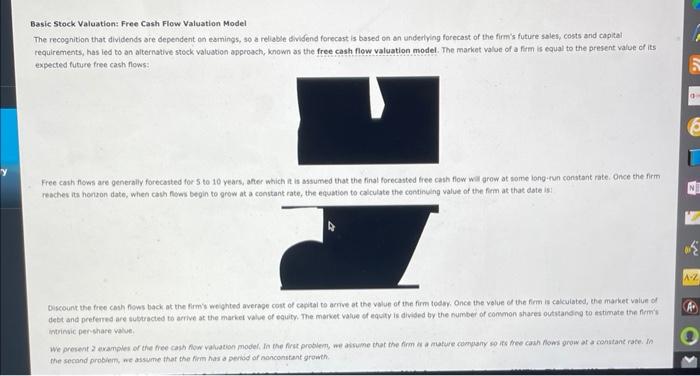
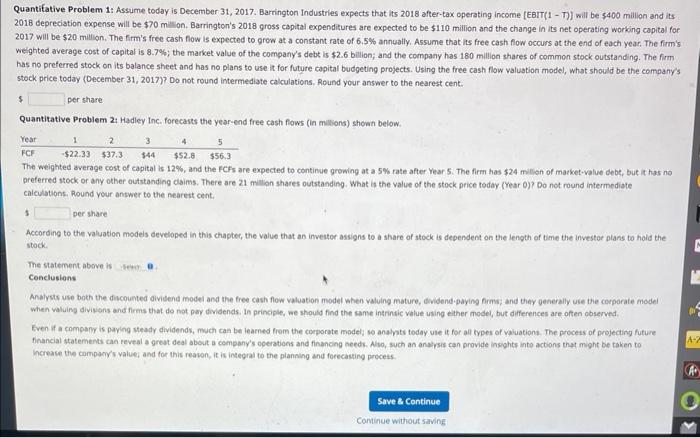
Basic Stock Valuation: Free Cash Flow Valuation Model The recognition that dividends are dependent on esmings, so a reliable divisend forecast is based on an underlying forecast of the firm's future sales, costs and capitalrequirements, has led to an alternative stock valuakion approach, known as the free cash flow valuation model. The market value of a firm is equal to the present value of its expected future free cash flows: Free cash flows are generally forecasted for 5 to 10 years, after which it is assumed that the final forecasted free cash flow wir arow at some lang-tun constant rate. Once the firm Feaches its honzon date, when cavh fores begin to grow at a constant rate, the equatien to calculate the continuing value of the firm at that date is: Discount the thee cosh fiews back at the firmis weighted averape cost of captal to arrive at the value of the firm todev. Once the volue of the firm is calculated, the market value of debt and prefensa are subtracted to artive at the markel value of eqisty. The marvet value of equity is divised by the number of common shares outstanding to estimate the firm' intrinsic penshare valuei the secand probiem, ne assume that the firm has o penid of nonconutant greweh. Quantifative Problem 1: Assume today is December 31, 2017. Barrington Industries expects that its 2018 after-tax operating income [EBIT(1-T)] will be $400 million and its 2018 deprecistion expense will be $70 mili on. Barrington's 2018 gross capital expenditures are expected to be $110 million and the change in its net operating working capital for 2017 will be $20 million. The firm's free cash fow is expected to grow at a constant fate of 6.5% annually. Assume that its free cash flow occurs at the end of each year. The firm's weighted average cost of copital is 8.7%; the market value of the company's debt is $2.6 billion; and the company has 180 million shares of common stock outstanding. The firm has no preferred stock on its balance sheet and has no plans to use it for future capital budgeting projects. Using the free cash flow valuation model, what should be the company?s stock price today (December 31, 2017)? Do not round intermediate calculations. Round your answer to the nearest cent. \$. per share Quantitative Problem 2: Hadley inc. forecasts the year-end free cash fows (in mulions) shown below. The weighted average cost of capital is 12%, and the FCFs are expected to continue growing at a 5% rate after Year 5 . The firm has $24 million of matket-value debt, but it has no preferred stock or any other outstanding claims. There are 21 million shares outstanding. What is the value of the stock price today. (Year 0 )? Do not round intermediate calculations. Round your answer to the nearest cent. 3 per share According to the valuation modeis developed in this chapter, the value that an investor assigns to a share of stock is dependent on the length of time the investor plans to hoid the stock. The statement above is Conclusions Analysts use both the discounted dividend model and the free cash flow valuation model when valuing mature, dividend.paying firms; and they generally ure the corporate model when valuing divikions and firms that do not pory dividends. In principle, ne should find the same intrintic value using either model, but differences are often observed. Fven if a comosny is paving teady dividends, much can be learned from the corporate modeli so analyzts today use it for all typer of valuationa. The process of projecting future financial statements can reveal a grest deal abovt a company's operations and financing needs. Also, such an analysis can provide insights inte actions that might be taken to increace the compacy's value; and for this reavon, it is integral to the planning and forecasting process
Step by Step Solution
There are 3 Steps involved in it

Get step-by-step solutions from verified subject matter experts
 Study Help