







Question: Bayes Network / Bayes Net Problem can be better read in attached image. Additional hints/help is provided in italics. Incidences of diseases A and B
Bayes Network / Bayes Net
Problem can be better read in attached image. Additional hints/help is provided in italics.
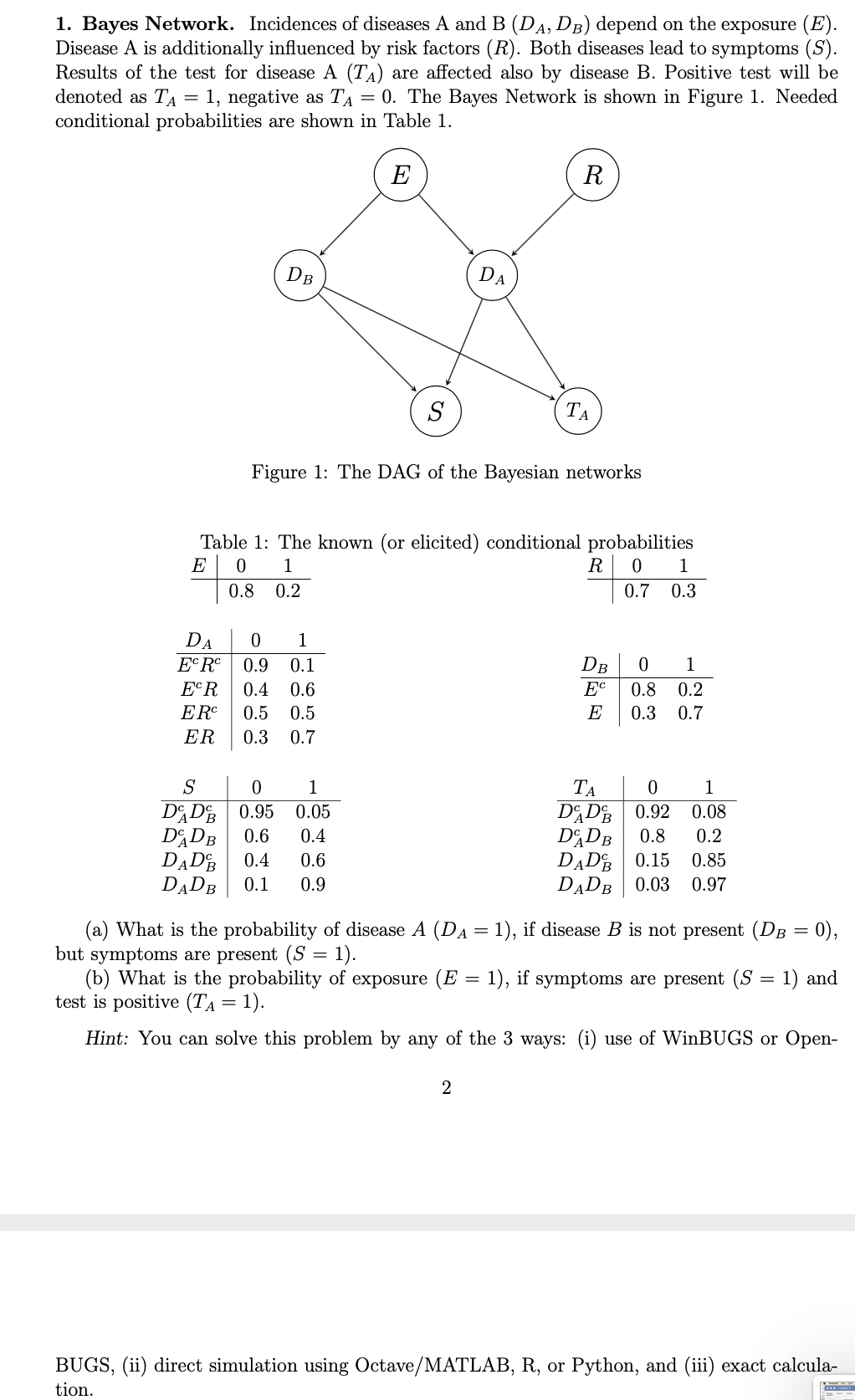
Incidences of diseases A and B (DA,DB) depend on the exposure (E). Disease A is additionally influenced by risk factors (R). Both diseases lead to symptoms (S). Results of the test for disease A (TA) are affected also by disease B. Positive test will be denoted asTA= 1, negative asTA= 0. The Bayes Network is shown in Figure 1. Needed conditional probabilities are shown in Table 1.
Table in Image
(a) What is the probability of diseaseA(DA= 1), if diseaseBis not present (DB= 0), but symptoms are present (S= 1).
Hint: This is looking for P(D_A|D_B^C,S) where C means complement/in other words DB=0.
(b) What is the probability of exposure (E= 1), if symptoms are present (S= 1) and test is positive (TA= 1).
Hint: This is looking for P(E|S, T_A)
Hint:You can solve this problem by any of the 2 ways:
1) direct simulation using Octave/MATLAB, R, or Python, and (2) exact calculation.
?
l. Bayes Network. Incidences of diseases A and B (DA, DB) depend on the exposure (E). Disease A is additionally inuenced by risk factors [R]. Both diseases lead to symptoms (5'). Results of the test for disease A (TA) are affected also by disease B. Positive test will be denoted as TA = 1, negative as T A = 0. The Bayes Network is shown in Figure 1. Needed conditional probabilities are shown in Table 1. 9 9 @0 Figure 1: The DAG of the Bayesian networks Table 1: The known (or elicited) conditional probabilities E O 1 R 0 1 0.8 0.2 0.7 0.3 055,063 0.95 0.05 1.)ng 0.92 0.08 03,133 0.6 0.4 03,193 0.8 0.2 DADCB 0.4 0.6 DADCB 0.15 0.85 DADB 0.1 0.9 DADB 0.03 0.97 (a) What is the probability of disease A (D A = 1), if disease B is not present (D3 = 0), but symptoms are present (5' = 1). (b) What is the probability of exposure (E = 1), if symptoms are present (S = 1) and test is positive [TA = 1). Hint: You can solve this problem by any of the 3 ways: (i) use of WinBUGS or Open- 2 BUGS, (ii) direct simulation using Octave/MATLAB, R, or Python, and (iii) exact calcula- tion. [IEr
Step by Step Solution
There are 3 Steps involved in it

Get step-by-step solutions from verified subject matter experts
 Study Help