



Question: B&E Cooling B&E Cooling The B&E Cooling Technology Company, a maker of automobile air conditioners, faces an impending deadline to phase out the traditional chilling
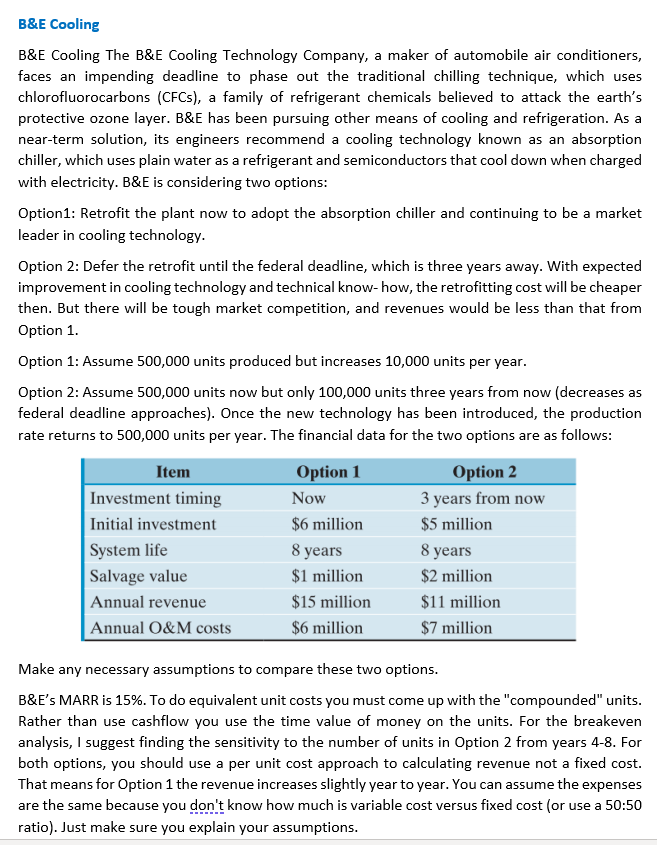
B&E Cooling B&E Cooling The B&E Cooling Technology Company, a maker of automobile air conditioners, faces an impending deadline to phase out the traditional chilling technique, which uses chlorofluorocarbons (CFCs), a family of refrigerant chemicals believed to attack the earth's protective ozone layer. B&E has been pursuing other means of cooling and refrigeration. As a near-term solution, its engineers recommend a cooling technology known as an absorption chiller, which uses plain water as a refrigerant and semiconductors that cool down when charged with electricity. B&E is considering two options: Option1: Retrofit the plant now to adopt the absorption chiller and continuing to be a market leader in cooling technology. Option 2: Defer the retrofit until the federal deadline, which is three years away. With expected improvement in cooling technology and technical know-how, the retrofitting cost will be cheaper then. But there will be tough market competition, and revenues would be less than that from Option 1. Option 1: Assume 500,000 units produced but increases 10,000 units per year. Option 2: Assume 500,000 units now but only 100,000 units three years from now (decreases as federal deadline approaches). Once the new technology has been introduced, the production rate returns to 500,000 units per year. The financial data for the two options are as follows: Item Option 1 Option 2 Investment timing Now 3 years from now Initial investment $6 million $5 million System life 8 years 8 years Salvage value $1 million $2 million Annual revenue $15 million $11 million Annual O&M costs $6 million $7 million Make any necessary assumptions to compare these two options. B&E's MARR is 15%. To do equivalent unit costs you must come up with the "compounded" units. Rather than use cashflow you use the time value of money on the units. For the breakeven analysis, I suggest finding the sensitivity to the number of units in Option 2 from years 4-8. For both options, you should use a per unit cost approach to calculating revenue not a fixed cost. That means for Option 1 the revenue increases slightly year to year. You can assume the expenses are the same because you don't know how much is variable cost versus fixed cost (or use a 50:50 ratio). Just make sure you explain your assumptions
Step by Step Solution
There are 3 Steps involved in it

Get step-by-step solutions from verified subject matter experts