



Question: Before calculating costs we need to understand how different costs behave. In cost accounting we typically classify costs by three types of behaviour: ?Fixed costs
Before calculating costs we need to understand how different costs behave. In cost
accounting we typically classify costs by three types of behaviour: ?Fixed costs - costs
which don't change as the activity level changes ?Variable costs - costs which change in
direct proportion to changes in the activity level ?Semi-variable costs - costs which have
both fixed and variable elements. Explain the purpose classifying costs into the behavior
patterns.
(6 Marks)
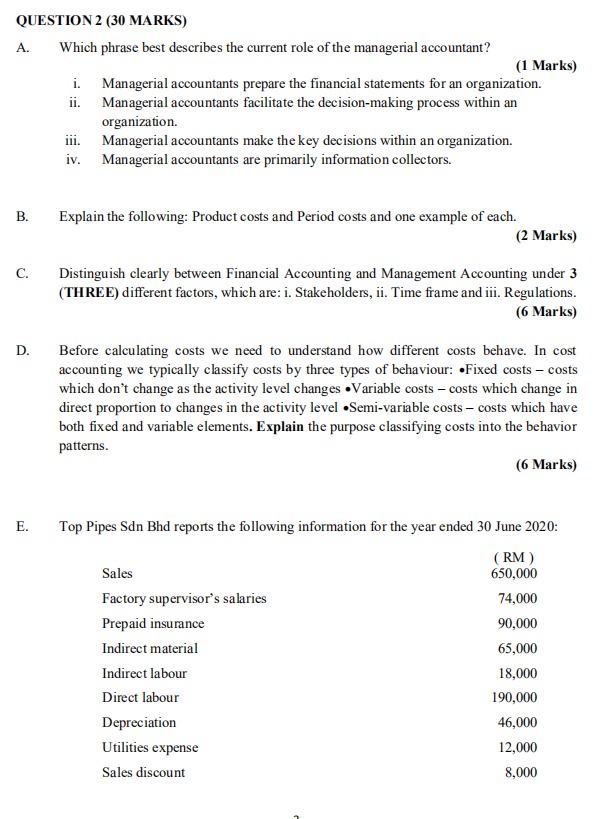
QUESTION 2 (30 MARKS) A. Which phrase best describes the current role of the managerial accountant? (1 Marks) i. Managerial accountants prepare the financial statements for an organization. ii. Managerial accountants facilitate the decision-making process within an organization. iii. Managerial accountants make the key decisions within an organization. iv. Managerial accountants are primarily information collectors. B. Explain the following: Product costs and Period costs and one example of each. (2 Marks) C. Distinguish clearly between Financial Accounting and Management Accounting under 3 (THREE) different factors, which are: i. Stakeholders, ii. Time frame and iii. Regulations. (6 Marks) D. Before calculating costs we need to understand how different costs behave. In cost accounting we typically classify costs by three types of behaviour: .Fixed costs - costs which don't change as the activity level changes . Variable costs - costs which change in direct proportion to changes in the activity level .Semi-variable costs - costs which have both fixed and variable elements. Explain the purpose classifying costs into the behavior patterns. (6 Marks) E. Top Pipes Sdn Bhd reports the following information for the year ended 30 June 2020: ( RM ) Sales 650,000 Factory supervisor's salaries 74,000 Prepaid insurance 90,000 Indirect material 65,000 Indirect labour 18,000 Direct labour 190,000 Depreciation 46,000 Utilities expense 12,000 Sales discount 8,000
Step by Step Solution
There are 3 Steps involved in it

Get step-by-step solutions from verified subject matter experts