Question: Before completing your Writing Journal assignment this week, be sure to review pages 52-55 carefully. Once you have, please complete Exercise 2.5 on pages 55-58
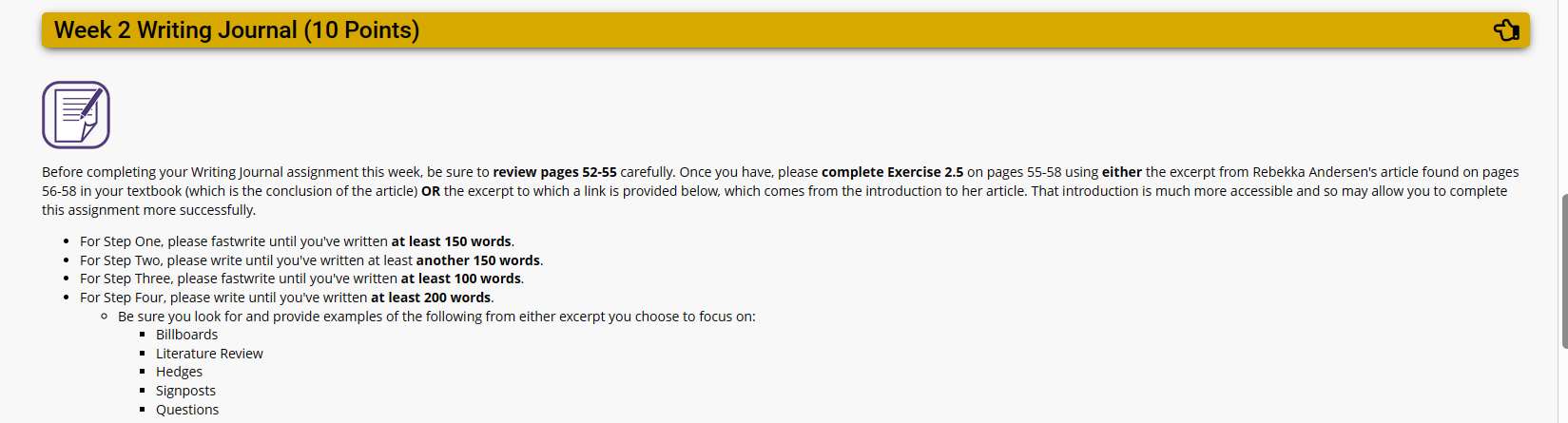
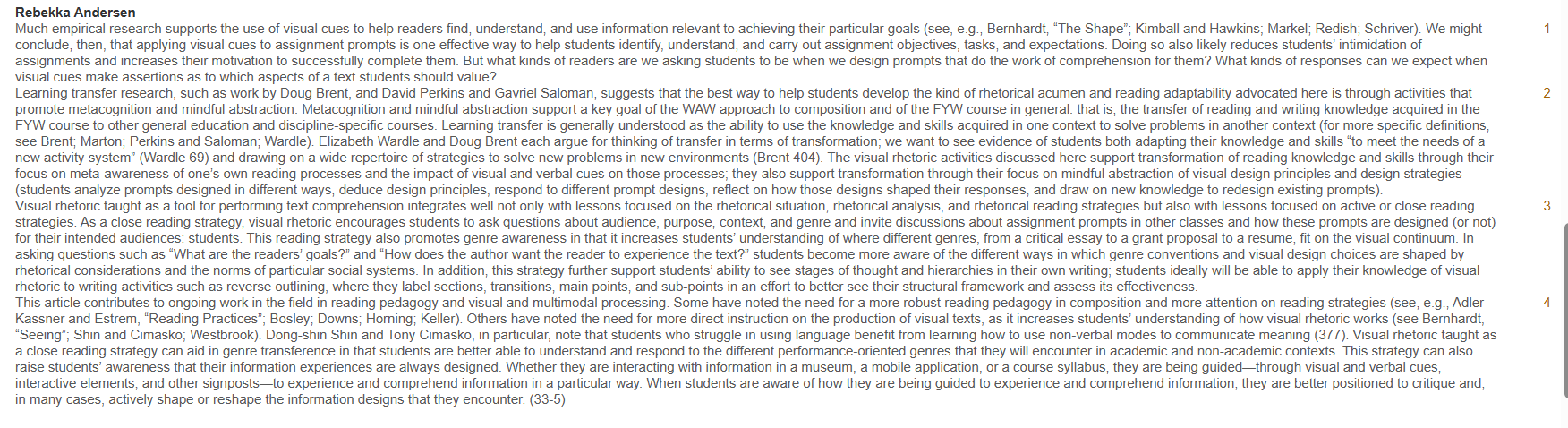
Before completing your Writing Journal assignment this week, be sure to review pages 52-55 carefully. Once you have, please complete Exercise 2.5 on pages 55-58 using either the excerpt from Rebekka Andersen's article found on pages 56-58 in your textbook (which is the conclusion of the article) OR the excerpt to which a link is provided below. which comes from the introduction to her article. That introduction is much more accessible and so may allow you to complete this assignment more successfully. * For Step One, please fastwrite until you've written at least 150 words. = For Step Two. please write until you've written at least another 150 words. * For Step Three, please fastwrite until you've written at least 100 words. = For Step Four, please write until you've written at least 200 words. Be sure you look for and provide examples of the following from either excerpt you choose to focus on: = Billboards = Literature Review = Hedges = Signposts = Questions Rebekka Andersen Much empirical research supports the use of visual cues to help readers find, understand, and use information relevant to achieving their particular goals (see, e g., Bernhardt, \"The Shape\"; Kimball and Hawkins; Markel; Redish; Schriver). We might conclude, then, that applying visual cues to assignment prompts is one effective way to help students identify, understand, and carry out assignment objectives, tasks, and expectations. Doing 50 also likely reduces students' intimidation of assignments and increases their motivation fo successfully complete them. But what kinds of readers are we asking students to be when we design prompts that do the work of comprehension for them? What kinds of responses can we expect when visual cues make assertions as to which aspects of a text students should value? Learning transfer research, such as work by Doug Brent, and David Perkins and Gavriel Saloman, suggests that the best way to help students develop the kind of rhetorical acumen and reading adaptability advocated here is through activities that promote metacognition and mindful abstraction. Metacognition and mindful abstraction support a key goal of the WAW approach to composition and of the FYW course in general: that is, the transfer of reading and writing knowledge acquired in the FYW course to other general education and discipline-specific courses. Learning transfer is generally understood as the ability to use the knowledge and skills acquired in one context to solve problems in another context (for more specific definitions, see Brent; Marton; Perkins and Saloman; Wardle). Elizabeth Wardle and Doug Brent each argue for thinking of transfer in terms of transformation; we want to see evidence of students both adapting their knowledge and skills \"to meet the needs of a new activity system\" (Wardle 69) and drawing on a wide repertoire of strategies to solve new problems in new environments (Brent 404). The visual rhetoric activities discussed here support fransformation of reading knowledge and skills through their focus on meta-awareness of one's own reading processes and the impact of visual and verbal cues on those processes; they also support transformation through their focus on mindful abstraction of visual design principles and design strategies (students analyze prompts designed in different ways, deduce design principles, respond to different prompt designs, reflect on how these designs shaped their responses, and draw on new knowledge to redesign existing prompts). Visual rhetoric taught as a tool for performing text comprehension integrates well not only with lessons focused on the rhetorical situation, rhetorical analysis, and rhetorical reading strategies but also with lessons focused on active or close reading strategies. As a close reading strategy, visual rhetoric encourages students to ask questions about audience, purpose, context, and genre and invite discussions about assignment prompts in other classes and how these prompts are designed (or not) for their intended audiences: students. This reading strategy also promotes genre awareness in that it increases students' understanding of where different genres, from a critical essay to a grant proposal to a resume, fit on the visual continuum. In asking questions such as \"What are the readers' goals?\" and "How does the author want the reader to experience the text?\" students become more aware of the different ways in which genre conventions and visual design choices are shaped by rhetorical considerations and the norms of particular social systems. In addition, this strategy further support students' ability to see stages of thought and hierarchies in their own writing; students ideally will be able to apply their knowledge of visual rhetoric to writing activities such as reverse outlining, where they label sections, transitions, main points, and sub-points in an effort to better see their structural framework and assess its effectiveness. This article contributes to ongoing work in the field in reading pedagogy and visual and multimodal processing. Some have noted the need for a more robust reading pedagogy in composition and more attention on reading strategies (see, e.g., Adler- Kassner and Estrem, \"Reading Practices\"; Bosley; Downs; Horning; Keller). Others have noted the need for more direct instruction on the production of visual texts, as it increases students' understanding of how visual rhetoric works (see Bernhardt, 'Seeing\"; Shin and Cimasko; Westbrook). Dong-shin Shin and Tony Cimasko, in particular, note that students who struggle in using language benefit from learing how to use non-verbal modes to communicate meaning (377). Visual rhetoric taught as a close reading strategy can aid in genre transference in that students are better able to understand and respond to the different performance-oriented genres that they will encounter in academic and non-academic contexts. This strategy can also raise students' awareness that their information experiences are always designed. Whether they are interacting with information in a museum, a mobile application, or a course syllabus, they are being guidedthrough visual and verbal cues, interactive elements, and other signpoststo experience and comprehend information in a particular way. When students are aware of how they are being guided to experience and comprehend information, they are better positioned to critique and, in many cases, actively shape or reshape the information designs that they encounter. (33-5) Exercise 2.5 Reader-Based Lens STEP ONE: Give the article a first reading. Take your time. Because you're dropping into a scholarly conversation that you don't know much about, some of what Andersen is writing about may not make much sense to you. Immediately after you're done, do some fastwriting in the right column that explores your initial reactions. The first things that strikes me about what this article is saying is . . . And then another thing is . . . And then Follow this exploratory writing until you run out of thoughts, but try fo keep it going for at least three or four minutes. STEP TWO: Give the article a second reading. This time, in the left column, collect material from the article that you think is important, beginning with key passages or phrasesthe kind of thing you might typically underline with a highlighter. We know it might seem like a pain to write these things down, but it really helps you to think about them as you do After you've taken notes from the article, it's time to start up your end of the conversation. On the right side, pick up where you left off from Step One. Review what you jotted down in the left side and start writing about what you now think are the significant ideas in the article. But always look for moments to circle back and ask yourself, \"What do [ think about this?\" Answer in writing. Author-Based Lens STEP THREE: Now let's analyze how the article seems to work, beginning with an initial exploration of what you noticed about the style, structure, moves, and conventions of what you read. Review the \"Features of Academic Discourse\" on page 53. Then in the right column, fastwrite about the following: = What are the first things I noticed about the author's choices? How was this article wriften? STEP FOUR: Return to the article and harvest examples of the following if you can find them (see pages 56-57): billboards, reviews, hedges, signposts, use of questions. Jot these down in the left column. Also find an example of a passage that you thought was fypical of how the article was written. Jot this down, too. Finally, find the passage that you thought best signaled the author's purpose, as you understand it. After you've mined this material, shift to the right side. Review what you collected in the left, and talk to yourself through writing about how you'd answer the following question: = What is the logic behind how it's written, especially given the purpose and audience of the article
Step by Step Solution
There are 3 Steps involved in it
1 Expert Approved Answer
Step: 1 Unlock
Question Has Been Solved by an Expert!
Get step-by-step solutions from verified subject matter experts
Step: 2 Unlock
Step: 3 Unlock
Students Have Also Explored These Related Business Writing Questions!











 Study Help