







Question: Before considering whether the section 2032A special use valuation may be used, D's entire gross estate was valued at $30 million as of the
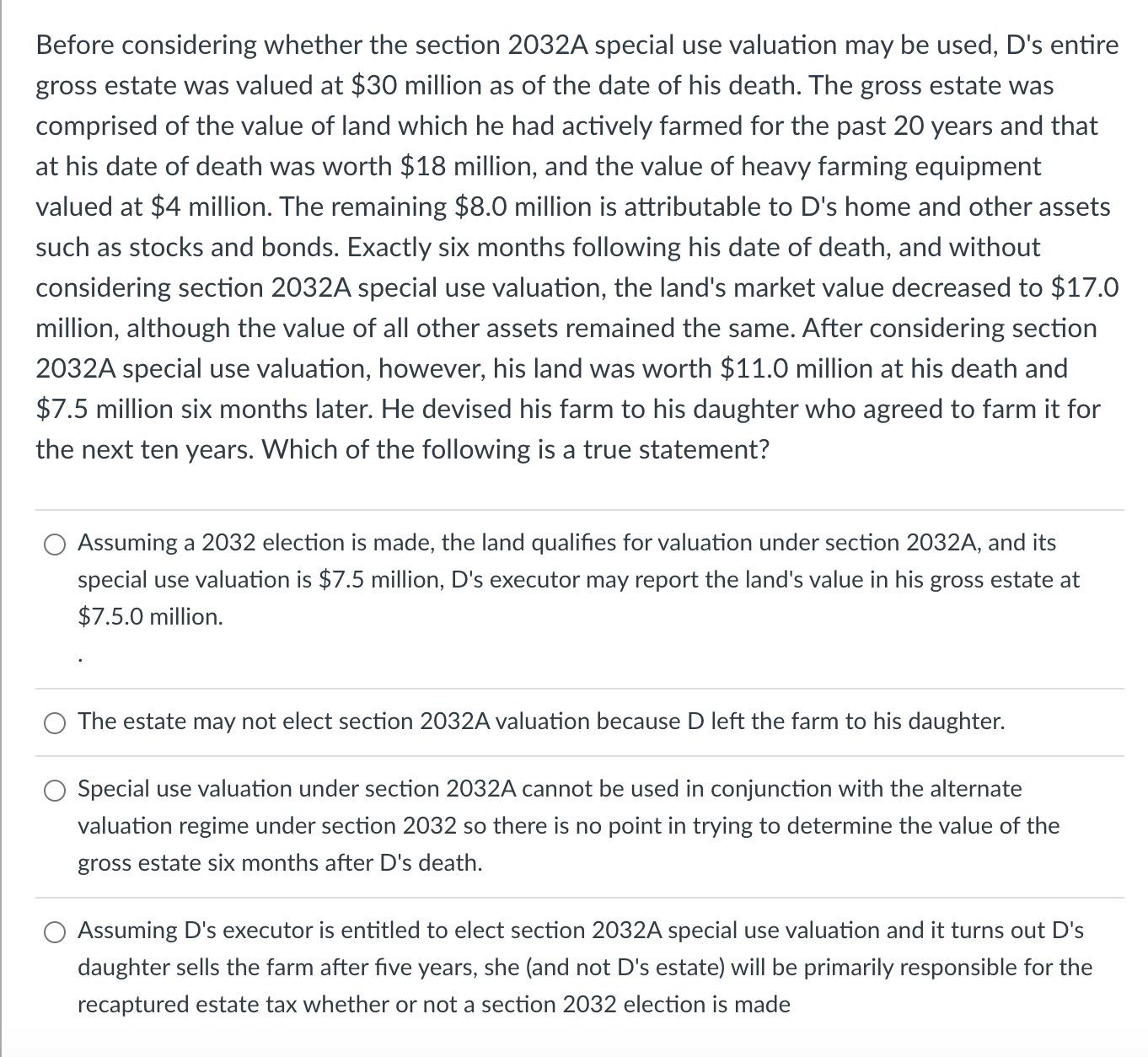
Before considering whether the section 2032A special use valuation may be used, D's entire gross estate was valued at $30 million as of the date of his death. The gross estate was comprised of the value of land which he had actively farmed for the past 20 years and that at his date of death was worth $18 million, and the value of heavy farming equipment valued at $4 million. The remaining $8.0 million is attributable to D's home and other assets such as stocks and bonds. Exactly six months following his date of death, and without considering section 2032A special use valuation, the land's market value decreased to $17.0 million, although the value of all other assets remained the same. After considering section 2032A special use valuation, however, his land was worth $11.0 million at his death and $7.5 million six months later. He devised his farm to his daughter who agreed to farm it for the next ten years. Which of the following is a true statement? Assuming a 2032 election is made, the land qualifies for valuation under section 2032A, and its special use valuation is $7.5 million, D's executor may report the land's value in his gross estate at $7.5.0 million. The estate may not elect section 2032A valuation because D left the farm to his daughter. Special use valuation under section 2032A cannot be used in conjunction with the alternate valuation regime under section 2032 so there is no point in trying to determine the value of the gross estate six months after D's death. Assuming D's executor is entitled to elect section 2032A special use valuation and it turns out D's daughter sells the farm after five years, she (and not D's estate) will be primarily responsible for the recaptured estate tax whether or not a section 2032 election is made
Step by Step Solution
There are 3 Steps involved in it

Get step-by-step solutions from verified subject matter experts
 Study Help