



Question: Before engaging in this discussion, please be sure to read and participate in the hypothetical games mentioned in our readings, beginning on page 187 -
Before engaging in this discussion, please be sure to read and participate in the hypothetical games mentioned in our readings, beginning on page 187 - the ultimatum, dictator, and trust games. After playing each of these, record your decisions/actions. For your initial posting, provide your decisions/actions from the three games. Following this, explain how effective you feel these experiments are in gauging social forces on investors. Discuss whether you feel this is an accurate portrayal of how individuals behave in the market.
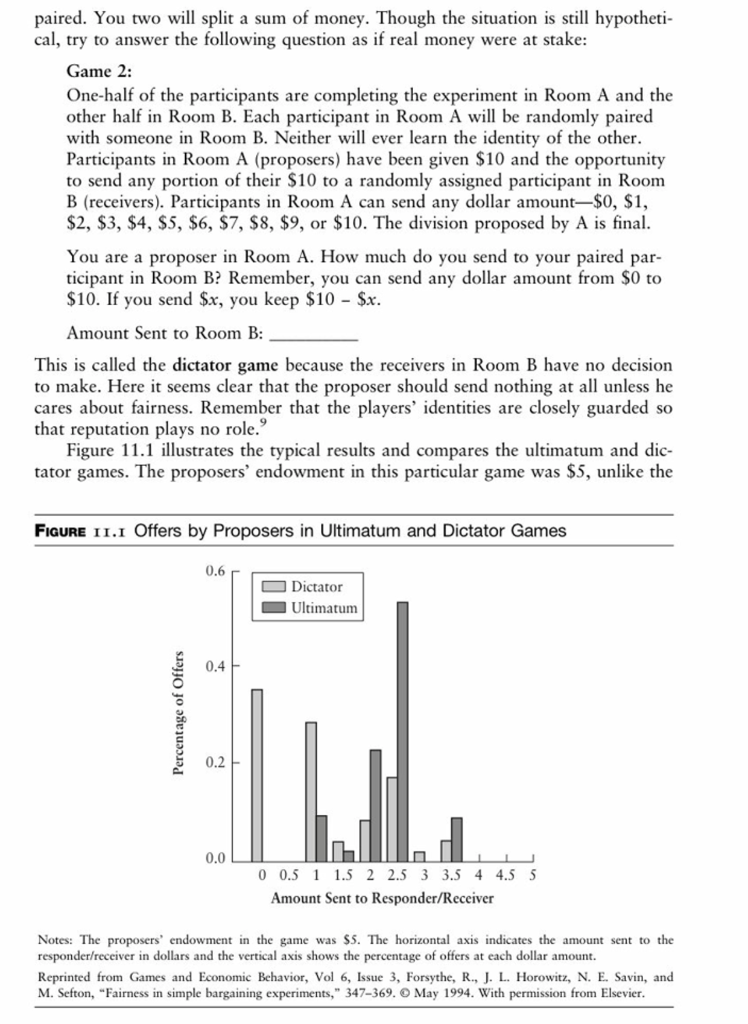
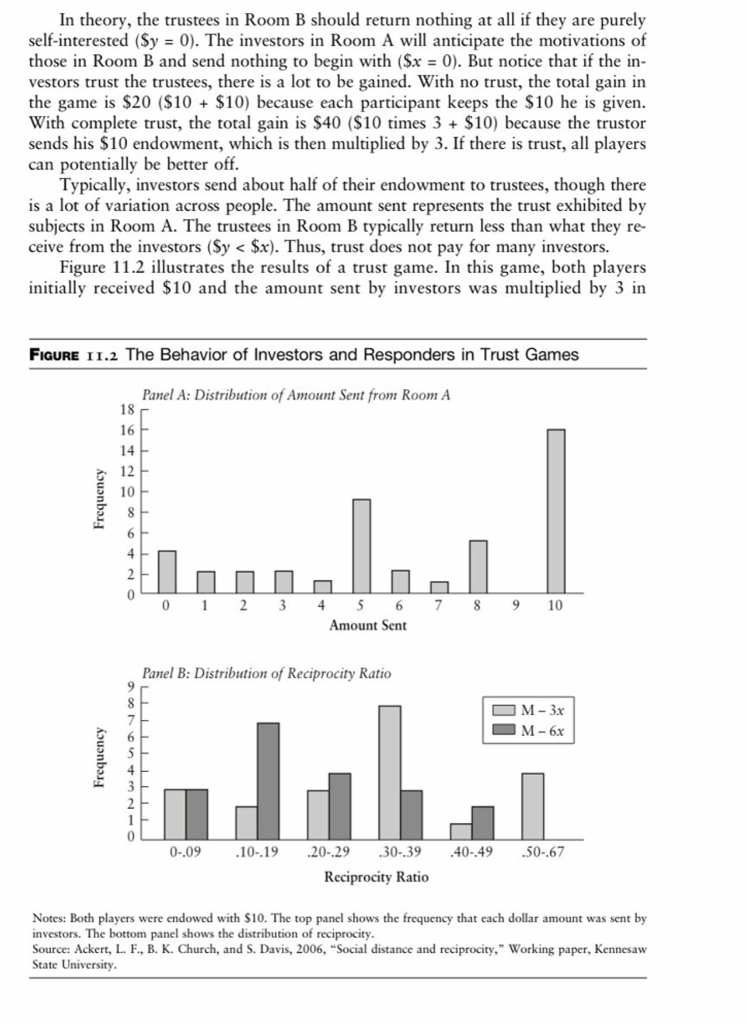
ULTIMATUM AND DICTATOR GAMES Consider a hypothetical experiment in which you and another student are anony- mously paired. You two will split a sum of money. Though the situation is hypo- thetical, try to answer the following question as if real dollars were at stake: Game 1: One-half of the participants are completing the experiment in Room A and the other half in Room B. Each participant in Room A will be randomly paired with someone in Room B. Neither will ever learn the identity of the other. Participants in Room A (proposers) have been given $10 and the opportunity to send any portion of their $10 to a randomly assigned participant in Room B (responders). Participants in Room A can send any dollar amount_$0, $1, $2, $3, $4, $5, $6, $7, $8, $9, or $10. Participants in Room B can choose to keep the amount sent, in which case the division proposed by A is final. Or, participants in Room B can reject the amount sent, in which case both indivi- duals receive nothing. You are a proposer in Room A. How much do you send to your paired par- ticipant in Room B? Remember you can send any dollar amount from $0 to $10 and the participant in Room B can accept this offer, or reject it, in which case you both receive nothing. If the other participant accepts and you send $x, you keep $10 - $x. Amount Sent to Room B: This is called the ultimatum game, and traditional economic theory predicts that a self-interested responder will accept any positive amount. A proposer who realizes this should make the smallest possible offer, $1 in the previous example. Is your choice similar to those of other students? On average, proposers send more than the minimum possible offer. Perhaps this is because they anticipate that responders will retaliate against offers they perceive to be unfair by rejecting them. Across many experiments in many different countries with different types of parti- cipants, responders reject offers that are less than 20% of the proposer's endow- ment ($2 in our example) about half of the time. The results of the ultimatum game seem to be inconsistent with pure self- interest in two respects. First, contrary to the maximization of their self-interest, responders reject positive offers. Second, proposers' behavior may indicate a taste for fairness as they, on average, send more than the minimum offer. This second conclusion could be premature because proposers may behave strategi- cally and offer more than the minimum if they anticipate the retaliation of the responders. Another game was proposed to separate fairness and strategy. Again, consider a hypothetical experiment in which you and another student are anonymously paired. You two will split a sum of money. Though the situation is still hypotheti- cal, try to answer the following question as if real money were at stake: Game 2: One-half of the participants are completing the experiment in Room A and the other half in Room B. Each participant in Room A will be randomly paired with someone in Room B. Neither will ever learn the identity of the other. Participants in Room A (proposers) have been given $10 and the opportunity to send any portion of their $10 to a randomly assigned participant in Room B (receivers). Participants in Room A can send any dollar amount_$0, $1, $2, $3, $4, $5, $6, $7, $8, $9, or $10. The division proposed by A is final. You are a proposer in Room A. How much do you send to your paired par- ticipant in Room B? Remember, you can send any dollar amount from $0 to $10. If you send $x, you keep $10 - $x. Amount Sent to Room B: This is called the dictator game because the receivers in Room B have no decision to make. Here it seems clear that the proposer should send nothing at all unless he cares about fairness. Remember that the players' identities are closely guarded so that reputation plays no role. Figure 11.1 illustrates the typical results and compares the ultimatum and dic- tator games. The proposers' endowment in this particular game was $5, unlike the FIGURE 11.1 Offers by Proposers in Ultimatum and Dictator Games 0.6 Dictator Ultimatum 0.4 Percentage of Offers 0.2 0.0 0 0.5 1 1.5 2 2.5 3 3.5 4 4.5 Amount Sent to Responder/Receiver Notes: The proposers' endowment in the game was $5. The horizontal axis indicates the amount sent to the responder/receiver in dollars and the vertical axis shows the percentage of offers at each dollar amount. Reprinted from Games and Economic Behavior, Vol 6, Issue 3, Forsythe, R., J. L. Horowitz, N. E. Savin, and M. Sefton, "Fairness in simple bargaining experiments," 347369. May 1994. With permission from Elsevier. In theory, the trustees in Room B should return nothing at all if they are purely self-interested ($y = 0). The investors in Room A will anticipate the motivations of those in Room B and send nothing to begin with ($x = 0). But notice that if the in- vestors trust the trustees, there is a lot to be gained. With no trust, the total gain in the game is $20 ($10 + $10) because each participant keeps the $10 he is given. With complete trust, the total gain is $40 ($10 times 3 + $10) because the trustor sends his $10 endowment, which is then multiplied by 3. If there is trust, all players can potentially be better off. Typically, investors send about half of their endowment to trustees, though there is a lot of variation across people. The amount sent represents the trust exhibited by subjects in Room A. The trustees in Room B typically return less than what they re- ceive from the investors (Sy
Step by Step Solution
There are 3 Steps involved in it

Get step-by-step solutions from verified subject matter experts