







Question: Before taking the self-test, refer to the learning objectives listed at the beginning of the chapter and the key terms listed at the end of
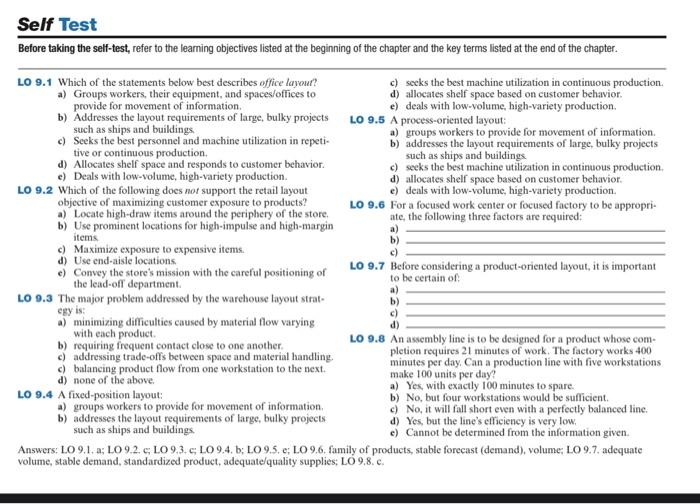
Before taking the self-test, refer to the learning objectives listed at the beginning of the chapter and the key terms listed at the end of the chapter. LO 9.1 Which of the statements below best describes office layout? a) Groups workers, their equipment, and spaces/offices to provide for movement of information. b) Addresses the layout requirements of large, bulky projects such as ships and buildings. c) Seeks the best personnel and machine utilization in repetitive or continuous production. d) Allocates shelf space and responds to customer behavior. e) Deals with low-volume, high-variety production. LO 9.2 Which of the following does not support the retail layout objective of maximizing customer exposure to products? a) Locate high-draw items around the periphery of the store. b) Use prominent locations for high-impulse and high-margin items. c) Maximize exposure to expensive items. d) Use end-aisle locations. e) Convey the store's mission with the careful positioning of the lead-off department. LO 9.3 The major problem addressed by the warehouse layout strategy is: a) minimizing difficulties caused by material flow varying with each product. b) requiring frequent contact close to one another. c) addressing trade-offs between space and material handling. c) balancing product flow from one workstation to the next. d) none of the above. LO 9.4 A fixed-position layout: a) groups workers to provide for movement of information. b) addresses the layout requirements of large, bulky projects such as ships and buildings. c) seeks the best machine utilization in continuous production. d) allocates shelf space based on customer behavior. e) deals with low-volume, high-variety production. LO 9.5 A process-oriented layout: a) groups workers to provide for movement of information. b) addresses the layout requirements of large, bulky projects such as ships and buildings. c) seeks the best machine utilization in continuous production. d) allocates shelf space based on customer behavior. e) deals with low-volume, high-variety production. LO 9.6 For a focused work center or focused factory to be appropriate, the following three factors are required: a) b) c) LO 9.7 Before considering a product-oriented layout, it is important to be certain of: a) b) c) d) LO 9.8 An assembly line is to be designed for a product whose com. pletion requires 21 minutes of work. The factory works 400 minutes per day. Can a production line with five workstations make 100 units per day? a) Yes, with exactly 100 minutes to spare. b) No, but four workstations would be sufficient. c) No, it will fall short even with a perfectly balanced line. d) Yes, but the line's effieiency is very low. e) Cannot be determined from the information given. Answers: LO 9.1, a; LO 9.2. c, LO 9.3, c, LO 9.4, b; LO 9.5, e; LO 9.6, family of products, stable forecast (demand), volume; LO 9.7, adequate volume, stable demand, standardized product, adequate/quality supplies; LO 9.8 . c
Step by Step Solution
There are 3 Steps involved in it

Get step-by-step solutions from verified subject matter experts
 Study Help