







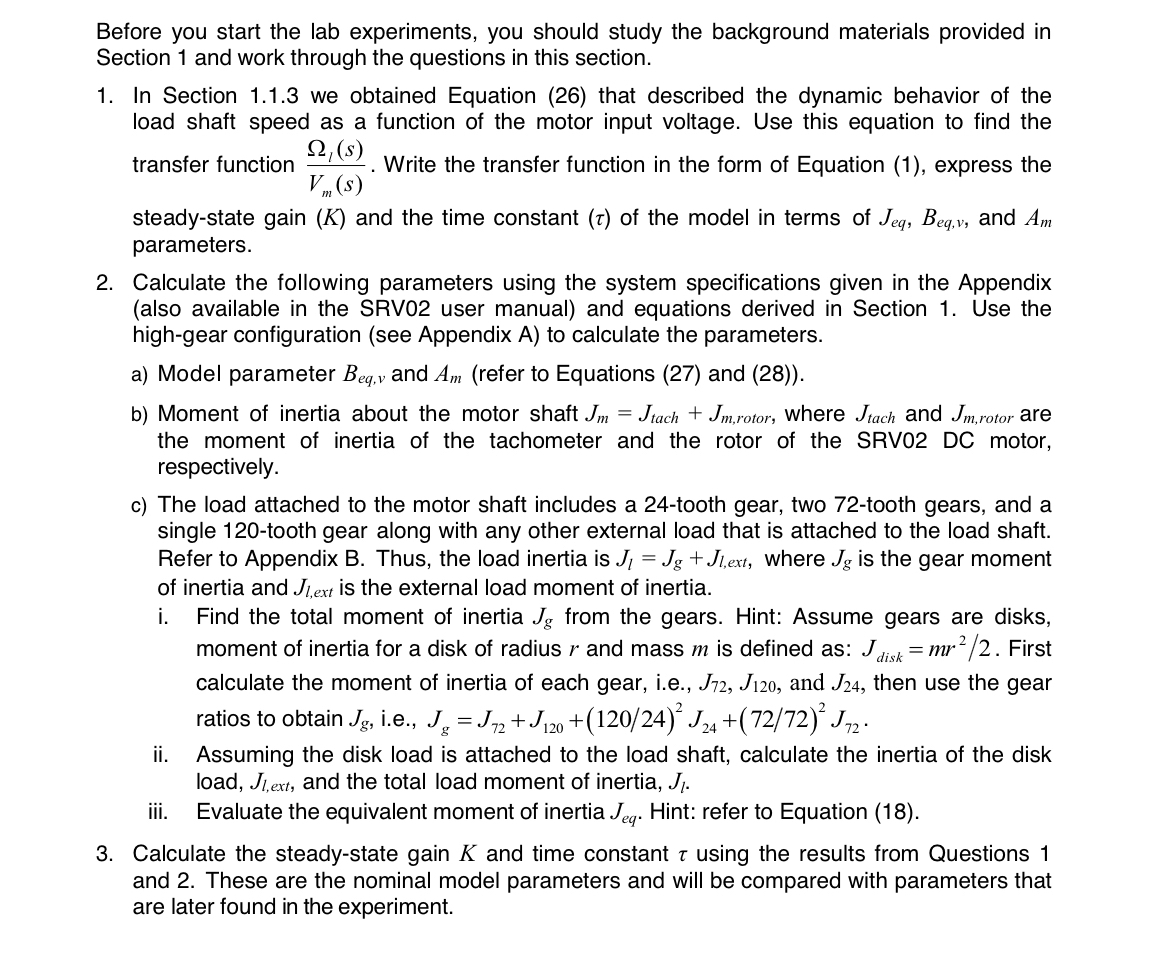
Question: Before you start the lab experiments, you should study the background materials provided in Section 1 and work through the questions in this section. In
Before you start the lab experiments, you should study the background materials provided in
Section and work through the questions in this section.
In Section we obtained Equation that described the dynamic behavior of the
load shaft speed as a function of the motor input voltage. Use this equation to find the
transfer function Write the transfer function in the form of Equation express the
steadystate gain and the time constant of the model in terms of and
parameters.
Calculate the following parameters using the system specifications given in the Appendix
also available in the SRV user manual and equations derived in Section Use the
highgear configuration see Appendix A to calculate the parameters.
a Model parameter and refer to Equations and
b Moment of inertia about the motor shaft where and are
the moment of inertia of the tachometer and the rotor of the SRV DC motor,
respectively.
c The load attached to the motor shaft includes a tooth gear, two tooth gears, and a
single tooth gear along with any other external load that is attached to the load shaft.
Refer to Appendix B Thus, the load inertia is where is the gear moment
of inertia and is the external load moment of inertia.
i Find the total moment of inertia from the gears. Hint: Assume gears are disks,
moment of inertia for a disk of radius and mass is defined as: First
calculate the moment of inertia of each gear, ie and then use the gear
ratios to obtain ie
ii Assuming the disk load is attached to the load shaft, calculate the inertia of the disk
load, and the total load moment of inertia,
iii. Evaluate the equivalent moment of inertia Hint: refer to Equation
Calculate the steadystate gain and time constant using the results from Questions
and These are the nominal model parameters and will be compared with parameters that
are later found in the experiment.
Step by Step Solution
There are 3 Steps involved in it
1 Expert Approved Answer
Step: 1 Unlock

Question Has Been Solved by an Expert!
Get step-by-step solutions from verified subject matter experts
Step: 2 Unlock
Step: 3 Unlock
 Study Help