







Question: Questions Q3-Q6 refer to the following graph: E F B A Q3. Plot the degree distribution for this graph. Recall that the degree of
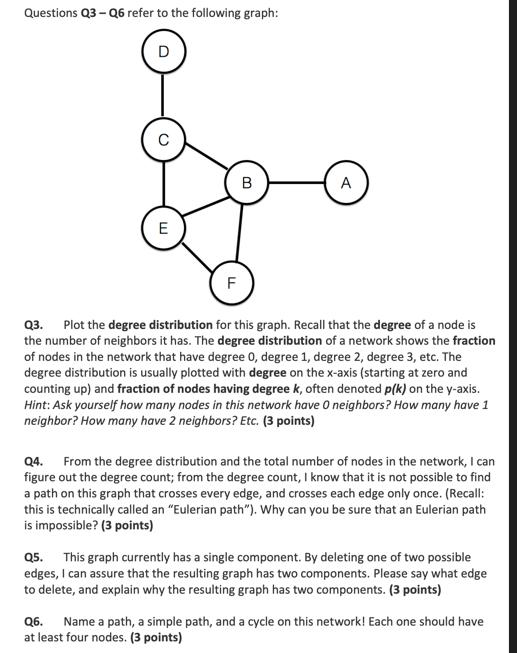
Questions Q3-Q6 refer to the following graph: E F B A Q3. Plot the degree distribution for this graph. Recall that the degree of a node is the number of neighbors it has. The degree distribution of a network shows the fraction of nodes in the network that have degree 0, degree 1, degree 2, degree 3, etc. The degree distribution is usually plotted with degree on the x-axis (starting at zero and counting up) and fraction of nodes having degree k, often denoted p(k) on the y-axis. Hint: Ask yourself how many nodes in this network have 0 neighbors? How many have 1 neighbor? How many have 2 neighbors? Etc. (3 points) Q4. From the degree distribution and the total number of nodes in the network, I can figure out the degree count; from the degree count, I know that it is not possible to find a path on this graph that crosses every edge, and crosses each edge only once. (Recall: this is technically called an "Eulerian path"). Why can you be sure that an Eulerian path is impossible? (3 points) Q5. This graph currently has a single component. By deleting one of two possible edges, I can assure that the resulting graph has two components. Please say what edge to delete, and explain why the resulting graph has two components. (3 points) Q6. Name a path, a simple path, and a cycle on this network! Each one should have at least four nodes. (3 points)
Step by Step Solution
There are 3 Steps involved in it

Get step-by-step solutions from verified subject matter experts
 Study Help