



Question: Begin this problem by calculating the steady-state flux (mg DDT /(m2 day)) for De= 2.5106cm2/s,a=35cm, and A=25mgDDT/L. Then, use equation (11) from the Thoma et
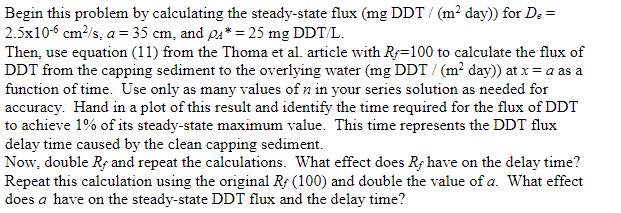

Begin this problem by calculating the steady-state flux (mg DDT /(m2 day)) for De= 2.5106cm2/s,a=35cm, and A=25mgDDT/L. Then, use equation (11) from the Thoma et al. article with Rf=100 to calculate the flux of DDT from the capping sediment to the overlying water (mg DDT / ( m2 day)) at x=a as a function of time. Use only as many values of n in your series solution as needed for accuracy. Hand in a plot of this result and identify the time required for the flux of DDT to achieve 1% of its steady-state maximum value. This time represents the DDT flux delay time caused by the clean capping sediment. Now, double Rf and repeat the calculations. What effect does Rf have on the delay time? Repeat this calculation using the original Rf(100) and double the value of a. What effect does a have on the steady-state DDT flux and the delay time? NA=aDeA[1+2n=1(1)nexp((RfDet)(an)2)]
Step by Step Solution
There are 3 Steps involved in it

Get step-by-step solutions from verified subject matter experts