



Question: beginning balance. Assets liabilities+ equity. d. Always a credit. e. Sellers allow customers to use credit cards To avoid having to evaluate a customer's credit
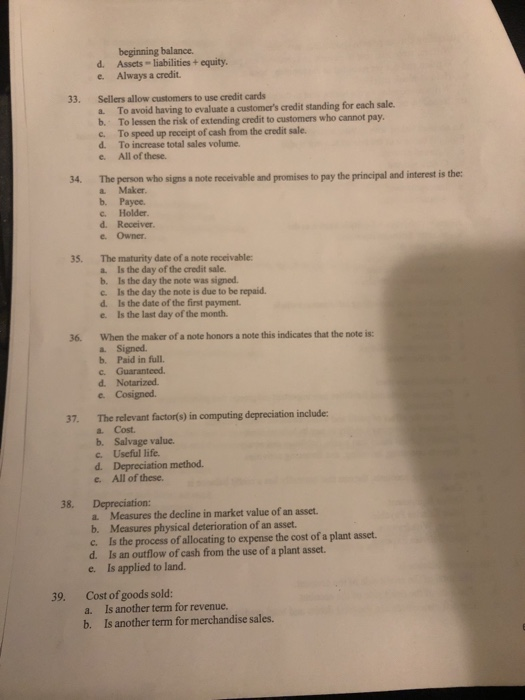
beginning balance. Assets liabilities+ equity. d. Always a credit. e. Sellers allow customers to use credit cards To avoid having to evaluate a customer's credit standing for each sale. To lessen the risk of extending credit to customers who cannot pay. 33. a. b. To speed up receipt of cash from the credit sale. d. To increase total sales volume. All of these. e. The person who signs a note receivable and promises to pay the principal and interest is the: Maker. 34. a. b. Payee. Holder. d. Receiver. e. Owner. c. The maturity date of a note receivable: a. Is the day of the credit sale. b. Is the day the note was signed. Is the day the note is due to be repaid. d. Is the date of the first payment. e. Is the last day of the month. 35. c. When the maker of a note honors a note this indicates that the note is: Signed. b. Paid in full. Guaranteed d. Notarized. e. Cosigned. 36. al c The relevant factor(s) in computing depreciation include: 37 Cost. a. b. Salvage value. c Useful life d. Depreciation method. All of these. e. Depreciation: Measures the decline in market value of an asset. b. Measures physical deterioration of an asset. Is the process of allocating to expense the cost of a plant asset. d. Is an outflow of cash from the use of a plant asset. Is applied to land. 38. a. C. e. Cost of goods sold: Is another term for revenue. b. Is another term for merchandise sales. 39. a. 1-4
Step by Step Solution
There are 3 Steps involved in it

Get step-by-step solutions from verified subject matter experts