



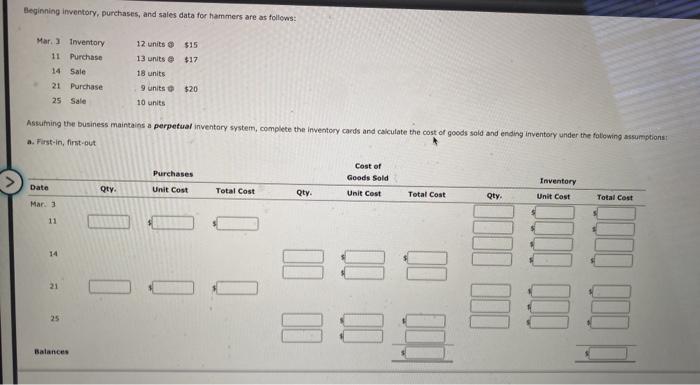
Question: Beginning inventory, purchases, and sales data for hammers are as follows: Mar. ] Inventory 11 Purchase 14 Sale 21 Purchase 25 Sale 12 units $15
![Mar. ] Inventory 11 Purchase 14 Sale 21 Purchase 25 Sale 12](https://dsd5zvtm8ll6.cloudfront.net/si.experts.images/questions/2024/09/66e6f6acaf1f4_46066e6f6ac4a16b.jpg)
Beginning inventory, purchases, and sales data for hammers are as follows: Mar. ] Inventory 11 Purchase 14 Sale 21 Purchase 25 Sale 12 units $15 13 units @ $17 18 units 9 units $20 10 units Assuming the business maintains a perpetual inventory system, complete the inventory cards and calculate the cost of goods sold and ending inventory under the following assumptions a. First-in, first-out Purchases Cost of Goods Sold Inventory Date Qty. Unit Cost Total Cost Qty. Unit Cost Total Cost Qty. Unit Cost Total Cost Mar. 3 11 14 389 21 all 25 Balances Balances Cost of goods sold Ending inventory b. Last-in, first-out Purchases Cost of Goods Sold Inventory Date Qty. Unit Cost Total Cost Qty. Unit Cost Total Obst Qty. Unit Cost Total Cost Mar. 3 11 21 001 25 Balances Cost of goods sold E Ending inventory
Step by Step Solution
There are 3 Steps involved in it

Get step-by-step solutions from verified subject matter experts