







Question: ?? ? begin{tabular}{|l|r|l|} hline a-1. Portfolio expected return & 12.34 & % hline a-2. Variance & 0.04353 & hline a-3. Standard deviation &
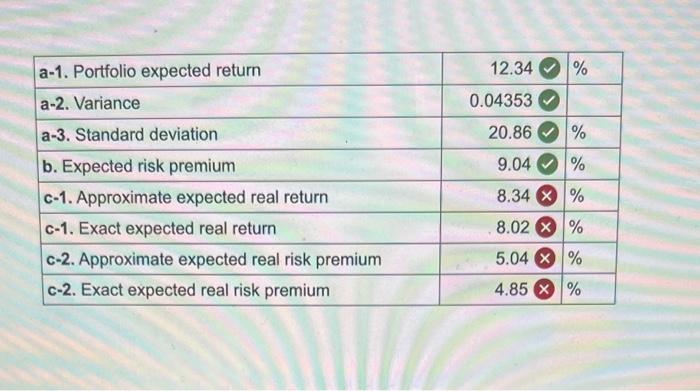
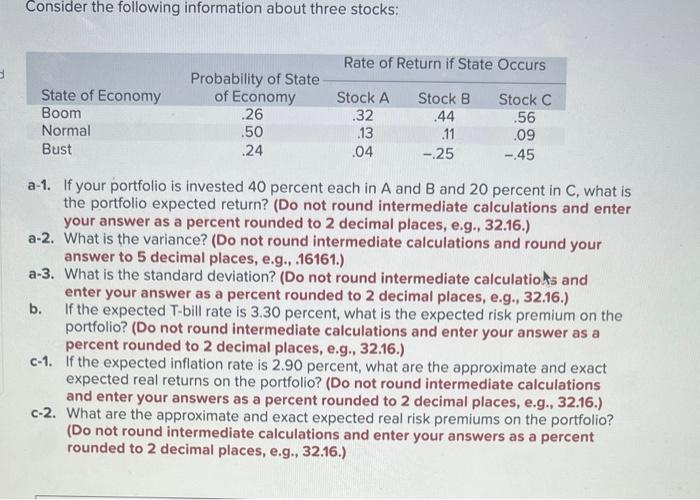
\begin{tabular}{|l|r|l|} \hline a-1. Portfolio expected return & 12.34 & % \\ \hline a-2. Variance & 0.04353 & \\ \hline a-3. Standard deviation & 20.86 & % \\ \hline b. Expected risk premium & 9.04 & % \\ \hline c-1. Approximate expected real return & 8.34 & % \\ \hline c-1. Exact expected real return & 8.02 & % \\ \hline c-2. Approximate expected real risk premium & 5.04 & % \\ \hline c-2. Exact expected real risk premium & 4.85 & % \\ \hline \end{tabular} Consider the following information about three stocks: a-1. If your portfolio is invested 40 percent each in A and B and 20 percent in C, what is the portfolio expected return? (Do not round intermediate calculations and enter your answer as a percent rounded to 2 decimal places, e.g., 32.16.) a-2. What is the variance? (Do not round intermediate calculations and round your answer to 5 decimal places, e.g., .16161.) a-3. What is the standard deviation? (Do not round intermediate calculatiots and enter your answer as a percent rounded to 2 decimal places, e.g., 32.16.) b. If the expected T-bill rate is 3.30 percent, what is the expected risk premium on the portfolio? (Do not round intermediate calculations and enter your answer as a percent rounded to 2 decimal places, e.g., 32.16.) c-1. If the expected inflation rate is 2.90 percent, what are the approximate and exact expected real returns on the portfolio? (Do not round intermediate calculations and enter your answers as a percent rounded to 2 decimal places, e.g., 32.16.) c-2. What are the approximate and exact expected real risk premiums on the portfolio? (Do not round intermediate calculations and enter your answers as a percent rounded to 2 decimal places, e.g., 32.16.)
Step by Step Solution
There are 3 Steps involved in it

Get step-by-step solutions from verified subject matter experts
 Study Help