







Question: begin{tabular}{|l|r|r|r|} hline Work Order & Setup Time & Processing Time & Order Size hline Single tooth crown 1st appt. & 10 & 95 &
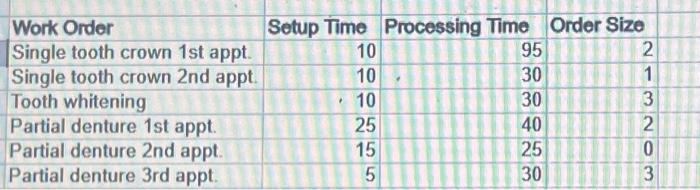
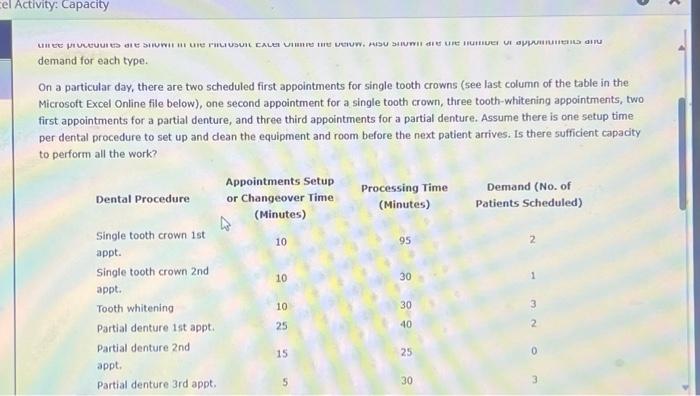
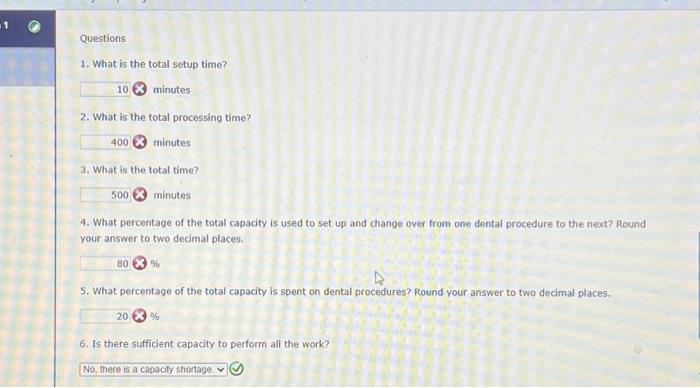
\begin{tabular}{|l|r|r|r|} \hline Work Order & Setup Time & Processing Time & Order Size \\ \hline Single tooth crown 1st appt. & 10 & 95 & 2 \\ \hline Single tooth crown 2nd appt. & 10 & 30 & 1 \\ \hline Tooth whitening & 10 & 30 & 3 \\ \hline Partial denture 1st appt. & 25 & 40 & 2 \\ \hline Partial denture 2nd appt. & 15 & 25 & 0 \\ \hline Partial denture 3rd appt. & 5 & 30 & 3 \\ \hline \end{tabular} demand for each type. On a particular day, there are two scheduled first appointments for single tooth crowns (see last column of the table in the Microsoft Excel Online file below), one second appointment for a single tooth crown, three tooth-whitening appointments, two first appointments for a partial denture, and three third appointments for a partial denture. Assume there is one setup time per dental procedure to set up and dean the equipment and room before the next patient arrives. Is there sufficient capacity to perform all the work? 1. What is the total setup time? minutes 2. What is the total processing time? minutes 3. What is the total time? minutes 4. What percentage of the total capacity is used to set up and change over from one dental procedure to the next? Round your answer to two decimal places. % 5. What percentage of the total capacity is spent on dental procedures? Round your answer to two decimal places. % 6. Is there sufficient capacity to perform all the work
Step by Step Solution
There are 3 Steps involved in it

Get step-by-step solutions from verified subject matter experts
 Study Help