







Question: Below are two Regular Languages defined by their respective Regular Expres- sion. Parts b, c, and d must use the DFAs that you create for
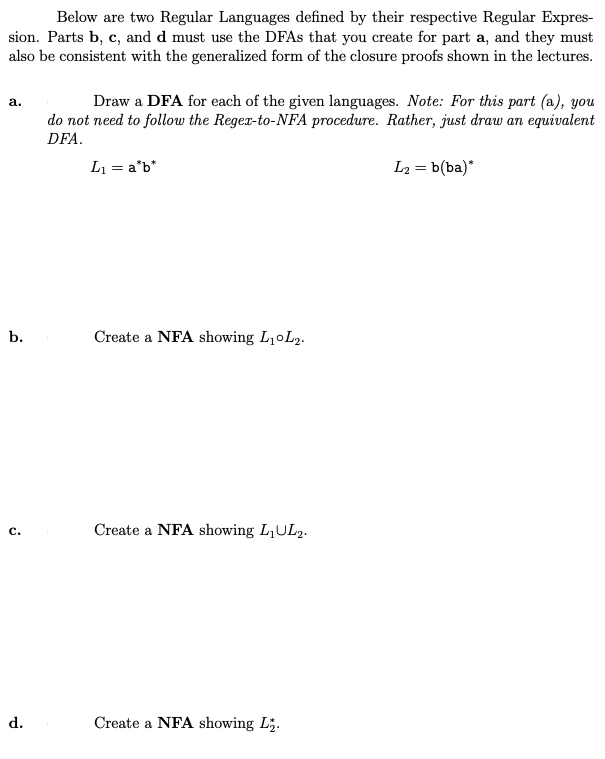
Below are two Regular Languages defined by their respective Regular Expres- sion. Parts b, c, and d must use the DFAs that you create for part a, and they must also be consistent with the generalized form of the closure proofs shown in the lectures. a. Draw a DFA for each of the given languages. Note: For this part (a), you do not need to follow the Reger-to-NFA procedure. Rather, just draw an equivalent DFA. Li = a*b* L2 = b(ba)* b. Create a NFA showing L1L2. C. Create a NFA showing L, UL. d. Create a NFA showing L
Step by Step Solution
There are 3 Steps involved in it
1 Expert Approved Answer
Step: 1 Unlock

Question Has Been Solved by an Expert!
Get step-by-step solutions from verified subject matter experts
Step: 2 Unlock
Step: 3 Unlock
 Study Help