







Question: Below I will add source code. You have to write code wherever stub is written. AlsoYou just have to write codes on the Arrayqueue.java and
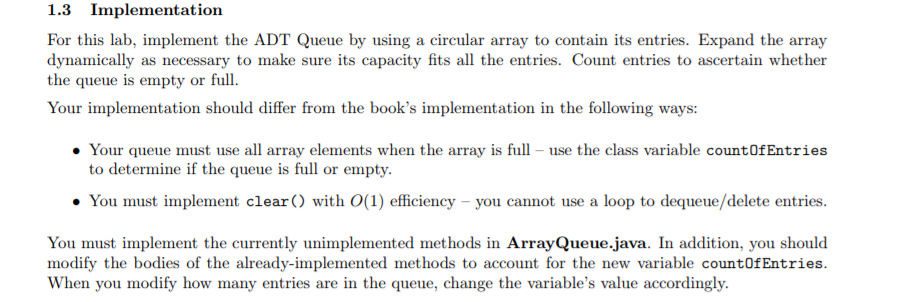
Below I will add source code. You have to write code wherever stub is written. AlsoYou just have to write codes on the Arrayqueue.java and on test file.The rest of files are for references.
Arrayqueue.java:
ublic final class ArrayQueue
{
private T[] queue; // Circular array of queue entries and one unused location
private int frontIndex;
private int backIndex;
private boolean initialized = false;
private int countOfEntries = 0;
private static final int DEFAULT_CAPACITY = 50;
private static final int MAX_CAPACITY = 10000;
public ArrayQueue()
{
this(DEFAULT_CAPACITY);
} // end default constructor
public ArrayQueue(int initialCapacity)
{
checkCapacity(initialCapacity);
// The cast is safe because the new array contains null entries
@SuppressWarnings("unchecked")
T[] tempQueue = ( T[] ) new Object[initialCapacity];
queue = tempQueue;
frontIndex = 0;
backIndex = initialCapacity - 1;
initialized = true;
} // end constructor
private void checkInitialization()
{
// STUB
} // end checkInitialization()
private void checkCapacity(int initialCapacity)
{
// STUB
} // end checkCapacity()
// Doubles the size of the array queue if it is full
// Precondition: checkInitialization has been called.
// Modified
private void ensureCapacity()
{
if (countOfEntries == queue.length) // if array is full,
{ // double size of array
T[] oldQueue = queue;
int oldSize = oldQueue.length;
int newSize = 2 * oldSize;
checkCapacity(newSize);
// The cast is safe because the new array contains null entries
@SuppressWarnings("unchecked")
T[] tempQueue = (T[]) new Object[2 * oldSize];
queue = tempQueue;
for (int index = 0; index
{
queue[index] = oldQueue[frontIndex];
frontIndex = (frontIndex + 1) % oldSize;
} // end for
frontIndex = 0;
backIndex = oldSize - 1;
} // end if
} // end ensureCapacity()
@Override
public void enqueue(T newEntry)
{
checkInitialization();
ensureCapacity();
backIndex = (backIndex + 1) % queue.length;
queue[backIndex] = newEntry;
} // end enqueue()
@Override
public T dequeue()
{
checkInitialization();
if (isEmpty())
throw new EmptyQueueException();
else
{
T front = queue[frontIndex];
queue[frontIndex] = null;
frontIndex = (frontIndex + 1) % queue.length;
return front;
} // end if
} // end dequeue()
@Override
public T getFront()
{
// STUB
return null;
} // end getFront()
@Override
public boolean isEmpty()
{
// STUB
return false;
} // end isEmpty()
@Override
public void clear()
{
// STUB
} // end clear()
} // end class ArrayQueue
EmptyQueueException.java:
public class EmptyQueueException extends RuntimeException
{
private static final long serialVersionUID = 1L;
public EmptyQueueException()
{
this(null);
} // end default constructor
public EmptyQueueException(String message)
{
super(message);
} // end constructor
} // end class EmptyQueueException
QueueInterfece.java
public interface QueueInterface
LAB4Tests.java
import static org.junit.Assert.assertTrue;
import java.security.Permission;
import org.junit.After;
import org.junit.Before;
import org.junit.Rule;
import org.junit.Test;
import org.junit.rules.Timeout;
import edu.wit.cs.comp2000.QueueInterface;
import edu.wit.cs.comp2000.ArrayQueue;
public class LAB4Tests{
@Rule
public Timeout globalTimeout = Timeout.seconds(5);
@SuppressWarnings("serial")
private static class ExitException extends SecurityException {}
private static class NoExitSecurityManager extends SecurityManager
{
@Override
public void checkPermission(Permission perm) {}
@Override
public void checkPermission(Permission perm, Object context) {}
@Override
public void checkExit(int status) { super.checkExit(status); throw new ExitException(); }
}
@Before
public void setUp() throws Exception
{
System.setSecurityManager(new NoExitSecurityManager());
}
@After
public void tearDown() throws Exception
{
System.setSecurityManager(null);
}
/*
* enqueue does not return a value, so we check to make sure
* our implementation doesn't crash and check exceptions
*/
@Test
public void testEnqueue() {
QueueInterface
testQueue = new ArrayQueue(3);
// check that each enqueue call is successful
for (int i = 0; i
testQueue.enqueue("item " + i);
// check that enqueue works with resizing
testQueue.enqueue("resizing time");
/* exception testing pattern:
*
boolean exceptionDetected = false;
try {
queue.operation("hi");
} catch (ExceptionType e) {
exceptionDetected = true;
}
assertTrue("Performing operation in current state should throw ExceptionType", exceptionDetected);
*/
}
@Test
public void testIsEmpty() {
QueueInterface
assertTrue("Queue should start out empty", testQueue.isEmpty());
testQueue.enqueue("testing");
assertTrue("Queue should not be empty with 1 entry", !testQueue.isEmpty());
testQueue.enqueue("more testing");
assertTrue("Queue should not be empty with 2 entries", !testQueue.isEmpty());
}
@Test
public void testDequeue() {
assertTrue("Implement this test", false); // STUB
}
@Test
public void testGetFront() {
assertTrue("Implement this test", false); // STUB
}
@Test
public void testClear() {
assertTrue("Implement this test", false); // STUB
}
}
1.3 Implementation For this lab, implement the ADT Queue by using a circular array to contain its entries. Expand the array dynamically as necessary to make sure its capacity fits all the entries. Count entries to ascertain whether the queue is empty or full Your implementation should differ from the book's implementation in the following ways: . Your queue must use all array elements when the array is full -use the class variable countOfEntries You must implement clear with O(1) efficiency -you cannot use a loop to dequeue/delete entries. You must implement the currently unimplemented methods in ArrayQueue.java. In addition, you should to determine if the queue is full or empty. modify the bodies of the already-implemented methods to account for the new variable countOfEntries When you modify how many entries are in the queue, change the variable's value accordingly. 1.3 Implementation For this lab, implement the ADT Queue by using a circular array to contain its entries. Expand the array dynamically as necessary to make sure its capacity fits all the entries. Count entries to ascertain whether the queue is empty or full Your implementation should differ from the book's implementation in the following ways: . Your queue must use all array elements when the array is full -use the class variable countOfEntries You must implement clear with O(1) efficiency -you cannot use a loop to dequeue/delete entries. You must implement the currently unimplemented methods in ArrayQueue.java. In addition, you should to determine if the queue is full or empty. modify the bodies of the already-implemented methods to account for the new variable countOfEntries When you modify how many entries are in the queue, change the variable's value accordingly
Step by Step Solution
There are 3 Steps involved in it

Get step-by-step solutions from verified subject matter experts
 Study Help