



Question: Below is a list of names in Numpy format. That are the bank accounts. In the cell below create a ( 1 0 , 2
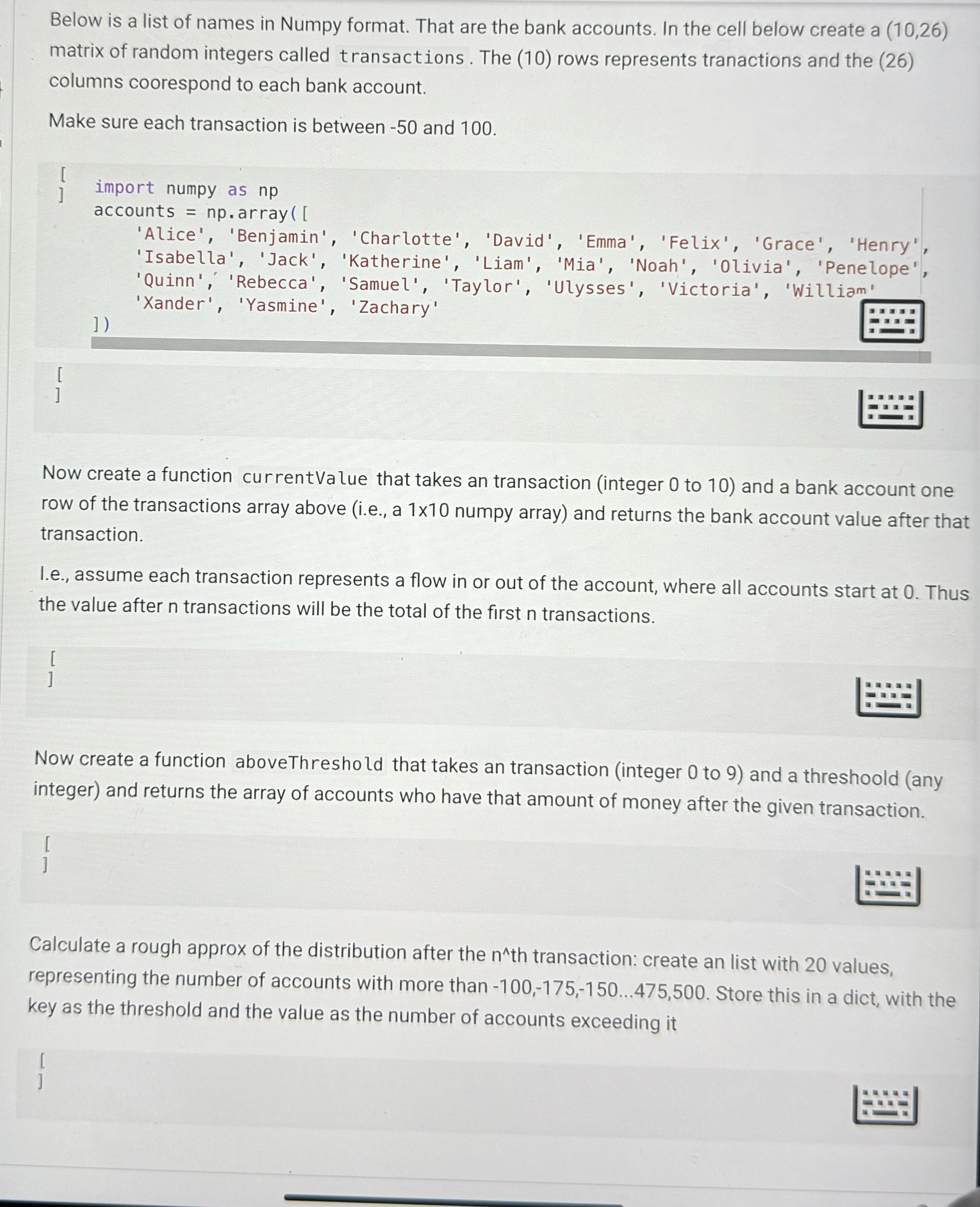
Below is a list of names in Numpy format. That are the bank accounts. In the cell below create a matrix of random integers called transactions. The rows represents tranactions and the columns coorespond to each bank account.
Make sure each transaction is between and 'Alice', 'Benjamin', 'Charlotte', 'David', 'Emma', 'Felix', 'Grace', 'Henry','Isabella', 'Jack', 'Katherine', 'Liam', 'Mia', 'Noah', 'Olivia', 'Penelope','Quinn', 'Rebecca', 'Samuel', 'Taylor', 'Ulysses', 'Victoria', 'William''Xander', 'Yasmine', 'Zachary'Now create a function currentValue that takes an transaction integer to and a bank account one row of the transactions array above ie a times numpy array and returns the bank account value after that transaction.I.e assume each transaction represents a flow in or out of the account, where all accounts start at Thus the value after n transactions will be the total of the first n transactions.
Now create a function aboveThreshold that takes an transaction integer to and a threshoold any integer and returns the array of accounts who have that amount of money after the given transaction.
Calculate a rough approx of the distribution after the th transaction: create an list with values, representing the number of accounts with more than dots Store this in a dict, with the key as the threshold and the value as the number of accounts exceeding it
Step by Step Solution
There are 3 Steps involved in it
1 Expert Approved Answer
Step: 1 Unlock

Question Has Been Solved by an Expert!
Get step-by-step solutions from verified subject matter experts
Step: 2 Unlock
Step: 3 Unlock