Question: Below is an excerpt from the article: D. Gashu et al., The nutritional quality of cereals varies geospatially in Ethiopia and Malawi Nature, vol. 594,
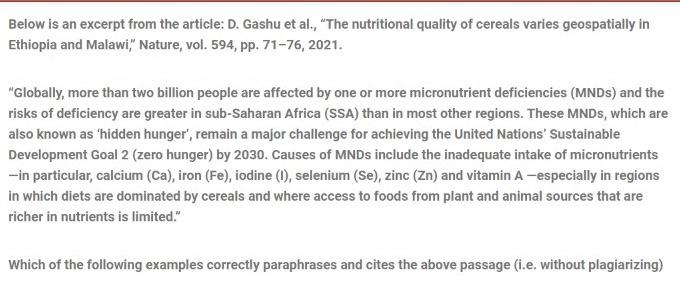
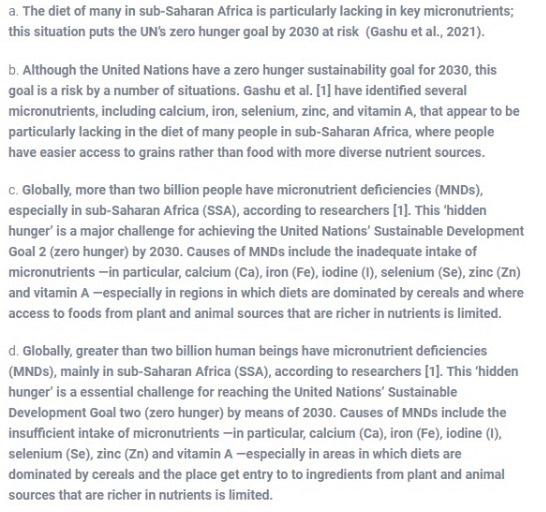
Below is an excerpt from the article: D. Gashu et al., "The nutritional quality of cereals varies geospatially in Ethiopia and Malawi" Nature, vol. 594, pp. 71-76, 2021. "Globally, more than two billion people are affected by one or more micronutrient deficiencies (MNDs) and the risks of deficiency are greater in sub-Saharan Africa (SSA) than in most other regions. These MND, which are also known as 'hidden hunger', remain a major challenge for achieving the United Nations' Sustainable Development Goal 2 (zero hunger) by 2030. Causes of MNDs include the inadequate intake of micronutrients -in particular, calcium (Ca), iron (Fe), iodine (1), selenium (Se), zinc (Zn) and vitamin A-especially in regions in which diets are dominated by cereals and where access to foods from plant and animal sources that are richer in nutrients is limited." Which of the following examples correctly paraphrases and cites the above passage (i.e. without plagiarizing) a. The diet of many in sub-Saharan Africa is particularly lacking in key micronutrients; this situation puts the UN's zero hunger goal by 2030 at risk (Gashu et al., 2021). b. Although the United Nations have a zero hunger sustainability goal for 2030, this goal is a risk by a number of situations. Gashu et al. [1] have identified several micronutrients, including calcium, iron, selenium, zinc, and vitamin A, that appear to be particularly lacking in the diet of many people in sub-Saharan Africa, where people have easier access to grains rather than food with more diverse nutrient sources. C. Globally, more than two billion people have micronutrient deficiencies (MNDS), especially in sub-Saharan Africa (SSA), according to researchers [1]. This "hidden hunger' is a major challenge for achieving the United Nations' Sustainable Development Goal 2 (zero hunger) by 2030. Causes of MNDs include the inadequate intake of micronutrients -in particular, calcium (Ca), iron (Fe), iodine (I), selenium (Se), zinc (Zn) and vitamin A-especially in regions in which diets are dominated by cereals and where access to foods from plant and animal sources that are richer in nutrients is limited. d. Globally, greater than two billion human beings have micronutrient deficiencies (MNDS), mainly in sub-Saharan Africa (SSA), according to researchers [1]. This 'hidden hunger' is a essential challenge for reaching the United Nations' Sustainable Development Goal two (zero hunger) by means of 2030. Causes of MNDs include the insufficient intake of micronutrients in particular, calcium (Ca), iron (Fe), iodine (1), selenium (Se), zinc (Zn) and vitamin A -especially in areas in which diets are dominated by cereals and the place get entry to to ingredients from plant and animal sources that are richer in nutrients is limited









 Study Help