Question: Below is my writting assignment, using the grading rubric, help me go over it, correct it , and make some suggestion . Growth, Development and
Below is my writting assignment, using the grading rubric, help me go over it, correct it , and make some suggestion .
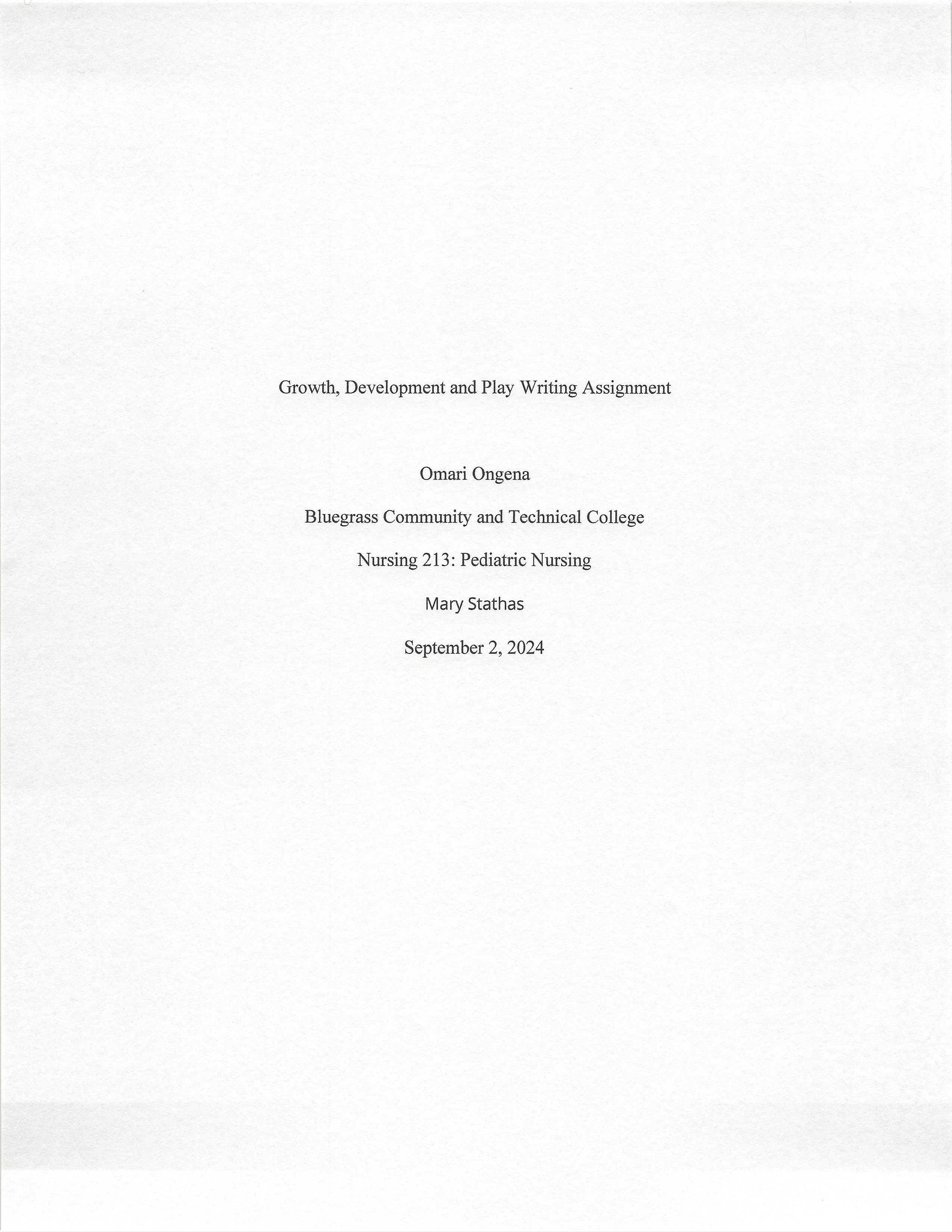
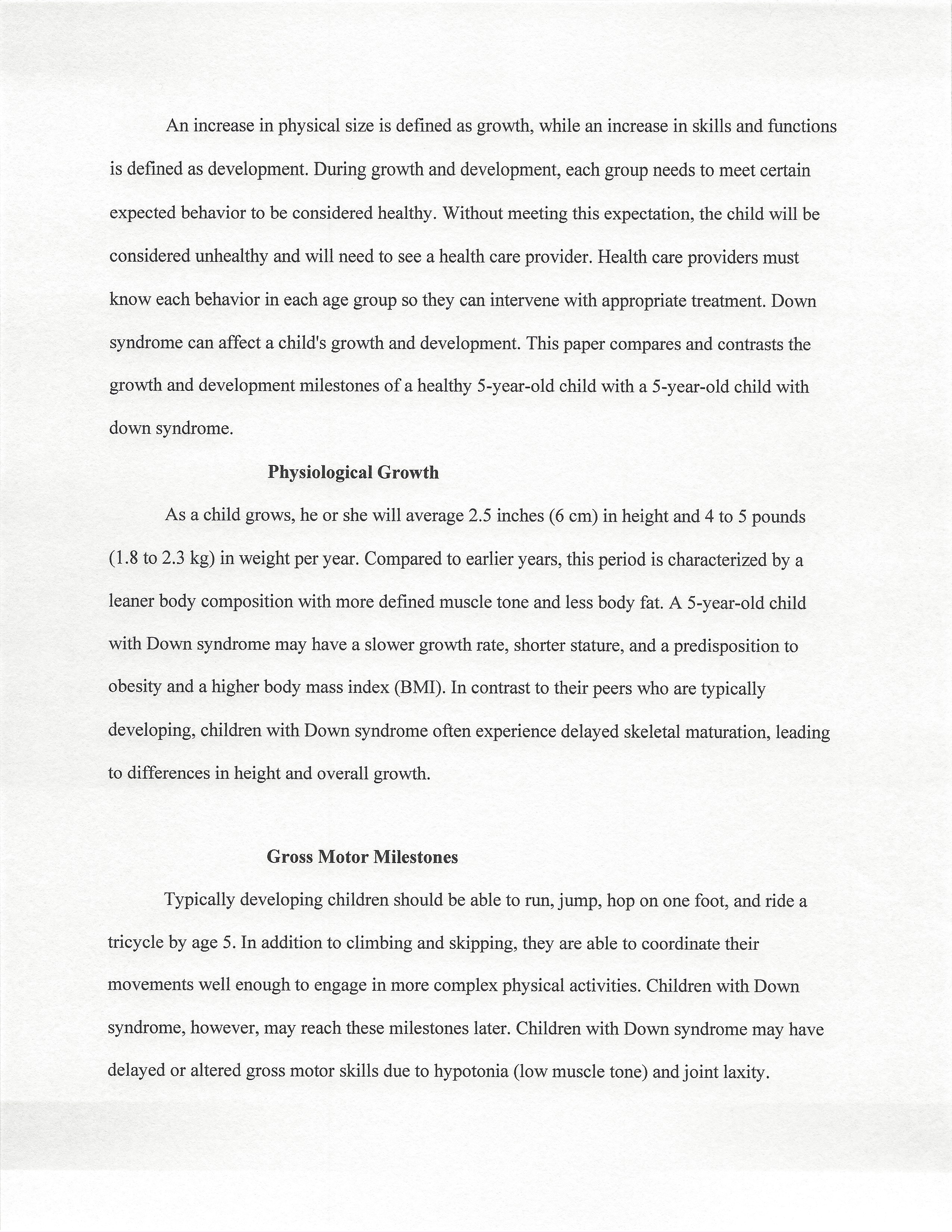
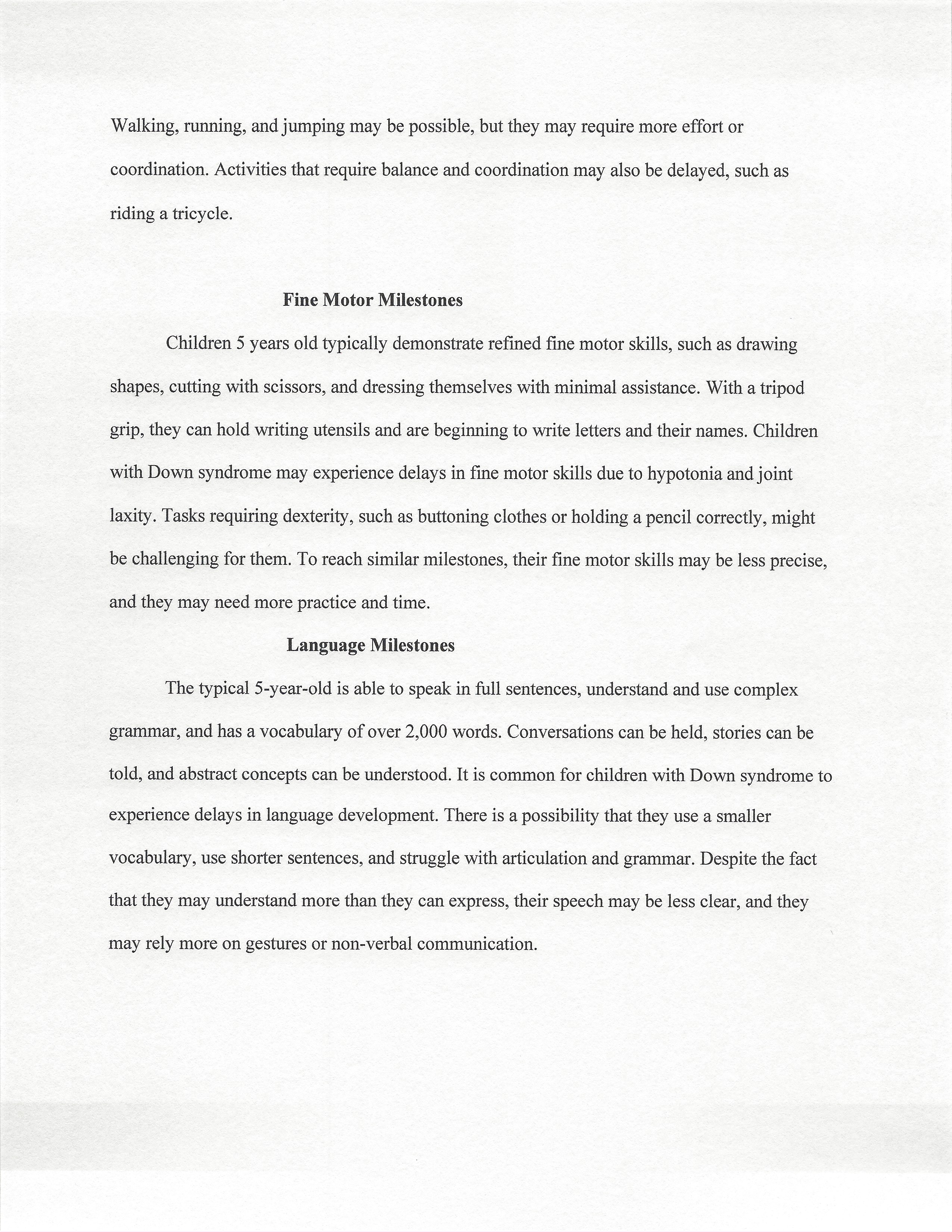
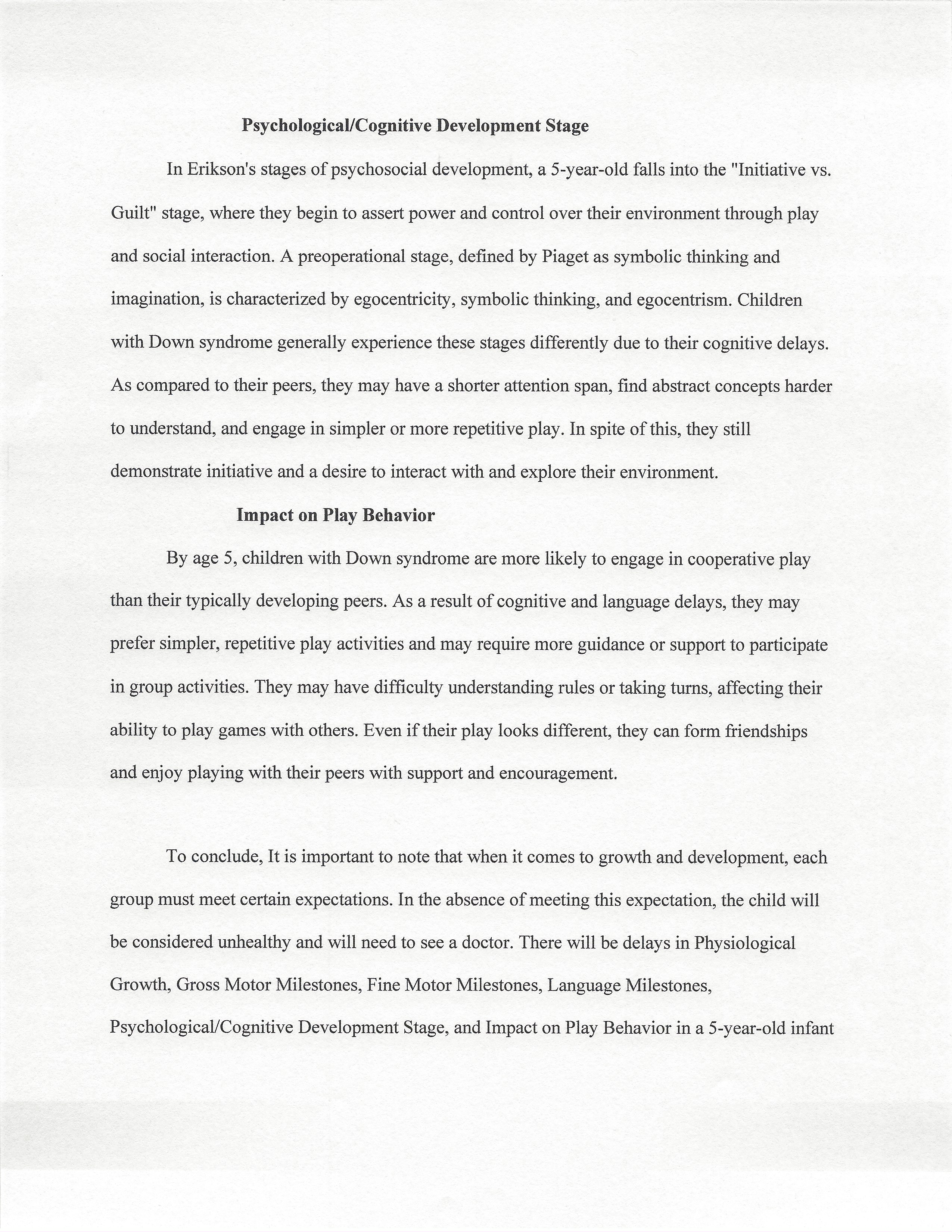
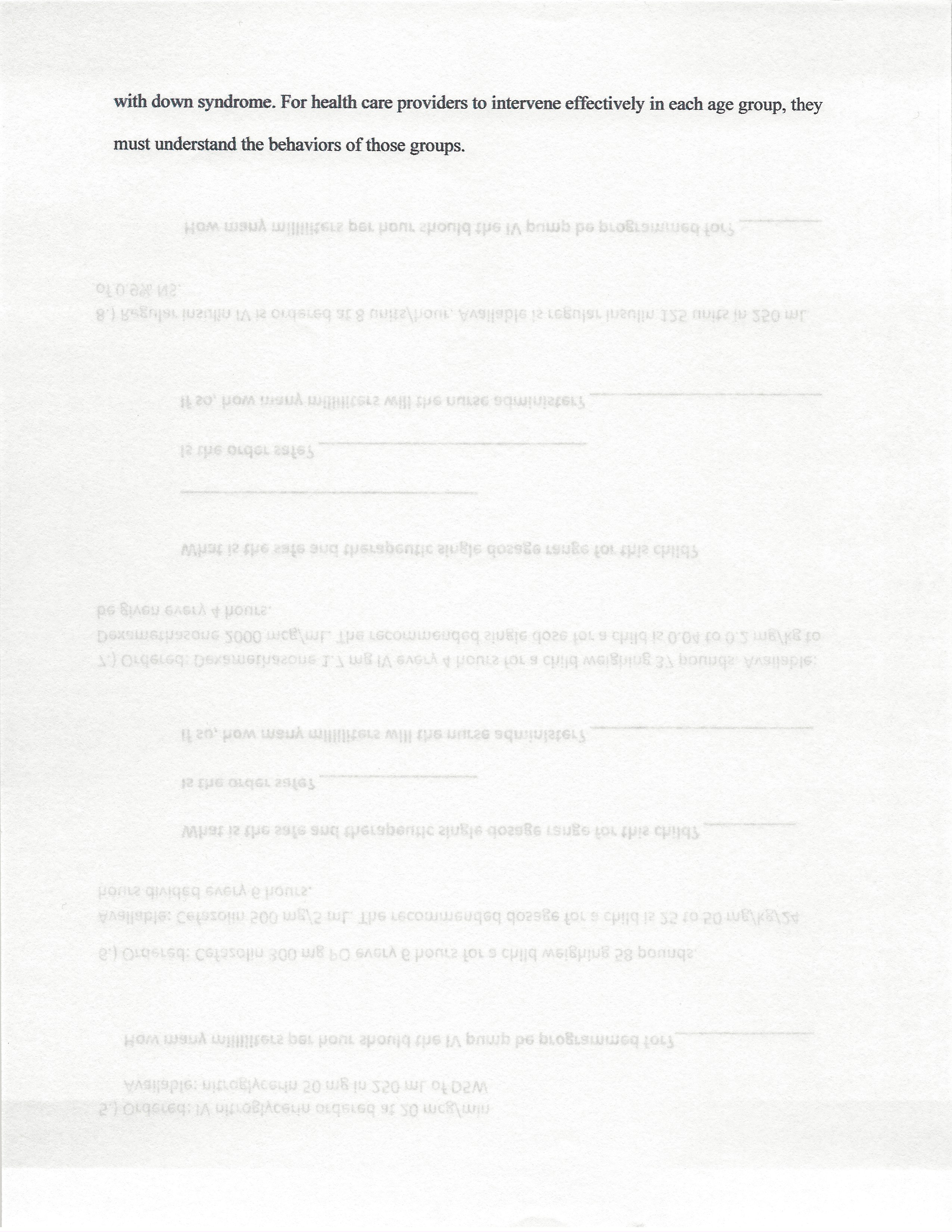
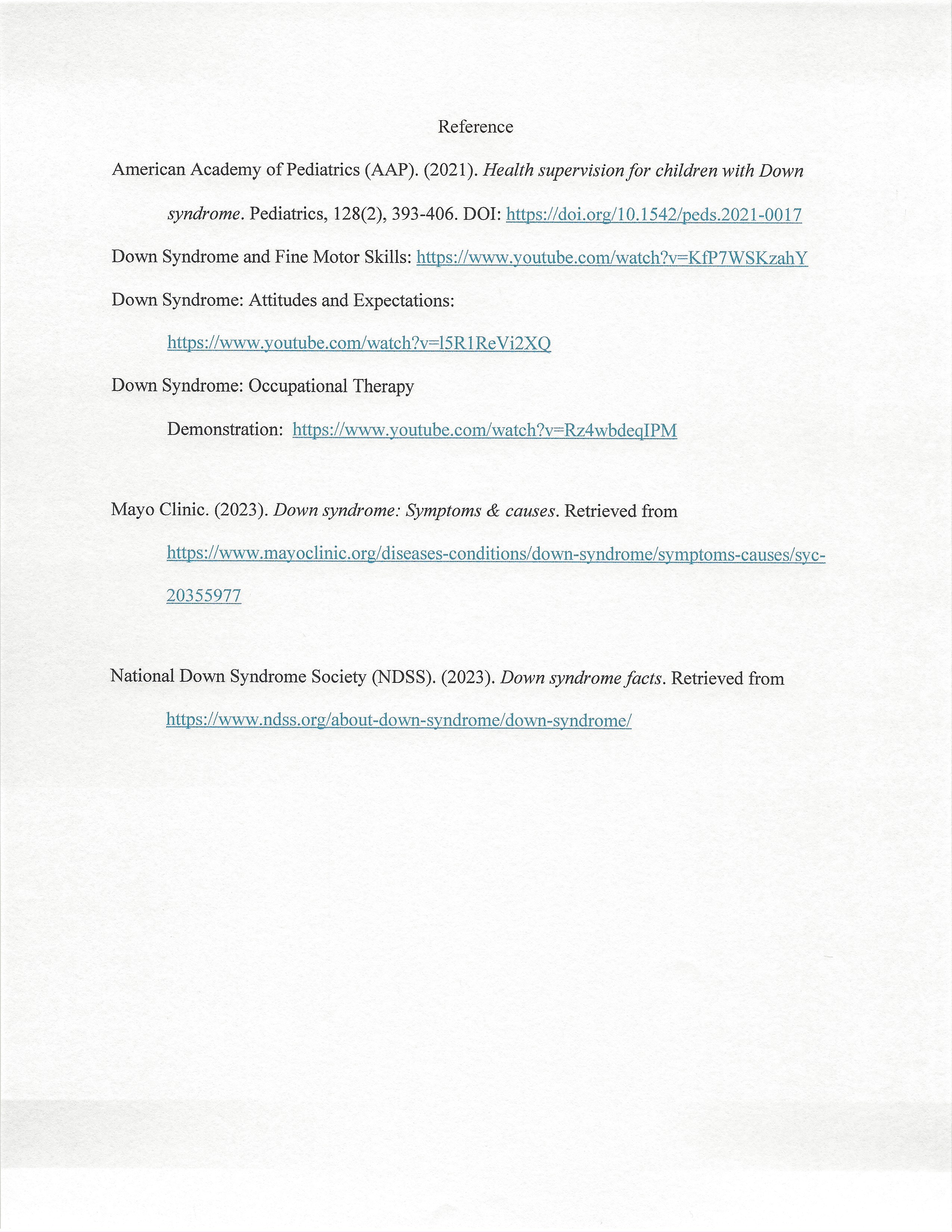
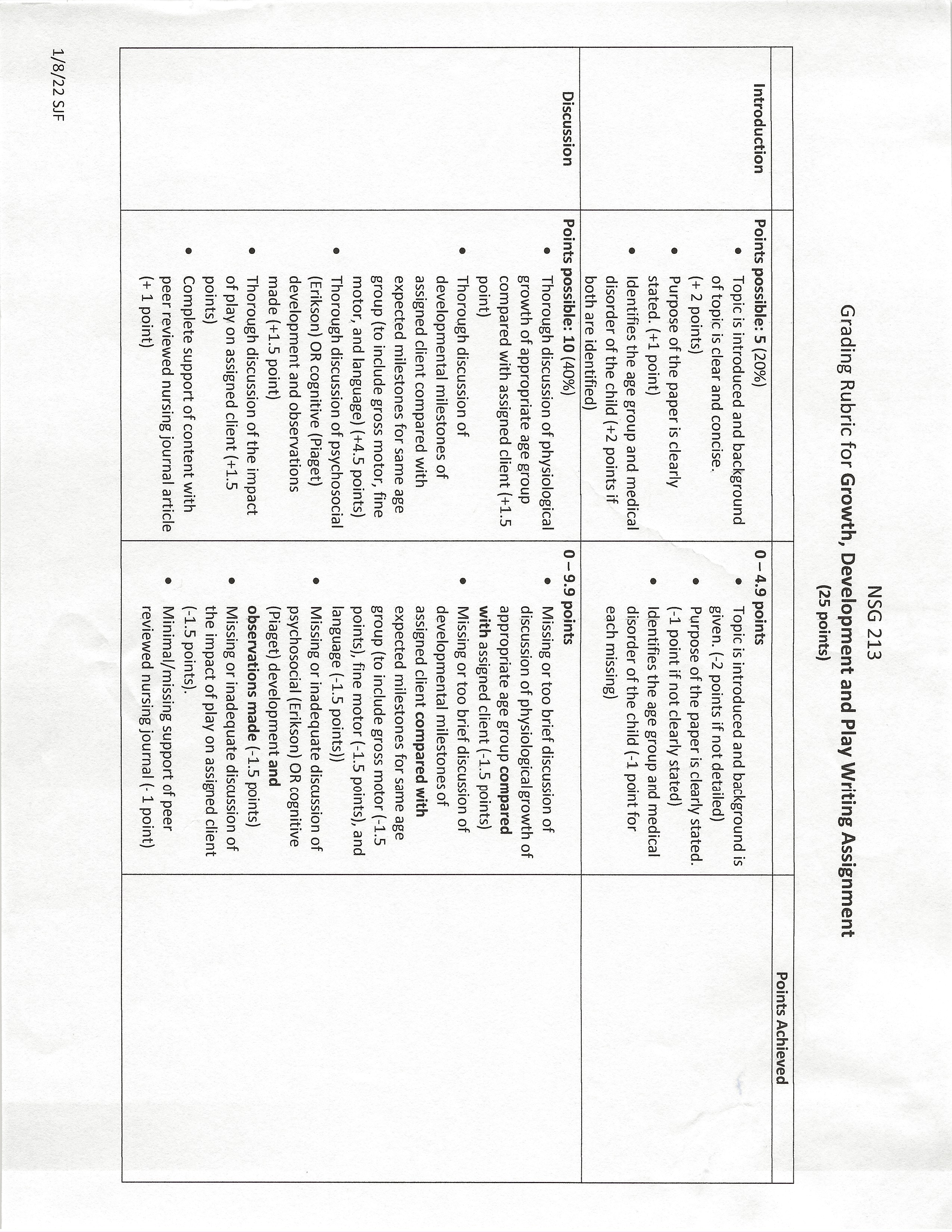
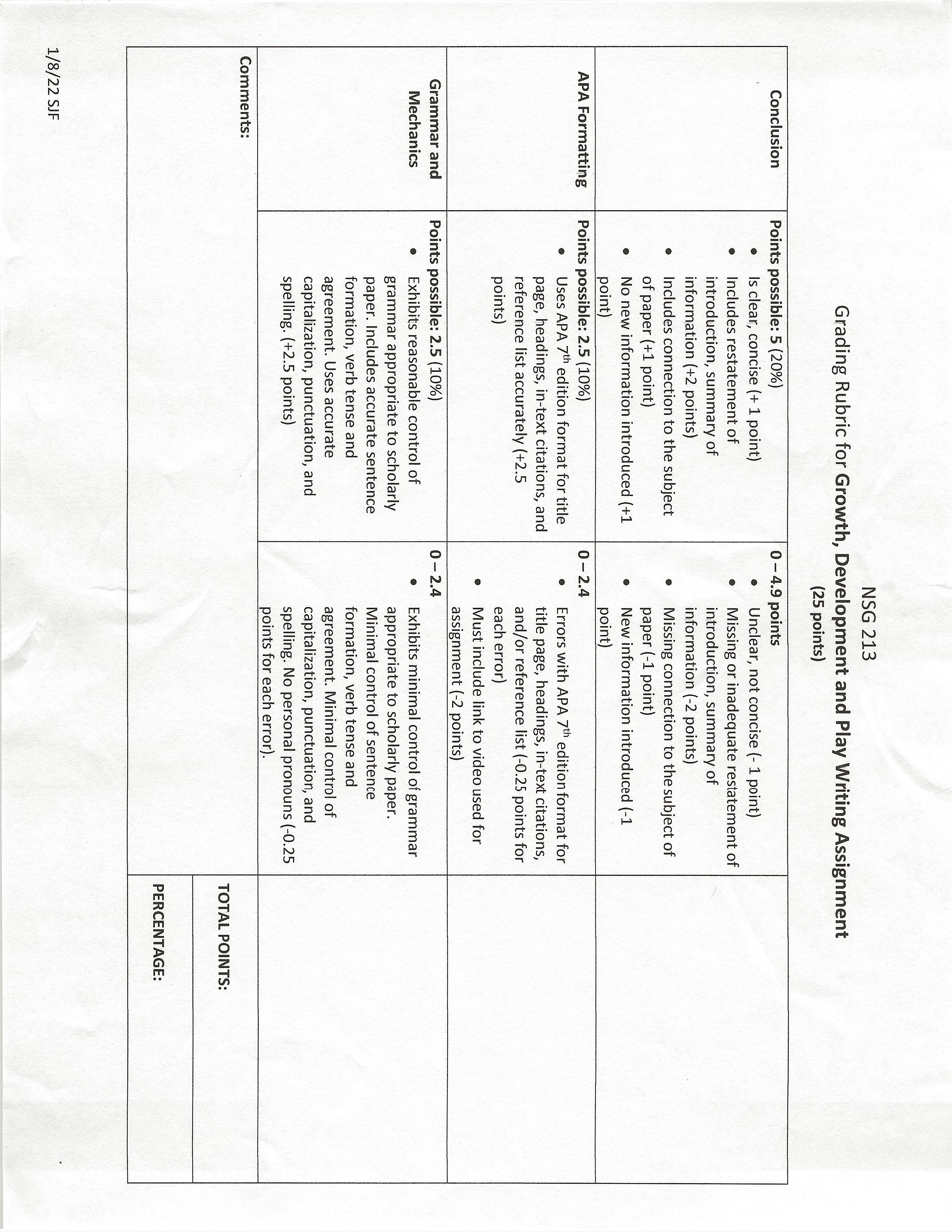
Growth, Development and Play Writing Assignment Omari Ongena Bluegrass Community and Technical College Nursing 213: Pediatric Nursing Mary Stathas September 2, 2024An increase in physical size is defined as growth, while an increase in skills and functions is defined as development. During growth and development, each group needs to meet certain expected behavior to be considered healthy. Without meeting this expectation, the child will be considered unhealthy and will need to see a health care provider. Health care providers must know each behavior in each age group so they can intervene with appropriate treatment. Down syndrome can affect a child's growth and development. This paper compares and contrasts the growth and development milestones of a healthy 5-year-old child with a 5-year-old child with down syndrome. Physiological Growth As a child grows, he or she will average 2.5 inches (6 cm) in height and 4 to 5 pounds (1.8 to 2.3 kg) in weight per year. Compared to earlier years, this period is characterized by a leaner body composition with more defined muscle tone and less body fat. A 5-year-old child with Down syndrome may have a slower growth rate, shorter stature, and a predisposition to obesity and a higher body mass index (BMI). In contrast to their peers who are typically developing, children with Down syndrome often experience delayed skeletal maturation, leading to differences in height and overall growth. Gross Motor Milestones Typically developing children should be able to run, jump, hop on one foot, and ride a tricycle by age 5. In addition to climbing and skipping, they are able to coordinate their movements well enough to engage in more complex physical activities. Children with Down syndrome, however, may reach these milestones later. Children with Down syndrome may have delayed or altered gross motor skills due to hypotonia (low muscle tone) and joint laxity. Walking, running, and jumping may be possible, but they may require more effort or coordination. Activities that require balance and coordination may also be delayed, such as riding a tricycle. Fine Motor Milestones Children 5 years old typically demonstrate refined fine motor skills, such as drawing shapes, cutting with scissors, and dressing themselves with minimal assistance. With a tripod grip, they can hold writing utensils and are beginning to write letters and their names. Children with Down syndrome may experience delays in fine motor skills due to hypotonia and joint laxity. Tasks requiring dexterity, such as buttoning clothes or holding a pencil correctly, might be challenging for them. To reach similar milestones, their fine motor skills may be less precise, and they may need more practice and time. Language Milestones The typical 5-year-old is able to speak in full sentences, understand and use complex grammar, and has a vocabulary of over 2,000 words. Conversations can be held, stories can be told, and abstract concepts can be understood. It is common for children with Down syndrome to experience delays in language development. There is a possibility that they use a smaller vocabulary, use shorter sentences, and struggle with articulation and grammar. Despite the fact that they may understand more than they can express, their speech may be less clear, and they may rely more on gestures or non-verbal communication. Psychological/Cognitive Development Stage In Erikson's stages of psychosocial development, a 5-year-old falls into the "Initiative vs. Guilt" stage, where they begin to assert power and control over their environment through play and social interaction. A preoperational stage, defined by Piaget as symbolic thinking and imagination, is characterized by egocentricity, symbolic thinking, and egocentrism. Children with Down syndrome generally experience these stages differently due to their cognitive delays. As compared to their peers, they may have a shorter attention span, find abstract concepts harder to understand, and engage in simpler or more repetitive play. In spite of this, they still demonstrate initiative and a desire to interact with and explore their environment. Impact on Play Behavior By age 5, children with Down syndrome are more likely to engage in cooperative play than their typically developing peers. As a result of cognitive and language delays, they may prefer simpler, repetitive play activities and may require more guidance or support to participate in group activities. They may have difficulty understanding rules or taking turns, affecting their ability to play games with others. Even if their play looks different, they can form friendships and enjoy playing with their peers with support and encouragement. To conclude, It is important to note that when it comes to growth and development, each group must meet certain expectations. In the absence of meeting this expectation, the child will be considered unhealthy and will need to see a doctor. There will be delays in Physiological Growth, Gross Motor Milestones, Fine Motor Milestones, Language Milestones, Psychological/Cognitive Development Stage, and Impact on Play Behavior in a 5-year-old infant with down syndrome. For health care providers to intervene effectively in each age group, they must understand the behaviors of those groups. Reference American Academy of Pediatrics (AAP). (2021). Health supervision for children with Down syndrome. Pediatrics, 128(2), 393-406. DOI: https://doi.org/10.1542/peds.2021-0017 Down Syndrome and Fine Motor Skills: https://www.youtube.com/watch?v=KfP7WSKzahY Down Syndrome: Attitudes and Expectations: https://www.youtube.com/watch?v=15R1ReVi2XQ Down Syndrome: Occupational Therapy Demonstration: https://www.youtube.com/watch?v=Rz4wbdeqIPM Mayo Clinic. (2023). Down syndrome: Symptoms & causes. Retrieved from https://www.mayoclinic.org/diseases-conditions/down-syndrome/symptoms-causes/syc- 20355977 National Down Syndrome Society (NDSS). (2023). Down syndrome facts. Retrieved from https://www.ndss.org/about-down-syndrome/down-syndrome/NSG 213 Grading Rubric for Growth, Development and Play Writing Assignment (25 points) 4 Points Achieved Introduction Points possible: 5 (20%) 0 -4.9 points e Topicis introduced and background e Topicisintroduced and background is of topic is clear and concise. given. (-2 points if not detailed) (+ 2 points) e Purpose of the paper is clearly stated. e Purpose of the paper is clearly (-1 point if not clearly stated) stated. (+1 point) e Identifies the age group and medical e Identifies the age group and medical disorder of the child (-1 point for disorder of the child (+2 points if each missing) both are identified) Discussion Points possible: 10 (40%) 0-9.9 points Thorough discussion of physiological growth of appropriate age group compared with assigned client (+1.5 point) Thorough discussion of developmental milestones of assigned client compared with expected milestones for same age group (to include gross motor, fine motor, and language) (+4.5 points) Thorough discussion of psychosocial (Erikson) OR cognitive (Piaget) development and observations made (+1.5 point) Thorough discussion of the impact of play on assigned client (+1.5 points) Complete support of content with peer reviewed nursing journal article (+ 1 point) 1/8/22 SIF Missing or too brief discussion of discussion of physiological growth of appropriate age group compared with assigned client (-1.5 points) Missing or too brief discussion of developmental milestones of assigned client compared with expected milestones for same age group (to include gross motor (-1.5 points), fine motor (-1.5 points), and language (-1.5 points)) Missing or inadequate discussion of psychosocial (Erikson) OR cognitive (Piaget) development and observations made (-1.5 points) Missing or inadequate discussion of the impact of play on assigned client (-1.5 points). Minimal/missing support of peer reviewed nursing journal (- 1 point) NSG 213 Grading Rubric for Growth, Development and Play Writing Assignment (25 points) Conclusion APA Formatting Grammar and Points possible: 5 (20%) Is clear, concise (+ 1 point) Includes restatement of introduction, summary of information (+2 points) Includes connection to the subject of paper (+1 point) No new information introduced (+1 point) Points possible: 2.5 (10%) Uses APA 7 edition format for title page, headings, in-text citations, and reference list accurately (+2.5 points) Points possible: 2.5 (10%) 0 - 4.9 points 0-2.4 0-24 Unclear, not concise (- 1 point) Missing or inadequate restatement of introduction, summary of information (-2 points) Missing connection to the subject of paper (-1 point) New information introduced (-1 point) Errors with APA 7t edition format for title page, headings, in-text citations, and/or reference list (-0.25 points for each error) Must include link to video used for assignment (-2 points) Mechanics e Exhibits reasonable control of e Exhibits minimal control of grammar grammar appropriate to scholarly appropriate to scholarly paper. paper. Includes accurate sentence Minimal control of sentence formation, verb tense and formation, verb tense and agreement. Uses accurate agreement. Minimal control of capitalization, punctuation, and capitalization, punctuation, and spelling. (+2.5 points) spelling. No personal pronouns (-0.25 points for each error). Comments: TOTAL POINTS: PERCENTAGE: 1/8/22 SJF
Step by Step Solution
There are 3 Steps involved in it
1 Expert Approved Answer
Step: 1 Unlock
Question Has Been Solved by an Expert!
Get step-by-step solutions from verified subject matter experts
Step: 2 Unlock
Step: 3 Unlock
Students Have Also Explored These Related Business Writing Questions!









 Study Help